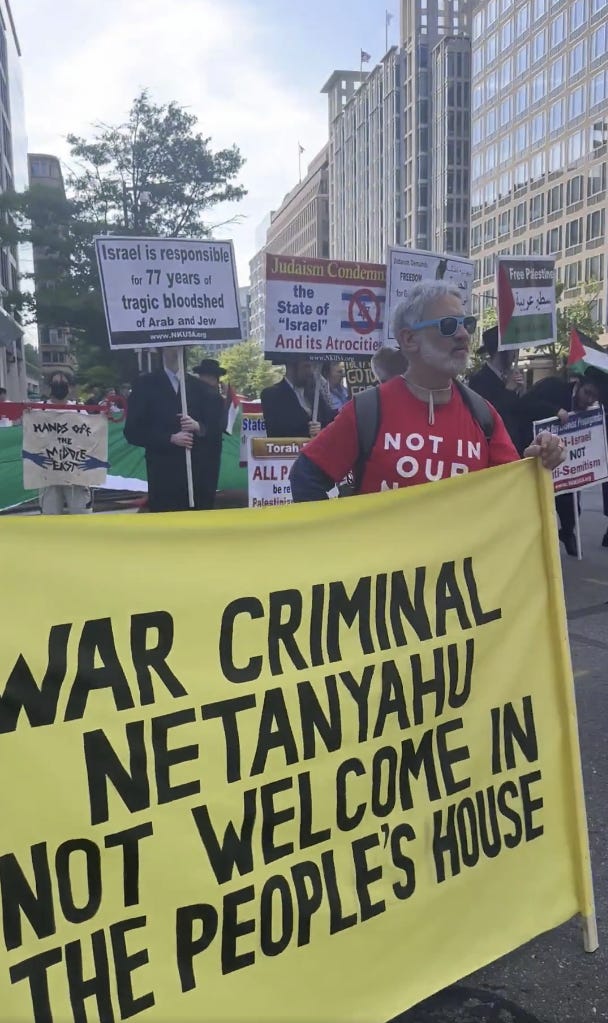
Rabbi Elliot Cosgrove’s recent essay epitomizes a troubling tendency among American Jewish leaders: moral posturing disconnected from the harsh realities Israel confronts daily. Cosgrove urges American Jews to publicly pressure Israeli Prime Minister Benjamin Netanyahu into a ceasefire with Hamas, advocating simplistic solutions to deeply complex security dilemmas and dangerously blurring critical moral distinctions.
Cosgrove asserts earnestly:
"When Prime Minister Netanyahu visits the White House on Monday, a coalition of Jews will be in Washington, not to protest but to press. Not to grandstand, but to implore."
Yet Cosgrove's "pressing" is effectively indistinguishable from protest, undermining Israel's elected leadership abroad. Such public displays inevitably provide fodder for Israel's adversaries, who eagerly exploit perceived internal divisions. Rather than enhancing Israel’s diplomatic leverage, Cosgrove’s approach weakens it, precisely when unity and strength are essential.
Further, Cosgrove makes the grievous error of equating a temporary ceasefire with lasting peace:
"But a decisive threat to closing the deal comes not only from forces beyond Israel’s body politic but from extremists within,where members of Israel’s own government are trying to torpedo any chance for peace."
This characterization is dangerously naive. A ceasefire with Hamas is not peace; genuine peace demands mutual recognition and legitimacy,conditions explicitly rejected by Hamas. Historically, Hamas uses ceasefires solely to rearm and recalibrate for future aggression. Portraying Israeli officials who resist hasty concessions as extremists fundamentally misconstrues their obligation to protect citizens from a terrorist organization committed openly to Israel's destruction.
Moreover, Cosgrove broadly proclaims:
"We must secure the release of these innocent people still held in Hamas captivity, halt the unrelenting violence and suffering on all sides."
Every decent person wants all hostages safely returned. Yet, while nobody disputes the tragedy of human suffering, Cosgrove’s formulation dangerously conflates Hamas' calculated terror with Israel’s defensive military responses. Hamas deliberately targets civilians; Israel actively seeks to minimize civilian harm, often placing its own soldiers at heightened risk. Suggesting moral equivalence between aggressors and defenders is morally indefensible and profoundly misleading.
Cosgrove also argues that:
"Diplomatic decisions, even painful ones, are the only path to bring home the living and the dead."
Yet history repeatedly demonstrates that diplomatic overtures toward Hamas yield betrayal and renewed violence rather than lasting security. True security for Israel emerges from strength, deterrence, and measured diplomacy,not from hopeful appeals detached from strategic realities.
If there is anything we have learned from Israel’s actions in Iran, it is that the public is privy only to a fraction of the larger strategic picture. How, then, can rabbis in America presume to know precisely how Netanyahu and Trump should engage in their conversation?
The fundamental question remains: Why should American rabbis and Jewish leaders choose precisely the moment when Israel’s prime minister meets with a supportive American president to publicly undermine his position? The majority of us wish to respect Israeli democracy and refrain from protesting the sitting prime minister on foreign soil. Netanyahu’s policies may be debated, but they undeniably reflect the harsh realities faced by Israelis daily,realities poorly grasped by distant critics.
Ultimately, the spectacle of American rabbis endorsing public pressure against Israel’s elected leadership at critical diplomatic junctures fractures Jewish unity and jeopardizes Israeli security. Instead of indulging in symbolic and counterproductive actions, American Jewish leaders would serve Israel far better by providing practical support rooted in a sober, nuanced appreciation of its profound security and diplomatic challenges.