


In an era addicted to outrage, we don’t let the mundane just be mundane anymore. Every bureaucratic hiccup has to be elevated into some grand ideological struggle. Every minor inconvenience gets recast as a deliberate assault on civilization itself. We saw this pathology on full display recently in Jerusalem, where a police error at a church entrance was instantly spun into a phantom religious war.
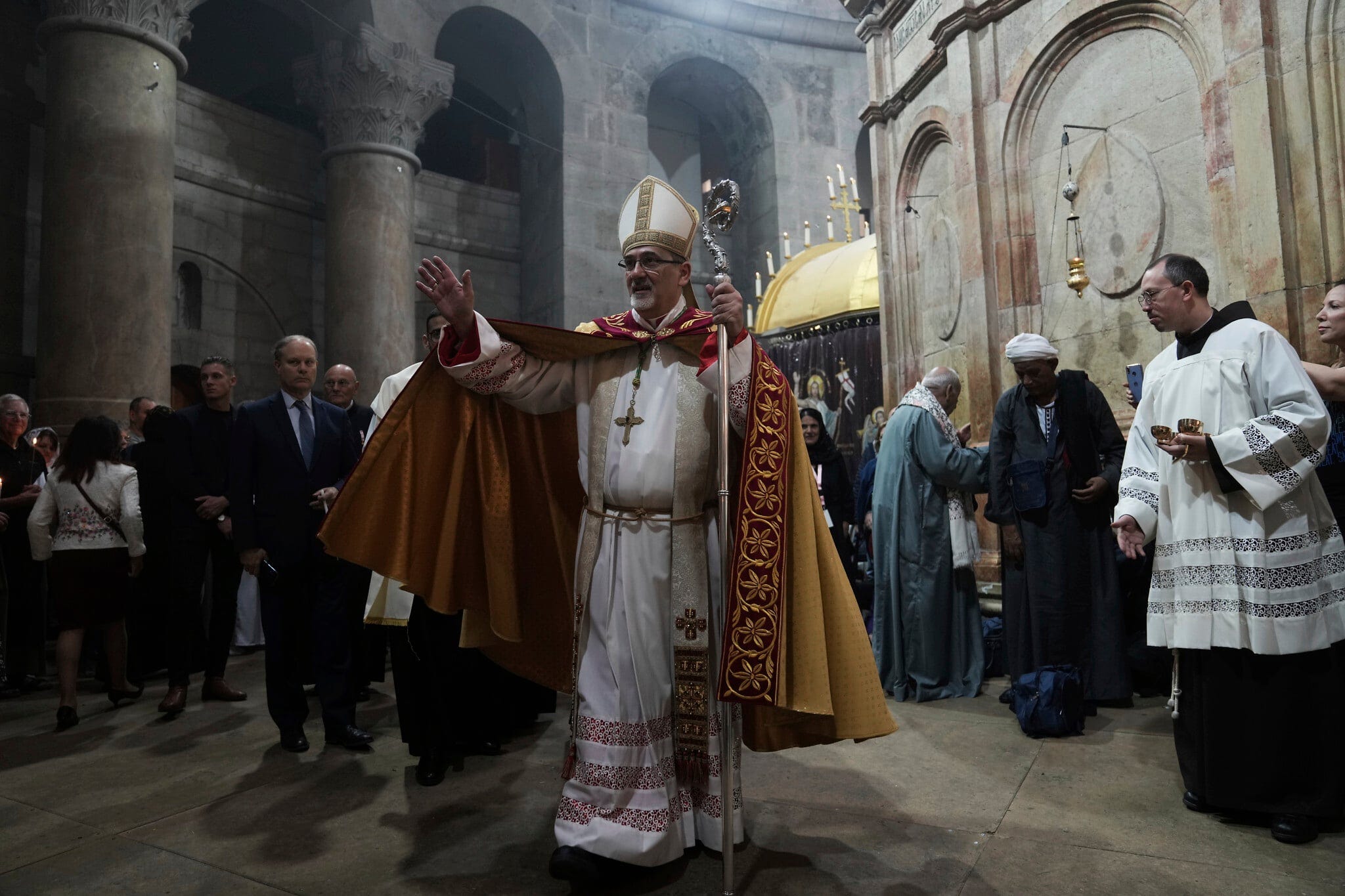
The actual facts of the incident are so boring they’re almost comical. On Palm Sunday, Cardinal Pierbattista Pizzaballa, the Latin Patriarch of Jerusalem, and the Custos of the Holy Land were walking privately to the Church of the Holy Sepulchre. When they arrived, police prevented them from entering and forced them to turn back. It was a stark moment. For the first time in centuries, the heads of the church were prevented from celebrating Palm Sunday Mass at the site.
But look at how the Cardinal himself reacted. Showing the kind of grace you’d hope to see from a religious leader, he didn’t throw a tantrum or call a press conference to declare a holy war. He simply pivoted. He went to the nearby St. Savior’s Monastery, which happens to sit next to an underground music school deemed a safe shelter space by the military, and celebrated Mass there instead. Later that day, he held a prayer service on the Mount of Olives, and kept his focus exactly where it belonged: on faith and the safety of the people in his care. He later described the disagreement with authorities as a polite difference of opinion.
That really should have been the end of it. Just a bit of logistical friction in a city that has seen plenty of actual, bloody conflict over the millennia. But in the fever swamps of modern political commentary, restraint is basically a sin. Opportunists immediately hijacked the incident to feed their own narratives, turning a fleeting moment of confusion into a full blown international crisis.
Take French President Emmanuel Macron. Instead of pausing to get the facts straight, Macron rushed out a solemn condemnation of the Israeli police. He declared his full support for the Patriarch and framed the incident as part of a “worrying sequence of violations” of the status quo at holy sites, demanding that freedom of worship be guaranteed. It was a statement of profound gravity that was completely disconnected from the triviality of the actual event. When the leader of a major Western power treats a beat cop’s error like a geopolitical crisis, you start to grasp the depth of the hysteria.
The populist right was just as eager to fan the flames. Professional provocateurs like Jack Posobiec immediately cast the police action not as a misunderstanding, but as a deliberate, sinister provocation. He declared that “these people really don’t care to understand Christians,” framed the incident as an attack on access to holy sites, and dramatically urged his followers to “Defend the Holy Sepulchre.” When Hungarian Prime Minister Viktor Orban chimed in to call the police action “unacceptable,” Posobiec offered a sycophantic “Amen, Prime Minister.”
Others in that same ecosystem took it even further. Commentator Auron MacIntyre bizarrely framed the incident as “just one humiliation ritual after another,” suggesting it proved the Israeli government doesn’t care about the dignity of Christians. For this crowd, the incident was an intentional insult, a sign of some deep seated animus against Christianity orchestrated by the Israeli state. It’s the kind of reflexive grievance peddling that only works if you strip away all context and nuance.
Then you have the other side of the political spectrum, populated by hyperventilating critics of the current Israeli government like commentator Nadav Eyal. Their instinct is to immediately blame any friction in Jerusalem on the machinations of the political right. Eyal acknowledged that a junior officer had made a discretionary call, but couldn’t resist turning it into a sweeping indictment of the government. He declared that “this government is the most hostile to other religions since the state’s founding,” and tied the incident directly to Ben Gvir, whom he described as “a convicted felon, a disciple of Kahanism, and a former member of the outlawed racist movement Kach.” He sees the heavy hand of radical nationalism in what was, quite obviously, the clumsy hand of a low level police officer. To Eyal, the incident is ironclad proof of a deliberate erosion of the status quo, a warning shot of things to come.
Both narratives are equally absurd. Both require a massive suspension of disbelief and a willful ignorance of how the real world actually operates.
If you want to understand what truly happened, just apply Occam’s razor. The principle is straightforward: the simplest explanation is usually the right one. When faced with competing theories, pick the one that requires the fewest assumptions.
Look at the assumptions required by the outrage peddlers. To believe Posobiec, MacIntyre, or Macron, you have to assume that the Israeli government, currently fighting a multi front war for its very survival, decided that Palm Sunday was the perfect moment to intentionally antagonize the Vatican, the global Catholic community, and its Western allies. To believe Eyal, you have to assume that a minor police action at a church gate was a carefully calibrated ideological maneuver directed from the highest levels of the national security apparatus, and then executed flawlessly by a junior officer on the ground.
The simplest explanation requires zero grand conspiracies. Israel is a nation at war. Jerusalem is a city on edge, operating under heightened security protocols. The context that the outrage merchants conveniently ignore is stark: just days prior, an Iranian ballistic missile fragment fell within 1,500 feet of the Church of the Holy Sepulchre. The threat of mass casualty events isn’t theoretical. It’s a daily reality.
In this environment, the police department has to manage massive crowds in narrow, ancient streets. They issued orders to prevent gatherings in places without adequate shelter. The Old City is a complex maze that doesn’t allow access for large emergency and rescue vehicles. A mass casualty event there would be an absolute nightmare. So, a police officer, likely exhausted and operating under strict directives regarding public safety in the shadow of literal missile strikes, enforced those rules at the church entrance when the Patriarch arrived.
It was a mistake. A classic example of bureaucratic rigidity clashing with religious tradition. And we know it was a mistake because the Israeli government corrected it almost immediately. Within hours of the incident, Prime Minister Benjamin Netanyahu personally intervened, instructing authorities to grant the Cardinal full and immediate access. The Israeli police themselves clarified the situation the very next day, confirming that the incident was entirely about enforcing safety regulations, not some sinister change in policy regarding freedom of worship.
In fact, the police and the Latin Patriarchate quickly sat down and hammered out a perfectly reasonable agreement. They arranged for limited groups of Christians to pray at the church and for ceremonies to be broadcast to the faithful worldwide. It was a practical compromise, balancing very real wartime restrictions with the need for worship. The churches even publicly thanked President Isaac Herzog for his intervention.
If this was a deliberate “humiliation ritual” or a grand ideological plot orchestrated by Ben Gvir, why would the Prime Minister instantly reverse it? Why would the President step in to smooth things over? Why would the police immediately negotiate a compromise? The conspiracy theories collapse under the weight of basic facts.
There is no grand conspiracy here. There is no war on religion. There is only the friction of daily life in a complex, heavily policed city during wartime.
The rush to politicize this non event reveals a deep sickness in our public discourse. We’ve lost the ability to tell the difference between a genuine crisis and a clerical error. We are so desperate for villains that we invent them out of thin air, projecting our own ideological obsessions onto the actions of ordinary people who are just trying to do their jobs.
Cardinal Pizzaballa understood this. He saw the incident for what it was and refused to play the role assigned to him by the outrage merchants. He chose proportion over panic. He chose grace over grievance.
It’s a lesson that the commentators, the provocateurs, and even heads of state would do well to learn. Not everything is a symbol. Not every plot is a conspiracy. Sometimes, a misunderstanding is just a misunderstanding. And sometimes, the most radical act of all is simply to tell the truth, unadorned by hysteria, and move on.
Excellent analysis.