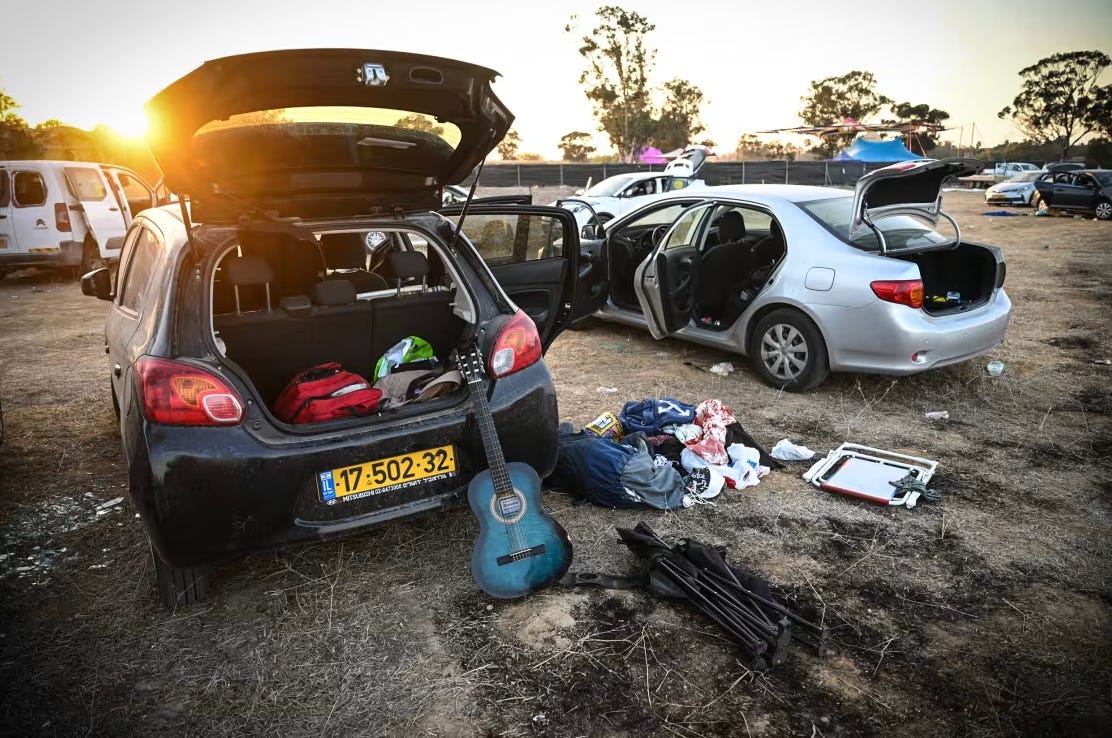
History is merciless to those who mistake authority for responsibility. Colonel Haim Cohen, then commander of the Northern Brigade in the Gaza Division, stands as one such example. On the morning of October 7 he arrived at the Nova music festival, saw thousands of young Israelis gathered under the desert sky, observed the threadbare security, and did nothing. An hour later, the massacre began.
This is not the distortion of hindsight. It is fact, revealed by Haaretz through the IDF’s own internal investigation. Cohen had personally signed off on the festival’s security plan earlier that week. He knew the responsibility was his. He also knew that intelligence agencies were already flagging unusual Hamas activity during the night. At 3:13 a.m., for reasons the IDF itself described as “unclear,” he left his home in Tiberias and drove nearly two hours south. By 5:30 a.m. he was at Nova. Before him were 4,000 civilians and barely fifty police officers. He spotted a Yamam unit and a patrol car and persuaded himself the event was secure.
What kind of process produces such complacency? What kind of leadership mistakes the sight of a single police vehicle for a protective shield? Why would a senior officer in the middle of the night abandon his post and drive two hours to the Gaza frontier unless he already suspected something was gravely wrong? And if he suspected, why did he not act to safeguard the thousands in harm’s way?
The contrast could not be clearer. I have spoken to dozens of soldiers who were deployed along the border that morning. Not one told me they had been alerted that anything was out of the ordinary. Not one. The troops on the line were left blind, unaware of both the gathering storm and the presence of thousands of civilians nearby. Meanwhile Cohen, who had personally visited the site and who alone possessed firsthand knowledge of its scale and vulnerability, withheld that information and allowed the festival to continue.
The IDF’s internal report concedes what Cohen will not. He miscalculated by failing to assign forces to the festival. It acknowledges that a deeper discussion could have led to dispersing the crowd entirely. That is not hindsight. That is the essence of command responsibility. Leaders are tasked not simply with reacting to what is certain but with anticipating what is possible.
Even after reaching his base, as warnings multiplied, Cohen did not raise the issue of the festival in situation briefings. He had the knowledge. He had the authority. He had the chance to change the outcome. He chose silence. The result was catastrophic. Three hundred seventy eight Israelis were slaughtered. Forty four were abducted into Gaza.
What has been the price of this failure? In December 2024 Chief of Staff Herzi Halevi dismissed Cohen. A quiet retirement followed. For Cohen the cost was a career. For those who danced their last dance under the dawn sky, the cost was their lives.
Israel cannot afford to look away from this failure. Cohen’s conduct was not an isolated lapse. It reflects a system that allowed a senior commander to treat responsibility as a formality, to interpret warnings as background noise, and to observe a festival on the Gaza frontier without grasping its obvious vulnerability.
Security is not about abstractions such as intelligence constraints or the fog of war. It is about men and women entrusted with choices that carry mortal consequence. On October 7, Haim Cohen chose inaction. In that choice hundreds paid the price. Great nations survive because they demand more of their leaders than excuses. At Nova, Israel’s young were not failed by their country. They were failed by the commander who saw the danger, possessed the responsibility, and walked away.