


There is a profound difference between being guided by a religious tradition and using that tradition as a ventriloquist’s dummy. When a community genuinely submits to an ancient legal and ethical framework, it wrestles with the entirety of that inheritance, including the parts that offend modern sensibilities. But when a community merely seeks decorative cover for a pre-baked political agenda, it treats its sacred texts like a buffet, plucking out the appetizing morsels while discarding the rest.
This is the central intellectual sleight of hand performed by Sharon Brous, the prominent Reform rabbi, and IKAR, the progressive Los Angeles congregation she founded. They present themselves as a vibrant, modern expression of Jewish tradition. In reality, there is very little about their political activism that is rooted in that tradition. Instead, they engage in a relentless, cynical exercise of reverse-engineering: deciding on a progressive political outcome first, and then rummaging through ancient texts to find a quote that can be twisted to justify it.
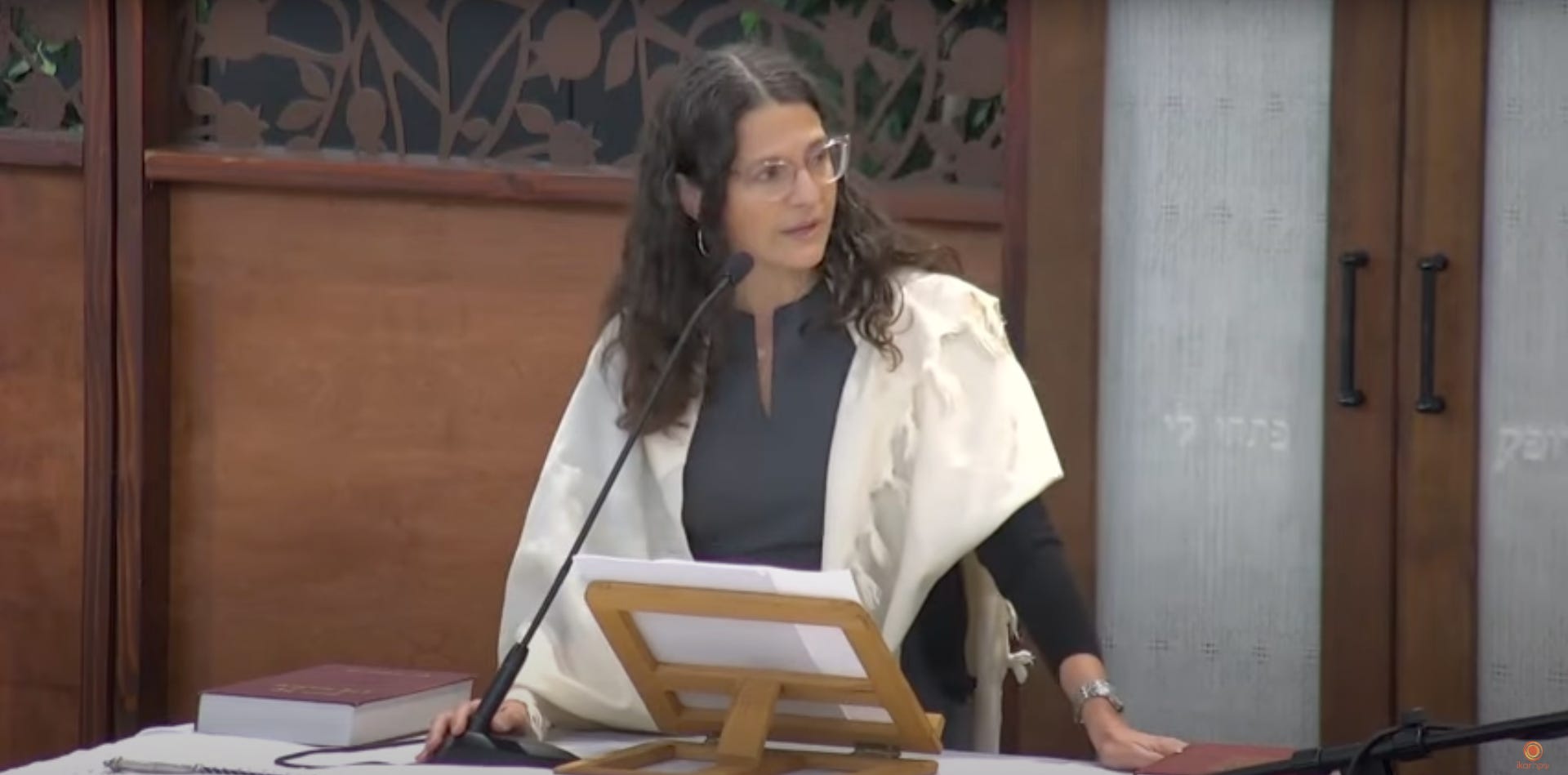
Nowhere is this dynamic more glaring than in Brous’s recent speech condemning Israel’s new death penalty legislation for convicted terrorists. In her address, she described the Knesset’s passage of the law as a “dark day” and a “poison pill” destroying Israel’s moral core. She branded the legislation, which targets Palestinians convicted by military courts of deadly terror attacks, as racist, dangerous, and vengeful.
To lend this political attack the veneer of religious authority, Brous retreated into the Talmud. She cited the story of the “murder beneath the fig tree,” a narrative illustrating how ancient rabbinic courts interrogated witnesses with such absurd specificity about the color of the figs and the thickness of the branches that their testimony was inevitably thrown out, allowing the accused to go free. She presented this as a model of enlightened jurisprudence, arguing that a justice system should be so encumbered by procedural hurdles that execution becomes practically impossible.
It is a clever rhetorical trick, but it is intellectually bankrupt. Brous is taking an ancient debate about the theoretical limits of capital punishment in a fundamentally different legal system and weaponizing it against a modern nation-state fighting for its survival against genocidal terror.
The individuals targeted by Israel’s legislation are not the hypothetical subjects of a Talmudic thought experiment. They are terrorists. They are men who have committed premeditated, savage attacks against innocent civilians. They are individuals who often film their atrocities and broadcast them to the world, celebrating the slaughter of children, women, and the elderly.
To demand perfect, unassailable testimony about the “twigs and branches” of a crime scene when the perpetrators proudly confess to their barbarism is not a safeguard of justice. It is a surrender to evil. It is a mechanism for guaranteed acquittal dressed up as high-minded principle.
More importantly, Brous’s selective reading ignores the vast, robust tradition within Jewish law that deals with the absolute obligation to protect innocent life. She conveniently omits the concept of the rodef, the pursuer, which mandates that one must stop an individual who is attempting to murder another, even if it requires killing the pursuer. She ignores the overarching principle of pikuach nefesh, the preservation of human life, which overrides almost every other religious commandment. When a society is under constant siege from actors whose stated goal is its complete destruction, the death penalty for terrorists is not an act of vengeance. It is a desperate, necessary measure of deterrence. But Brous cannot acknowledge this, because doing so would conflict with the progressive dogma that views all state power, particularly Israeli state power, with inherent suspicion.
This is not an isolated incident. It is the defining methodology of IKAR. The organization has positioned itself at the vanguard of progressive religious activism, frequently aligning with groups like J Street and the New Israel Fund. These organizations have made a cottage industry out of criticizing Israel’s defensive measures while demanding concessions that would jeopardize the nation’s security.
Brous has made a habit of launching rhetorical broadsides against the Israeli government, always cloaked in the language of prophetic critique. During a Yom Kippur sermon, she accused Israel’s leadership of harboring a messianic agenda aimed at turning the country into a fascist theocracy. She described the government’s actions as a “metastatic tumor.” More recently, she publicly expressed “revulsion” at what she characterized as Israel’s “moral failure” in Gaza, accusing the government of using starvation as a weapon of war.
In a particularly revealing Purim sermon, she argued that American politicians who support Israel’s security measures are not acting out of genuine concern for Jewish safety. Instead, she claimed, they are exploiting Jewish trauma to advance a “white Christian nation” agenda in the United States.
This is not theology. It is partisan politics wearing a prayer shawl. The implication is staggering: any political support for Israel’s right to defend itself, particularly if it comes from the political right, is, at its core, a cynical manipulation. In this worldview, conservatism is inherently suspect, and any alliance with conservative forces is a moral compromise.
By consistently framing Israel’s defensive actions as moral failures and its government as a proto-fascist enterprise, Brous provides intellectual scaffolding for those who seek to delegitimize the state entirely. She draws a false, grotesque equivalence between the desperate, often imperfect decisions made by a country fighting for its life and the deliberate, ideologically driven violence of terrorist organizations like Hamas.
There is a profound moral difference between a nation that uses force to protect its citizens and a terrorist group that uses force to maximize civilian casualties. To blur that distinction is to lose one’s moral compass entirely.
It is remarkably easy to demand that a nation absorb the costs of procedural perfection when you are not the one burying your dead. It is easy to describe a government’s security measures as fascistic when your own city is not the target of relentless rocket fire. Brous’s congregation in Los Angeles is not rushing to bomb shelters in the middle of the night. Her children are not growing up with the sound of air raid sirens.
That geographical and existential distance does not disqualify her from having opinions. But it should inspire a profound humility. It should temper the absolute certainty with which she delivers her indictments.
Brous closes her speech with a vision of a redeemed world where every person sits peacefully under their own vine and fig tree. It is a beautiful, utopian vision. But utopias are not built by tying the hands of those forced to do the hard, ugly work of survival. Peace is not achieved by handcuffing the defenders while the aggressors run free.
True peace requires confronting evil honestly, not laundering it through a fog of philosophical abstraction. It requires acknowledging that sometimes, the only way to protect the innocent is to forcefully, unapologetically defeat the guilty. Until Brous and IKAR are willing to grasp that fundamental truth, their lectures on moral purity will remain exactly what they are: the empty, self-indulgent noise of the unthreatened, using ancient texts to justify modern cowardice.
I know this is not the point, but who the hell wants to sit thru a sermon on Purim?
I recently listened to "Rabbi" Brous on an episode of "Being Jewish" by Jonah Platt. She is a prime example of moral vanity, drunk on her own "virtue" while ignoring those who pay the price for her "goodness". With "friends" like Ms. Brous, the Jewish people don't need enemies.