


Rabbi Angela Buchdahl has become one of American Judaism’s most visible moral preachers. As senior rabbi of Central Synagogue, an institution that prides itself on conscience as much as congregation, she has spent years warning of the dangers of political complacency. She has marched, sermonized, and issued declarations of principle. She tells her flock that moral courage is Judaism’s highest calling. Yet when faced with a real test—Assemblyman Zohran Mamdani, the Democratic candidate for mayor of New York who calls Israel an apartheid state and glorifies “resistance”—Buchdahl, the self-proclaimed voice of conscience, falls silent.
In a recent letter to her congregation, she explained that she would not address Mamdani’s rhetoric because “as a religious institution, Central Synagogue does not endorse candidates or take sides in political races.” The synagogue, she wrote, “is committed to being a spiritual home for Jews across the political spectrum.” It sounds noble. It isn’t. Neutrality is a virtue only when truth is uncertain. When a politician seeking the city’s highest office echoes the language of Israel’s enemies, neutrality becomes moral failure.
This restraint contrasts sharply with Buchdahl’s long record of public agitation. In September 2023 she prepared to join protests outside the United Nations against Prime Minister Benjamin Netanyahu’s proposed judicial overhaul. She told The Forward that some congregants warned her it would “embolden Israel’s enemies.” Her answer was defiant: “I didn’t not show up because people were mad about it, because that is not how I roll.” The only reason she missed the rally, she admitted, was that she “tested positive for COVID-19” the night before.
That same week, she delivered one of the most widely discussed sermons of her career. “This year,” she declared, “Israel elected the most right-wing, ultra-religious government in its history. It quickly moved to weaken the independence of the judiciary and steamroll the rights of minorities. In a matter of months, this new government has taken actions that threaten to turn Israel into an authoritarian, theocratic state that very few American Jews will be able to support.”
Her Erev Rosh Hashanah sermon was framed as a call to arms. “We are reclaiming the flag,” she told her congregation, “we are reclaiming the Declaration of Independence, we are reclaiming this language around Jewish values… We shouldn’t walk away from Israel.” She described the sermon as an act of teshuvah—repentance—for American Jews who had been, in her words, “radically silent.”
Then came her most striking reflection: “I woke up one morning,” she recalled, “and thought to myself, ‘You are a rabbi in this moment, you have to talk about Israel.’ Up until this point, American Jews have been radically silent in the face of all that’s going on. It’s like, where the hell are American Jews right now?”
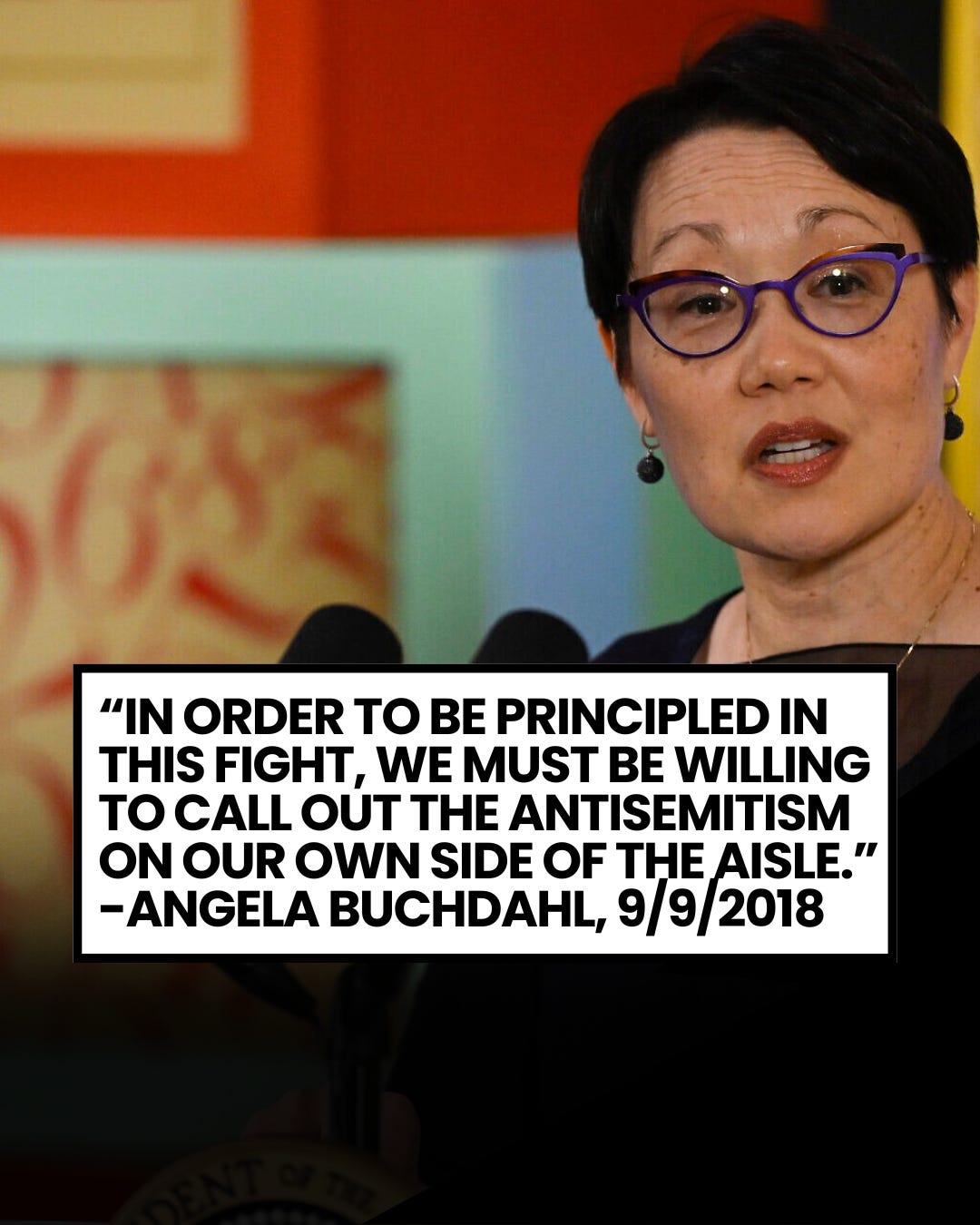
That question now belongs to her. Where is Angela Buchdahl right now, as Zohran Mamdani, the Democratic nominee for mayor, spreads the same falsehoods she once vowed to confront? Where is her moral urgency as he brands Israel an apartheid state, praises those who attack it, and pledges to sever ties with the Jewish homeland? Where is the “rabbi in this moment” when the moment is her own city?
When condemnation carries no social risk, Buchdahl is fearless. When it might offend her progressive peers, she retreats. Against the Israeli right, she is bold. Against the American left, she is mute. The rabbi who once called silence a sin has found comfort in it.
This is not about politics; it is about integrity. A leader who can accuse Israel’s elected government of authoritarianism should be able to denounce a mayoral candidate who spreads antisemitic lies. The refusal to do so reveals the source of her courage: applause, not conviction.
Buchdahl’s defenders will insist that opposing Mamdani would politicize her pulpit. But she politicized it long ago. She marched against Israel’s government, preached about democracy, and demanded public repentance from her congregants. The pulpit became a platform for protest when the target was Jerusalem. Now that the threat is local, she hides behind institutional policy.
Buchdahl once said that protesting Netanyahu was “a kind of return to our Israeli brothers and sisters.” But solidarity is not a slogan. It means standing with those brothers and sisters when they are maligned by those who share your politics. Silence before Mamdani’s hatred is not a return. It is retreat.
If Rabbi Buchdahl truly believes in the moral power of Judaism, she should use it now. She should name, clearly and publicly, the danger of a would-be mayor who defames the Jewish state. Anything less is not courage. It is performance.
Her sermons once demanded that American Jews stop being silent. Now they serve as an epitaph to her own.
This person should not be a rabbi. Is she even Jewish?