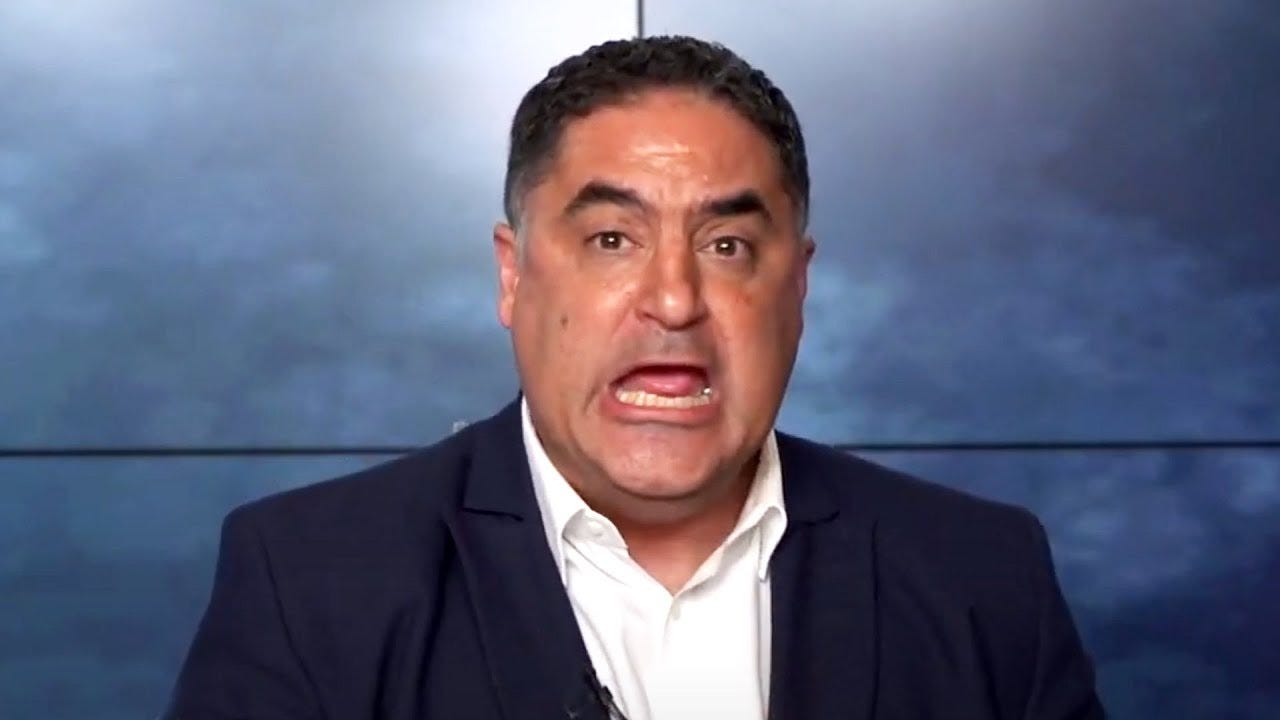
Some arguments don’t need to be refuted. They collapse the second you stop nodding along. Cenk Uygur’s take on Israel is one of those arguments. He wraps it in the language of courage, as though he’s telling a truth others are afraid to speak. But it’s not courage. It’s the oldest sleight of hand in politics: take a moral certainty, blur the edges until nothing is clear, then present the confusion as insight. Watching him lean toward the camera, voice rising, dabbing at the sweat trickling down his face, you don’t see someone chasing truth. You see a performer hitting his marks.
On May 27, 2024, Uygur declared: “Israel has now done 30 times October 7th… So, do you condemn the IDF as terrorists too?” This is the foundation of his worldview: whoever has the bigger body count is the villain. If you follow that logic, the Allies were “terrorists” in World War II because their bombing campaigns caused more civilian deaths than the Luftwaffe did in Britain. Numbers can measure casualties. They cannot measure intent, and intent is what defines the morality of an action.
Terrorism isn’t a matter of statistics. It’s the calculated targeting of civilians to achieve a political goal. That’s exactly what Hamas did on October 7. They hunted down young people at a concert, burned families alive, kidnapped children and grandparents, and proudly filmed the atrocities. These weren’t accidental casualties. They were the objective.
Israel’s military operates under the law of armed conflict, which recognizes that civilian casualties, while tragic, are not automatically crimes. The standard is that civilian harm must not be excessive in relation to the concrete and direct military advantage anticipated. And that judgment is made before the operation, not after a body count is taken. This is why Uygur’s body-count morality isn’t just flawed — it’s an outright distortion.
There’s also the reality he never addresses. Hamas embeds itself in hospitals, schools, and apartment buildings for a reason. The United States confirmed that Gaza’s al-Shifa Hospital was used as a Hamas command center. That’s a war crime. It forces Israel into decisions no military commander wants to face: strike and risk civilian deaths, or hold back and allow the enemy to keep operating. Ignoring this context is not analysis. It’s propaganda by omission.
And then there’s his July 24, 2024 post claiming Congress represents “AIPAC” instead of Americans. This is not fresh thinking. It’s an old prejudice with a new coat of paint — the suggestion that Jewish influence secretly controls government policy. The reality is simpler. In April 2024, Congress voted on aid to Israel. The bill passed 366 to 58. That margin wasn’t created in a backroom. It reflects decades of broad public support and a shared understanding of strategic interests.
Uygur also returns, again and again, to his numbers. “Israel has killed 49 times the civilians of October 7,” he says. Or “400 times the children.” These numbers come from Gaza’s health ministry, which is run by Hamas and counts fighters as civilians when it suits them. Israel claims thousands of Hamas fighters are among the dead. Outside monitors can’t produce precise ratios in urban warfare. But Uygur treats every unverified number as if it were carved into stone.
He has called Israel “a genocidal terrorist state” and accused it of committing genocide. Genocide is the deliberate destruction of a people. It’s the most serious crime in human history, and it requires evidence of intent — not simply high casualty figures. Using the term as a political insult cheapens it and disrespects the memory of victims of real genocides.
One of his most revealing moments came when he claimed Israel is doing “what Iran would do if they had a nuclear weapon.” That is pure false equivalence. It erases the difference between a militant theocracy that calls for another nation’s destruction and a state defending itself from attack. It is not moral clarity. It is a rhetorical trick that makes the aggressor and the defender seem the same.
The pattern is easy to spot. The more complicated the reality, the more Uygur boils it down to a slogan. Civilian casualties automatically mean terrorism. Military control automatically means oppression. Longstanding alliances automatically mean conspiracy. And when confronted with inconvenient facts, such as Hamas’s use of human shields or its placement of weapons in civilian areas, he waves them away. Always with the same delivery: raised voice, sharpened tone, and the familiar sheen of sweat as if he is trying to keep his contradictions from slipping through his grip.
None of this denies the suffering of Palestinians. Every civilian death is a tragedy, and Israel has a duty to minimize them. But responsibility for those deaths doesn’t come from a subtraction problem. It comes from understanding who is trying to avoid civilian casualties and who is trying to cause them. That is the difference between warfare and slaughter. Hamas erased that line on October 7. Israel, despite its failings, still operates under rules Hamas rejects entirely.
The truth matters even before the war ends. It matters because the way we talk about it shapes what happens next, not just how we judge it later. The difference between terrorism and warfare is intent, not arithmetic. By that measure, Cenk Uygur’s case isn’t just weak. It’s a surrender of moral reasoning. The debate worth having is how to dismantle a terrorist force that hides among civilians while sparing as many civilians as possible. The debate Uygur offers is a contest of numbers with no ethics attached. That isn’t bravery. It’s confusion, and it should be called exactly that.