


The New York Times claims to be the nation’s paper of record, yet in its coverage of Charlie Kirk it showed how narrative can overwhelm truth and decency. On September 11, only a day after Kirk was murdered while hosting a debate at Utah Valley University, the Times published an article titled “Where Charlie Kirk Stood on Key Political Issues.” The headline read like an election-season explainer, not an obituary for a man gunned down in front of thousands. The very framing treated him not as a victim of political violence, but as a subject for prosecution. The urgency of that story choice is baffling. The Times had already published nearly a dozen pieces about Kirk’s death, his career, the investigation, and the political fallout. Why was it necessary, less than 24 hours after his assassination, to publish a listicle of his most controversial positions? Why was that the priority?
The indecency was compounded by inaccuracy. The article contained one of the most astonishing journalistic reversals in recent memory. In the section on antisemitism, the Times accused Kirk of personally making an antisemitic statement on his podcast. Later that same day, they were forced to issue this correction:
“A correction was made on Sept. 11, 2025: An earlier version of this article described incorrectly an antisemitic statement that Charlie Kirk had made on an episode of his podcast. He was quoting a statement from a post on social media and went on to critique it. It was not his own statement.”
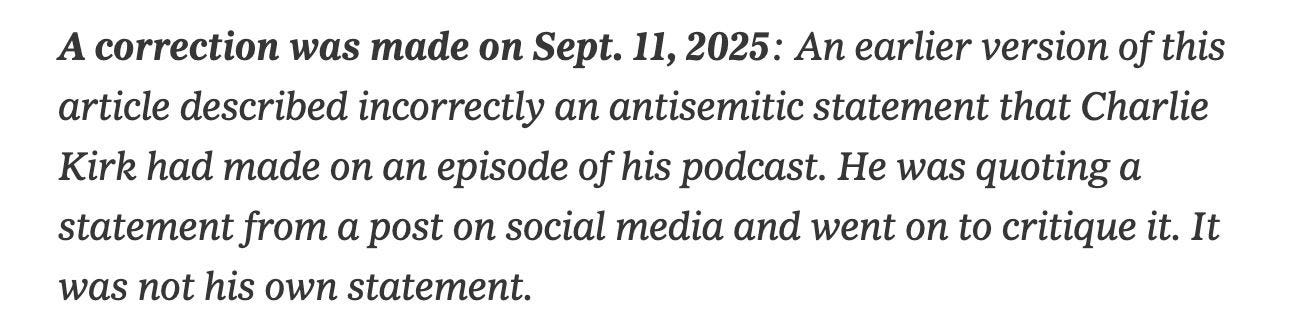
Think about that. The Times accused a man of antisemitism, published it as fact the day after his assassination, and then admitted in small print that it had gotten the story exactly backwards. He had not endorsed antisemitism. He had quoted a hateful remark and then critiqued it. The difference between repeating and refuting is not trivial. It is the difference between complicity and opposition. To collapse that difference is not a mistake. It is malpractice.
And this was not some obscure detail. The controversy at issue was the very podcast episode that activist groups had already attacked Kirk for. If one reads the transcript, the distortion becomes undeniable. Kirk parsed a poorly written tweet that Elon Musk had responded to. He said half of it was wrong, emphasized “not every Jewish person believes that,” and then pointed out a fact: progressive Jewish organizations have historically funded liberal causes in America. He criticized groups like the ADL for aligning with BLM and DEI. He named Jewish philanthropists who had since reconsidered their donations. And he concluded: “It is sloppy, it is shallow, it is wrong and repulsive to call a great man, Elon Musk, an antisemite. It cheapens the label of antisemitism. It is not good for anybody.” That was his bottom line.
Why is any of this controversial? Kirk was highlighting an objective truth about the history of progressive Jewish philanthropy in America. The Ethical Culture Society on Manhattan’s Upper West Side, founded in the 1870s by Felix Adler, a rabbi’s son, became a hub of Jewish-led progressive politics long before BLM or DEI existed. The ADL itself has spent decades partnering with liberal coalitions on civil rights, labor, and education. None of this is secret. It is celebrated history. To point it out is not antisemitism. It is sociology. It is fact.
I can speak with some authority about Kirk’s state of mind before the rallies and the spotlight. In 2014 and 2015 I was in near daily contact with him as we worked together to strategize against BDS resolutions on college campuses. He was constantly puzzled by the Jewish left. How could he, a young conservative activist, be more pro-Israel than many Jewish institutions in America? It was not hatred. It was confusion. He was genuinely trying to reconcile the political reality he saw with the assumptions he had about Jewish identity and Israel. That is a fair question. It is not antisemitism.
But instead of engaging his questions honestly, the press stripped away his caveats and branded him with the one accusation most designed to silence debate. The Times said he had made an antisemitic statement. In truth, he was critiquing one. Their own correction admits as much. Yet the correction is a footnote, while the smear traveled the world.
Antisemitism is among the gravest charges in public life. To level it falsely is to destroy reputations and to weaken our ability to confront real hatred when it appears. To do so the day after a man’s assassination is not only indecent. It is destructive.
Charlie Kirk died as a victim of political violence. That should have been the headline. That should have been the story. Instead, the Times published “Where Charlie Kirk Stood on Key Political Issues” and falsely accused him of words he had never spoken. Then they admitted, almost sheepishly, that “it was not his own statement.” They prosecuted his ideology when they should have mourned his death. In doing so, they showed not his flaws but their own.
This is brilliant. Exactly right. It's not just about the error itself, which is chronicled here masterfully. It's more like "why the hell are they writing this with blood literally not yet dry?" The whole effort to dwell into every remark uttered by one of his generation's greatest talkers is aimed at finding a repugnant sentence or two so the shocking number of people declaring how not upset they are over a young man's assassination can claim some justification. It's not just bad journalism by the Times. It's ghoulish behavior.
The NYT has done more to inflame antisemitism to 1930s level than almost any other legacy media publication.