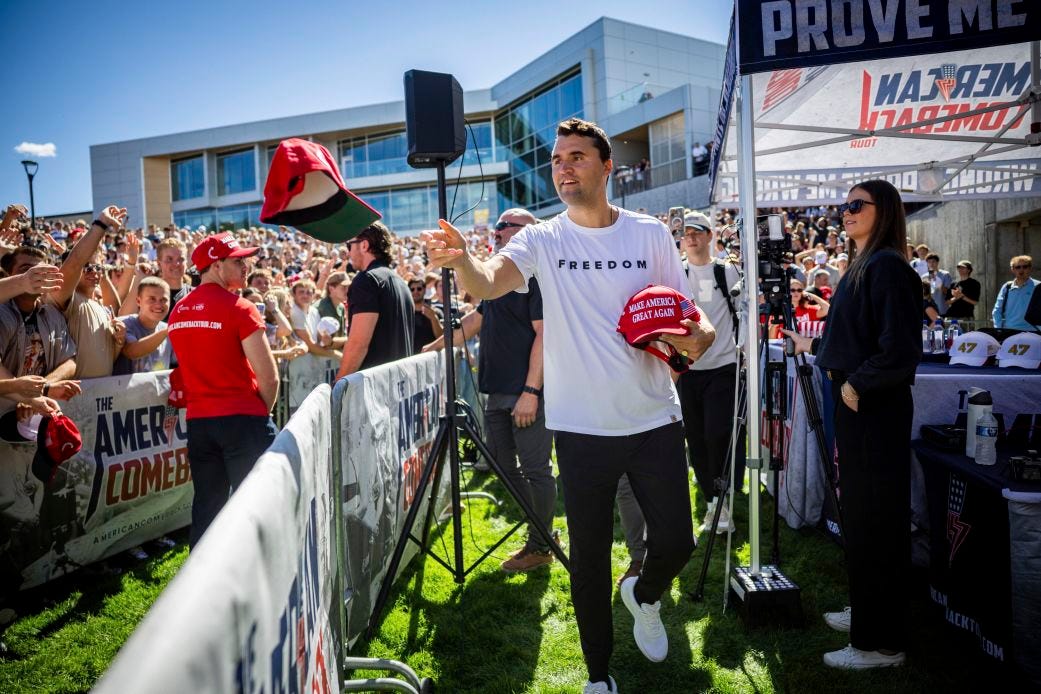
The murder of Charlie Kirk yesterday was not merely a crime. It was a political assassination. It was an act intended not only to silence a man but to strike at the heart of democratic life. To grasp it fully, to measure the evil behind it, the public needs clarity rather than sanitization. Sometimes clarity comes in the form of images that are almost impossible to bear.
Already there are voices urging that the footage be removed. Rep. Anna Paulina Luna of Florida has called on social media executives, including Elon Musk, to take down the video. Others echo the plea in the name of dignity and decency. The impulse is humane. It is also profoundly mistaken.
We have seen this before. In 2014 ISIS staged its theater of terror with filmed executions. The world remembers the names: James Foley and Steven Sotloff, American journalists; David Haines and Alan Henning, British aid workers; Peter Kassig, an American who had gone to Syria to heal rather than to kill; Kenji Goto, a Japanese reporter who believed truth was worth the risk. Their deaths, filmed and broadcast, seared themselves into the world’s conscience. The images forced us to look directly at evil. They galvanized action.
Today those videos are gone. Scrubbed, erased, disappeared into the void of the internet’s memory hole. The result is that ISIS now feels remote, abstract, less monstrous than it was. A new generation has grown up with little sense of what the group truly was, because they have never seen what it actually did. That amnesia is dangerous.
If the footage of Charlie Kirk’s assassination is erased, the same fate awaits this moment. The public will be left with softened accounts. The reality, that a man was murdered in front of 3,000 people on a college campus, will fade into a line of text, stripped of its gravity. The next generation will not feel the weight of what happened. They will be numbed to it. And forgetting, history teaches us, is the ally of repetition.
Civilization has always relied on witness. When the Allies liberated the concentration camps in 1945, they insisted on filming and preserving what they found. The evidence was unbearable, but it was indispensable. Without those images, “Never Again” would have been little more than words.
We face the same choice now. No one is demanding that the video of Kirk’s murder be broadcast on every screen. Dignity requires restraint. But erasure is something else entirely. Erasure is amnesia, and amnesia is peril.
Charlie Kirk’s assassination must not be reduced to a sanitized news brief. The public must see, must know, must remember. Only when we look squarely at evil do we summon the moral seriousness to defeat it.
That is not voyeurism. It is civic duty.