The Times of Israel’s coverage of Secretary of State Marco Rubio’s visit to the City of David was not journalism. It was a performance of clichés. Readers were treated to the usual incantations: “contentious site,” “settler-led project,” “undermines prospects for a Palestinian state.” The framing was deliberate. The rediscovery of the Pilgrims’ Road, one of the most significant archaeological finds in modern history, was cast not as the recovery of Jewish memory but as a political stunt.
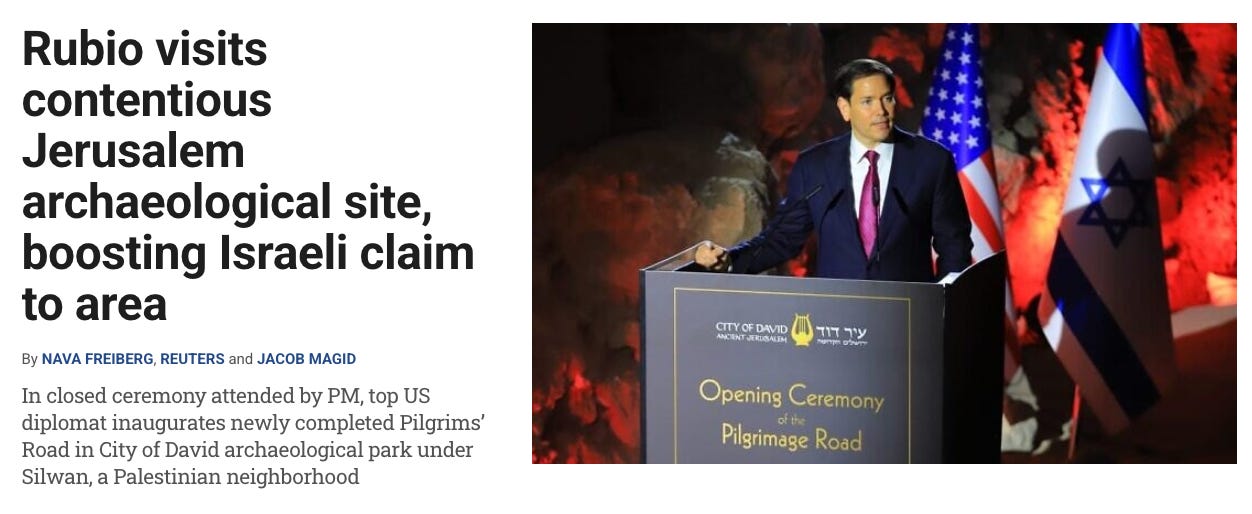
This is intellectual cowardice masquerading as reporting. The City of David is not a “project.” It is the foundation of Jewish sovereignty. Three thousand years ago King David established his capital there. From its slopes the kings of Judah ruled. From here the Psalms were first sung. Tens of thousands of pilgrims walked that very road to the Temple. When Secretary Rubio stood on those stones, he did not make a claim. He bore witness to fact.
The critics cannot admit this. They insist that archaeology “undermines peace.” What they mean is something far less subtle: they cannot tolerate Jewish history because it dismantles the fiction that Jews are strangers in their own capital. To them, every shard of pottery that proves Jewish life is an act of aggression. Every inscription that echoes the Bible is a provocation. These critics are not protecting peace. They are protecting a myth, and they know it.
The shift in American policy makes their discomfort more obvious. For decades, U.S. presidents tiptoed around Jerusalem, pretending its status was “to be negotiated.” President Trump ended that charade by recognizing Jerusalem as Israel’s capital. His acknowledgment of the City of David as a site of world significance was not a gift. It was clarity. Jewish history is not subject to international approval. It exists, whether diplomats like it or not.
Now, in 2025, the American Secretary of State has walked the Pilgrims’ Road. Rubio did not “boost Israel’s claim,” as the article suggested. The claim requires no boost. The stones themselves are the proof. What Rubio did was honor the truth by standing where Jewish worshippers once walked. That, apparently, is what terrifies the critics: that the evidence is too visible, too undeniable, too real.
The Times of Israel dutifully echoed the line that Silwan, the Arab neighborhood above the site, makes the excavation problematic. The insinuation is that the ruins beneath must be ignored so as not to disturb the politics above. But this is nonsense. Silwan is recent. David’s city is ancient. To excavate there is not to erase anyone’s story. It is to recover the Jewish story that has always been present.
For centuries Jews were barred from these stones. Under Jordanian rule from 1948 to 1967, they were forbidden even to pray at the Western Wall. To dig now is not colonization. It is restoration. It is justice delayed and finally done. And with the presence of America’s top diplomat, it is a justice recognized publicly by Israel’s closest ally.
The critics will sneer, because that is what they do. They sneer at Jewish archaeology, they sneer at Jewish memory, they sneer at Jewish sovereignty. They will continue to pretend that uncovering history is an act of aggression. But their sneering changes nothing. Stones do not lie. The Pilgrims’ Road exists. The City of David exists. Jewish history in Jerusalem exists.
Peace will never come by indulging those who build their politics on denial. It will not come by silencing archaeology or pretending that Jerusalem was a blank page until someone else wrote on it. If peace ever comes, it will rest on truth. And the truth is this: Jerusalem is, and always has been, the city of David.