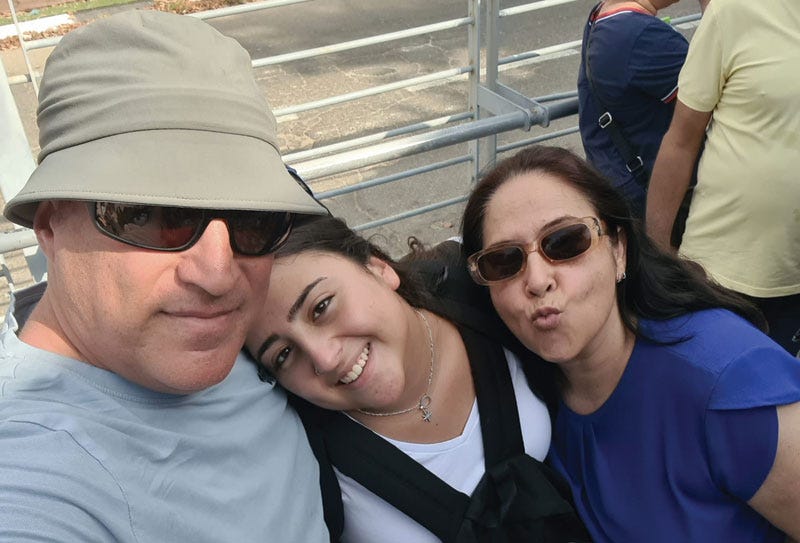
There are moments in the life of a nation when the private grief of a single citizen bursts forth with such moral clarity that it becomes the conscience of all. Eyal Eshel, a father whose daughter, Sergeant Roni Eshel, was stolen from him by the barbarism of October 7th and the institutional sclerosis that enabled it, has just issued such a cry. His recent Facebook post is not merely a lament. It is a searing indictment, a prosecutor’s opening statement against a system that has become a danger to itself and to the nation it is sworn to protect.
To read Eshel’s words is to witness a man meticulously dismantling the edifice of the Israel Defense Forces, not with the wild swings of a grieving parent, but with the cold, steady hand of a forensic investigator. He is a man who has spent nearly two years in the crucible of loss, not wallowing in sorrow, but turning his pain into a lens of unbearable focus. "I began to investigate in depth, I read, I talked, I researched," he writes, "and I quickly understood that the Saturday of October 7th could have been prevented; that is no longer a secret." What he reveals is a military culture so diseased that the catastrophe was not merely a failure, but an inevitability.
The central thesis of Eshel’s argument, and it is an argument of devastating logic, is that the IDF is promoting the very architects of its most humiliating failure. He names names, not for vengeance, but for the record. He points to officers with "the stains of the Saturday of October 7th on their uniforms" who "are still there, in the army." He highlights the commander of the Gaza Division being fast-tracked to a new role, a move he sees as emblematic of a system where "there is no investment in learning the role, no time or desire to delve deeper and become professional." These are not promotions; they are rewards for failure, a grotesque parody of meritocracy.
This is the "sick organizational culture" Eshel diagnoses, a bureaucracy where proximity to power trumps competence, where the "one who is close to the one who is close to the head" ascends. He speaks of the Intelligence Directorate as a club of "cronies who are close to the plate," a closed loop of self-congratulation that produced the "painful conception" that Hamas was deterred. This was not an intelligence failure in the classic sense. It was a moral and intellectual collapse, born of an arrogance so profound it could not see the enemy massing at the gates.
Eshel’s testimony forces a series of foundational questions that Israel can no longer afford to ignore. Has the IDF, an institution born of existential necessity, become just another bureaucracy, plagued by the same careerism and political maneuvering as any government ministry? When did the sacred duty to protect the nation become secondary to securing the next promotion? A system where an officer can enter a sensitive command for a few months and then "poof... get up from their chairs and disappear to the next position" is not a system designed for victory. It is a system designed for personal advancement.
The voice of Eyal Eshel is the voice of a man who has lost everything and is therefore liberated to speak the unvarnished truth. He is not a "military analyst," he clarifies, but something far more potent: a father who must now "raise a dead child." That searing phrase should be carved onto the walls of the Kirya, the IDF headquarters. It is the price of the "pus" of institutional rot that burst forth on that black Saturday. His call is not for revenge, but for something far more radical: change. He demands an end to the culture of "it stays in the IDF." He demands that the inquiries and documents not be buried in some "dark corner."
He understands that a military that cannot punish its failures is a military that will repeat them. The constant refrain of "we are at war" as an excuse to delay accountability is, as he implies, a cowardly evasion. A nation at war, more than any other, cannot afford to keep failed generals in command. It is a luxury that leads directly to more funerals, more bereaved fathers like Eyal Eshel. What does it say about a nation’s values when the men who presided over its darkest day face not courts-martial, but commendations?
The tragedy of Roni Eshel and her comrades was not just that they were murdered by Hamas. It is that they were, in a profound sense, abandoned by a system that had become more concerned with its own internal politics than with its sacred duty. Eyal Eshel’s post is a warning that this system remains fundamentally unchanged. The promotions continue, the culture persists, and the "next disaster," he warns, is at our doorstep. This is not the rant of a broken man. It is the clear, cold, and righteous anger of a patriot who sees the institution he was raised to revere rotting from the head down. He is doing the job the generals and politicians will not: holding a mirror up to the nation. The reflection is horrifying. His cry must be heeded, for if it is not, the bleeding heart of one father will become the bleeding wound of an entire nation.