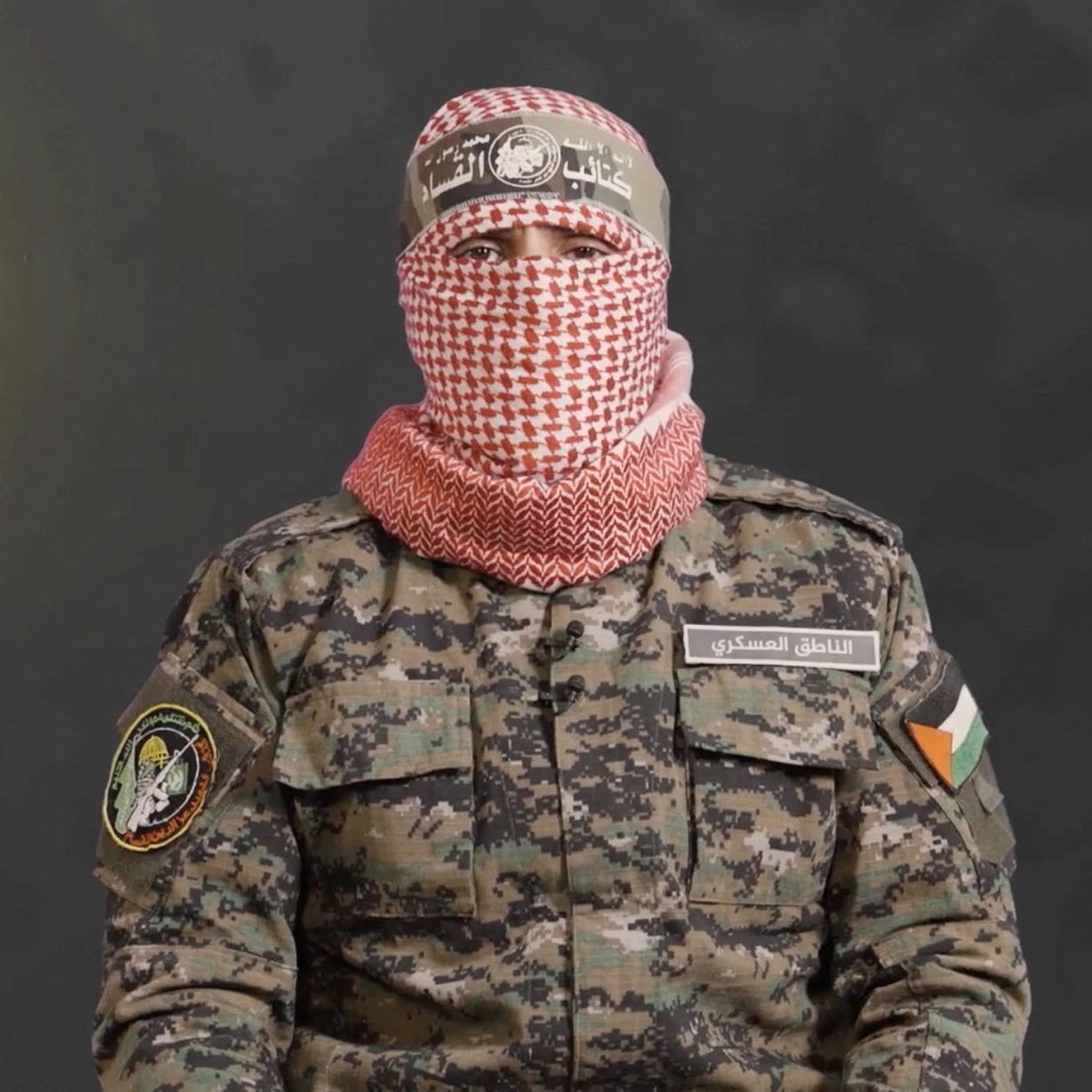
War reveals character. Some fight in the open. Others hide. Hudayfa Samir Abdallah al-Kahlout, known as Abu Ubaida, the masked spokesman of Hamas’ military wing, spent his life hiding. For nearly two decades he projected menace from behind a hood, sending others to fight while he stayed underground. On Saturday the IDF and Shin Bet silenced him.
Abu Ubaida was not a commander on the battlefield. On October 7, when Hamas carried out its massacre, he was not leading from the front. He was hidden away. In the months that followed, as Gaza burned and thousands died, he stayed in the shadows, issuing threats and videos from safe locations while urging others to resist. He operated under the leadership of Yahya Sinwar and was one of the key voices inciting further violence. His role was to be the face of Hamas’ propaganda machine, not its fighting ranks. The mask was not a symbol of strength but of fear.
His weapon was psychological warfare. He orchestrated hostage videos, choreographed threats, and selected the most grotesque images of October 7 for broadcast. He turned murder into theater. He glorified the suffering of Israelis while ensuring he never shared in the risk. He was a coward who cloaked himself in rhetoric while leaving others to bear the consequences of the war he incited.
The strike that killed him was precise, guided by intelligence that traced him to an apartment in Gaza City’s Rimal neighborhood. Palestinian reports and Arab media confirmed the death. Israeli defense officials called it a significant blow. Abu Ubaida, the so-called “voice of resistance,” died the way he lived: concealed, surrounded by civilians he used as shields.
His death carries symbolism beyond tactics. He was one of the last surviving leaders from Hamas’ pre-October 7 hierarchy. One by one, Israel has hunted down those who orchestrated that day’s massacre. The mythology of invincibility has cracked. The mask of permanence is gone.
Hamas will find another spokesman. Someone else will put on the hood, repeat the threats, and claim continuity. But the original figure carried a unique weight. His silence now speaks louder than his words. A myth has died with him.
The moral clarity is sharp. Free societies defend speech. But Abu Ubaida’s broadcasts were not speech. They were weapons of war, incitement to murder, recruitment calls for violence, and deliberate psychological assaults on civilians. Removing him was not censorship. It was defense.
He hid on October 7. He hid afterward. He incited violence under Sinwar’s command while urging others into battles he would never fight himself. He demanded sacrifice while giving nothing of his own. That is cowardice, plain and simple.
Now the mask has fallen. The coward behind it is gone.