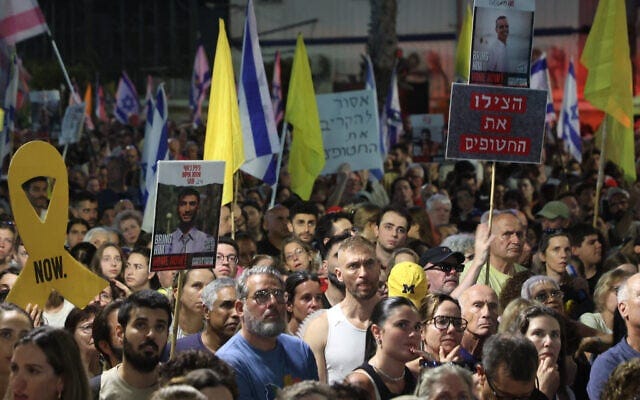
There is something almost perfect about the timing. Just a day after hundreds of thousands filled Tel Aviv to demand the release of hostages over military victory, Hamas announced it would accept the latest ceasefire proposal. The calculation was so transparent, one might almost admire the cynical brilliance if the stakes were not human lives.
This was no coincidence. Hamas has long studied Israel’s rhythms. From intifadas to disengagement, it has learned when to strike and when to pause, always seeking maximum leverage from timing alone.
The protests were wrenching, demanding Israel weigh the moral imperative of saving lives against defeating terrorism. But they went further, painting the Netanyahu government as callous and incompetent. Hamas saw not strength but weakness: a government under siege from its own people.
The proposal Hamas suddenly embraced was designed as a psychological weapon. A sixty-day pause in return for half the remaining hostages and 150 Palestinian prisoners, released in stages, would keep Hamas in control of leverage. It is not a path to peace but a reset on Hamas’s terms.
Even this “acceptance” was hollow. Hamas has perfected the conditional yes, offering agreements while attaching revisions and preconditions that gut the substance. The framework it now claims to accept was first presented in late May 2025 by U.S. envoy Steve Witkoff. Hamas rejected it then, leading Witkoff to pull his team from Doha. For months it sat idle. Now, with perfect timing, Hamas embraces it the day after Israel’s streets filled with anger. This is not progress. It is manipulation.
The vagueness was deliberate. Hamas did not specify which version of the deal it accepted. But the ambiguity was enough. Headlines wrote themselves: “Hamas Accepts Ceasefire, Netanyahu Hesitates.” The narrative was set before a single hostage was freed.
This is terrorism in its most modern form. Violence on the battlefield is only part of the strategy. Manipulating debate, exploiting outrage, and shaping headlines are just as effective. Hamas can lose on the ground and still gain politically if it fractures Israel from within.
Netanyahu was not wrong when he said the protests give Hamas comfort. They signal division under the weight of conflict. Hamas turns this openness into leverage. What makes the accusations especially unjust is the reality for Israel’s leaders. Ron Dermer, one of Netanyahu’s closest advisors, was recently described by Ambassador Yechiel Leiter as having two sons serving in Gaza. Leiter himself has already buried a son. These are not men seeking to prolong war. Their families are paying the price. To claim otherwise is obscene.
Yet in their anger, many protesters have adopted a narrative that portrays their own government as the primary obstacle to peace. Hamas sees this as validation. It does not need to defeat Israel militarily. It needs only to manipulate its internal tensions. Every chant and every headline becomes a weapon.
By claiming to accept a ceasefire at this moment, Hamas cast itself as the side of compromise while Israel appeared resistant. The optics were engineered for pressure. Yet the grotesque reality is that Hamas, a group that murders civilians and hides behind its own population, now poses as a partner for peace.
Many of the Tel Aviv protesters are sincere. Their anguish is real and their desire to save lives noble. Yet Hamas has turned them into pawns. Their humanity is being exploited by those who abandoned theirs.
Hamas is wagering that Israel cannot withstand the sustained pressure of hostage-taking and conflict. But its need to time announcements so carefully betrays weakness. If Hamas were strong, it would not rely on manipulating Israel’s politics.
The question now is whether Israel’s leaders can resist the trap. Accepting Hamas’s terms on Hamas’s timeline would hand terrorism its greatest victory: the power to dictate strategy through manipulation rather than strength.
Hamas’s timing reveals tactical skill but strategic bankruptcy. It can bend debates, but it cannot build a future. It can posture as a negotiator, but it remains a merchant of death. If Israel falls into this trap, it will not be because Hamas was strong. It will be because Israel doubted itself. That would be another great tragedy.