


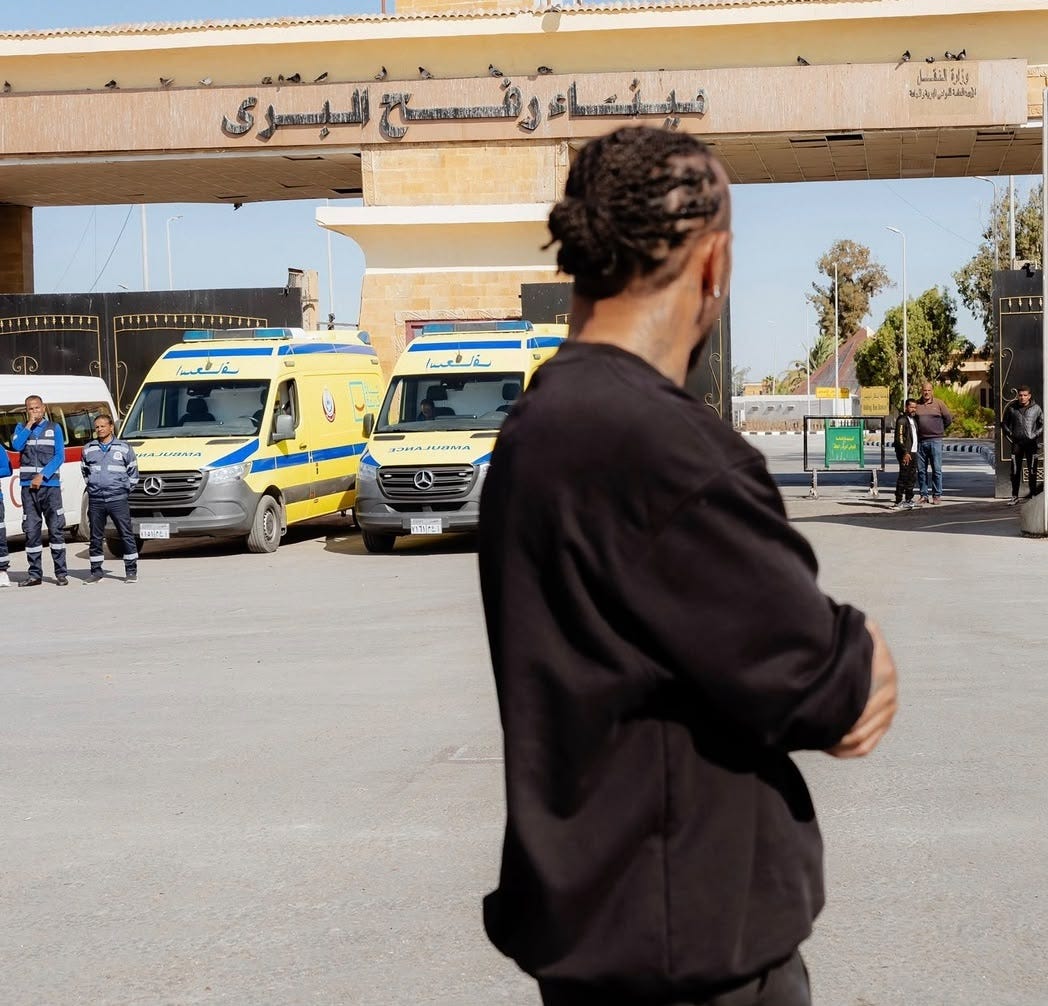
Lewis Hamilton flew to Egypt, stood at Egypt’s wall, and blamed Israel for it. Seven world championships taught him to read a racetrack at 200 miles an hour. One afternoon at Rafah revealed a man who cannot read the ground under his own shoes.
On Tuesday the Ferrari driver toured the Rafah land port and the Egyptian Red Crescent’s warehouses in El Arish. North Sinai’s governor, Khaled Megawer, escorted him. Egyptian officials briefed him on how Egypt handles the aid bound for Gaza. He stood on Egyptian soil as the guest of the Egyptian state, with Egyptian ambulances nearby. On Wednesday he handed down his ruling on Instagram:
“The past three years of Israel’s genocide in Gaza is appalling. It’s an injustice for people to being denied their freedom, their safety and their dignity. No human being should be treated as though their life matters less.
I saw walls stretching for miles, built to keep them in. Standing there, outside what felt like an open-air prison, all I could think about was getting in to help.
At Rafah border, I saw food trucks lined up ready to go, but they’re regularly not allowed in or face major delays. The first driver in line that I spoke to had already been waiting over 12 hours. At the nearby logistics centre, I saw the hard work of the aid workers, but I also saw what gets rejected for crazy reasons. Sleeping bags, first aid kits, medical equipment, wheelchairs, even footballs for kids.
Israel needs to fulfil its obligations under the ceasefire and let the aid trucks in. No excuse.”
The builder of those walls is never named. The caption parks the walls between “Israel’s genocide” and an order to Israel and trusts 44 million followers to draw the wrong conclusion. Most will oblige. That is the trick of a man who picked his villain before takeoff and went to Sinai for the lighting.
The walls are Egypt’s. Cairo began sinking steel into that sand in December 2009, when Hamilton had a single world title. Egyptian officials confirmed the project: 10 to 11 kilometers of steel driven 18 meters or more underground to strangle the smuggling tunnels.
Abdel Fattah al-Sisi thought Mubarak too soft. After jihadists killed Egyptian soldiers in North Sinai in October 2014, his government ordered a strip five to seven kilometers deep emptied along the entire Gaza frontier. By August 2015, Human Rights Watch had counted at least 3,255 buildings destroyed in Egyptian Rafah, a town of some 78,000, and about 685 hectares of farmland razed. Human Rights Watch is an anti-Israel rag that has spent years treating the Jewish state as its favorite defendant, and no serious person takes its verdicts as gospel. Yet even Human Rights Watch could not look at Rafah and blame the Jews. Hamilton managed it in one caption. Egypt bulldozed its own town to seal off Gaza, and the most celebrated humanitarian in motor racing stood in the result without writing a word about it.
That September the army began pumping Mediterranean seawater into the tunnels. Palestinian officials warned of poisoned groundwater and ruined fields. The same year, Egypt opened the Rafah crossing on 32 days. For the other 333, the open-air prison had an Egyptian lock on its only door to the Arab world. In 2020, Cairo began pouring a fresh concrete wall six to seven meters high.
Those are his “walls stretching for miles”. He saw them and posed at the crossing they enclose. Then he sent the bill to Jerusalem.
The war he calls genocide began on October 7, 2023, when Hamas murdered about 1,200 people and dragged 251 hostages into Gaza. The three years of outrage in his caption begin the morning after. Within two weeks, Egypt’s president had made plain where Gaza’s refugees would not be going. Sisi used the Cairo summit to proclaim Egypt’s “vehement rejection of the forced displacement of the Palestinians and their transfer to Egyptian lands in Sinai” before the assembled heads of state. Three days earlier he had offered an alternative. Israel, he said, could put them in the Negev. The man who owns the wall at Hamilton’s back wanted the Jewish state to take the refugees. Hamilton stood at that wall and convicted the Jewish state of caging them. Satire has no answer to that. It can only take notes.
The Gazans who did get out through Egypt paid for the door. In 2024 Hala, an Egyptian firm, charged about $5,000 per adult to put a name on the exit list, NPR and others reported. Cairo’s solidarity arrives with an invoice. That February, satellite images showed Egypt building a walled enclosure in the desert beside the border, which reports tied to the prospect of Gazans fleeing an Israeli push into Rafah. Cairo denied it. In May, when Israel took the Gaza side of the crossing, Egypt refused to coordinate with Israel on aid through Rafah until Sisi agreed, in a call with President Biden, to send it through Kerem Shalom instead. None of it made his caption.
Israel inspects what enters Gaza. It has cause. Hamas restocked its arsenal through tunnels under the very border where Hamilton posed for his photographs.
His caption names Israel twice. Egypt, his host, appears nowhere in it. That is no oversight. A man who can count the hours a driver waited can spot a six-meter wall. He wrote “No excuse” about one government while enjoying the hospitality of another, and in doing so he excused his host in advance.
A moral compass points the same way whoever is pouring the tea. Hamilton’s swings toward his host. His admirers call this courage. Courage would have meant one sentence about Egypt, written in El Arish, as the guest of Egyptian officials. That sentence would have cost him a warm welcome. He was not willing to pay even that. What he offered instead was a famous face lent to a verdict reached before the evidence, with the evidence standing a few meters away.
This is the vanity of the celebrity conscience. It requires a backdrop and a villain the audience already dislikes. It never requires homework. The outrage costs Hamilton nothing. The truth pays, and Israel pays, because a great many of his followers will walk away believing the wall at Rafah went up in Jerusalem. Ignorance broadcast to 44 million people does the work of a campaign, and he is its most famous volunteer.
Hamilton wrote that all he could think about was getting in to help. The governor at his side serves the state that kept that gate shut for 333 days in 2015. Hamilton had the jailer at his elbow and blamed the neighbor.