


An Orange County Superior Court judge has permanently barred Kars4Kids from airing its jingle in California, ruling that the charity spent two decades misleading donors about who their money was actually helping. The decision, which carries potential consequences well beyond the state’s borders, lands as federal scrutiny of the organization is already mounting.
The ruling, issued May 8 by Judge Gassia Apkarian, concluded a bench trial in Puterbaugh v. Oorah, Inc., a case filed in August 2021 by Bruce Puterbaugh, a cabinetmaker in his 70s from Orange County. Puterbaugh had heard the “1-877-Kars4Kids” jingle on the radio “over and over” and donated a 2001 Volvo XC he needed removed from his property. He testified that the ad led him to believe the money would go to underprivileged kids around the country, including in California. He found out otherwise from a neighbor. “That’s not what I wanted,” he told the court. “I feel taken advantage of.”
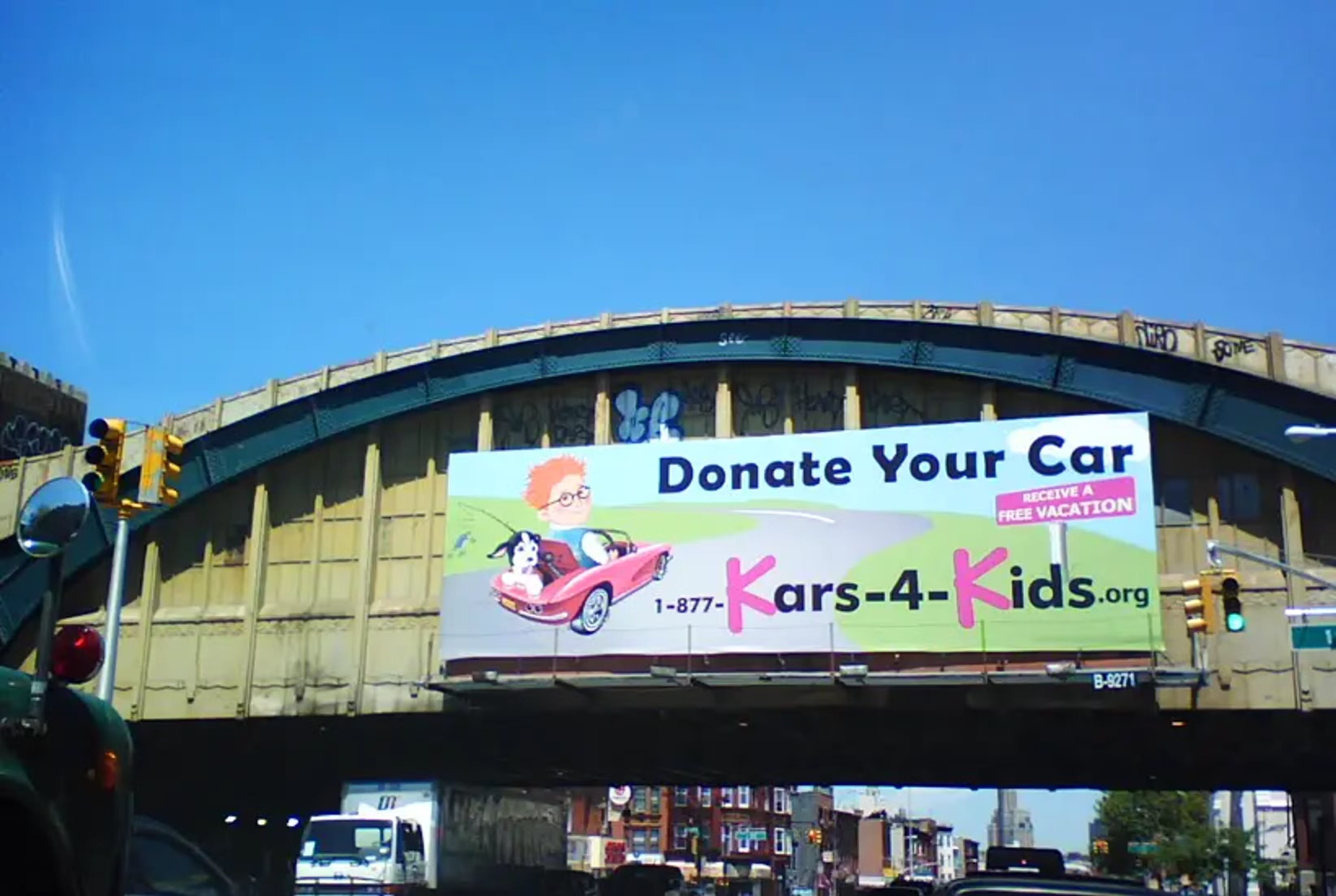
Judge Apkarian found that reaction not only understandable but legally significant. The jingle, featuring children aged 8 to 10 playing instruments, says nothing about the organization’s religious identity, where its programs operate, or who actually benefits. The judge found that the name “Kars4Kids,” the young children in the ads, and the relentless repetition of the jingle were not accidents. She called it an “actionable strategy of deception,” one designed to lodge itself in listeners’ memories by stripping out every substantive fact.
The most striking testimony at trial came from Kars4Kids’ own Chief Operating Officer, Esti Landau. She confirmed that the word “Jewish” appears nowhere in the advertisement and that the 30-second spot, which has been running for two decades, does not “say anything” about the charity’s specific nature. She testified that Kars4Kids sends roughly $45 million a year to Oorah, its sister organization, amounting to about 60 percent of everything it raises. Oorah operates out of the same office building as Kars4Kids in Lakewood, New Jersey, and its programs are focused on Orthodox Jewish children and families, not the general public. Another 30 percent of Kars4Kids’ revenue goes back into in-house advertising, with about 6 percent covering administrative costs. Landau also testified that Oorah’s programming includes matchmaking services for young adults and gap-year trips to Israel for 17- and 18-year-olds. She acknowledged that Kars4Kids’ mission is to “help Jewish children and their families and provide them with the support they need throughout their life,” a description that never surfaces anywhere in the ads.
The tax filings of both organizations flesh out what that model looks like in practice. Kars4Kids reported gross receipts of $185 million in 2024 and $188 million in 2023, making it one of the largest car-donation charities in the country. Yet despite processing that volume, the organization held only $35.8 million in total assets at the end of 2024. Its fundraising expenses, the cost of running those ads, came to $39.1 million in 2024 and $37.6 million in 2023, nearly matching the $35.4 million it transferred to Oorah in cash that year. In 2023, the cash transfer to Oorah was $34.1 million.
Oorah’s balance sheet tells a different story. While Kars4Kids stays lean, Oorah has been accumulating assets at a significant pace. Its 2024 filing shows total assets of $211.3 million, up from $199.4 million the year before, with net assets of $209.5 million. The organization’s revenue from related organizations, essentially the Kars4Kids pipeline, was $37.5 million in 2024 and $44.5 million in 2023. In 2023, Oorah also wired $16.5 million to an entity in the Middle East and North Africa region, listed in its 990 as a grant “to promote religious education,” the same Israel building purchase cited in the court’s ruling. In 2024, foreign grants in the same category totaled $4.6 million.
The numbers tell the rest of the story. While 25 percent of Kars4Kids’ revenue comes from California, the organization has no real programs in the state. Its only California-specific activity is a giveaway of branded backpacks, which Landau described as a promotional exercise. The court found that using the word “needy” on the organization’s website implies economic hardship, and that funding gap-year travel or a multimillion-dollar real estate purchase in Israel directly contradicts that framing. Kars4Kids argued that its website contained sufficient disclosure, but the judge rejected that too. A person who hears a broadcast ad and calls an 877 number cannot reasonably be expected to go research the organization online before deciding to give away their car.
The injunction requires that any future California ads include an audible, express disclosure of the organization’s religious affiliation, the geographic location of its primary beneficiaries, and whether programs serve children, families, or both. The ads may no longer use images of young children to solicit donations that primarily support adults. Kars4Kids was also ordered to pay Puterbaugh $250 for the fair market value of the Volvo.
The ruling carries weight beyond California. The court’s minute order was filed as a statement of recent decision in a pending federal class action lawsuit against Oorah and Kars4Kids, which alleges mail and wire fraud and racketeering. Plaintiff’s counsel in the California case has put potential federal exposure at $400 to $500 million.
Kars4Kids called the ruling “deeply flawed” and said it plans to seek a stay and appeal.
This is pure Jew hatred affirmed by a court. The law does not require identification of the religion or other affiliations of charity beneficiaries. Vile racists and antisemites should do their homework if they feel that way.