


The recent dismissal of criminal sexual battery charges against Ohad Fisherman doesn't merely cast doubt—it utterly dismantles the criminal case against Alon and Oren Alexander. Fisherman was explicitly and graphically named in both the Florida criminal complaint and the mirrored civil complaint filed in New York as a direct participant, accused of physically restraining the plaintiff while Oren Alexander allegedly committed a brutal assault, with Alon Alexander purportedly watching and subsequently participating. Specifically, the complaints alleged that Fisherman "grabbed Plaintiff from behind and pinned her shoulders down while Oren forcibly vaginally raped Plaintiff," and that Fisherman continued to "monitor Plaintiff" during and after the horrific assault. Fisherman’s alleged involvement was not peripheral; it was foundational.
Yet Fisherman's decisive vindication through irrefutable, time-stamped video evidence places him firmly elsewhere, on a boat accompanied by Alon Alexander himself. This evidence, publicly posted by Fisherman on social media, demonstrates conclusively that both he and Alon were together, miles away from the alleged crime scene. This simple, incontrovertible fact annihilates the prosecution's narrative, exposing it as a fabrication unsupported by the most elementary factual scrutiny.

The State of Florida's treatment of Fisherman has been disgraceful. Without credible evidence, they effectively destroyed his reputation, forced him to abruptly return from his honeymoon in Japan, paraded him humiliatingly in front of the media, and subjected him to public condemnation—all based on demonstrably false allegations. Such behavior raises a crucial question: Where is the justice in treating an innocent man this way?

The implications are clear and devastating. The criminal charges against the Alexanders rest entirely upon the presence and participation of Fisherman. If Fisherman was demonstrably not present, and Alon Alexander himself was with Fisherman at that precise time, the entire narrative collapses. To persist in prosecuting Alon and Oren Alexander under these circumstances amounts not merely to prosecutorial stubbornness but an outright abuse of judicial power.
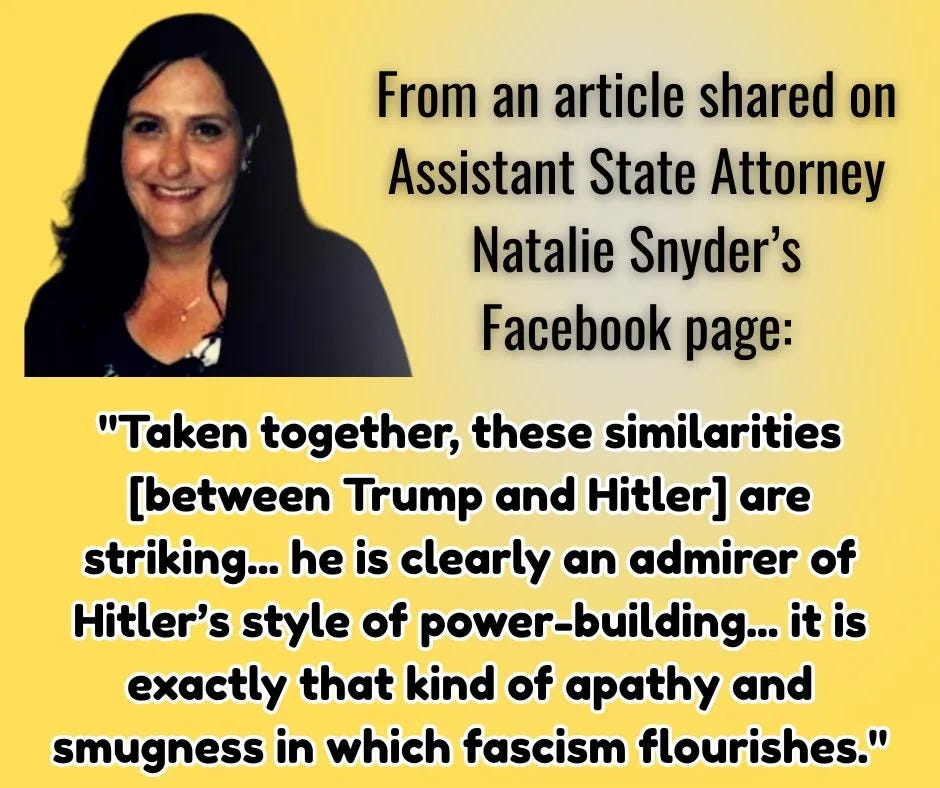
Further raising concerns about the integrity of this prosecution is the troubling revelation that prosecutor Natalie Snyder publicly shared an article likening former President Donald Trump to Adolf Hitler. Fisherman and the Alexanders, known supporters of Trump, naturally provoke the question of whether a political or personal agenda influenced the state's aggressive pursuit. Was justice truly the goal, or was something more sinister at play?
Attorney General Katherine Fernandez Rundle, by persisting with these untenable charges, engages in something disturbingly reminiscent of McCarthyism—a reckless and ruinous campaign, driven less by evidence than by ambition or misguided zeal. It is a legal witch hunt, exploiting sensational claims that collapse upon the slightest rigorous scrutiny. Such tactics undermine the very essence of American jurisprudence, trading due process for prosecutorial expediency and headline-grabbing sensationalism.
From a constitutional standpoint, this continuation of charges potentially violates the Alexanders' fundamental rights under the Fourteenth Amendment, which guarantees due process and protection against malicious prosecution. When prosecutors pursue accusations after essential elements have been conclusively disproven, they breach their duty to justice, becoming agents of injustice instead. Such an approach threatens not just the Alexanders but the credibility of the entire judicial system, eroding public trust in an institution that depends upon integrity and fairness.
The dismissal of charges against Fisherman completely eviscerates the state’s case against Alon and Oren Alexander. It is imperative that these charges be thrown out immediately, allowing the Alexanders to direct their full attention toward addressing the separate federal case against them. Continuing the state prosecution not only wastes resources but actively undermines the fairness and integrity of the justice system.
Thus, Attorney General Rundle now faces a decisive test of ethical and constitutional fidelity. If Fisherman, explicitly named as the linchpin of the prosecution's narrative, is incontrovertibly innocent, the continued prosecution of Alon and Oren Alexander becomes an indefensible act of judicial malfeasance. Persisting in these baseless accusations is not merely misguided—it is morally reprehensible, legally unjustifiable, and constitutionally impermissible.