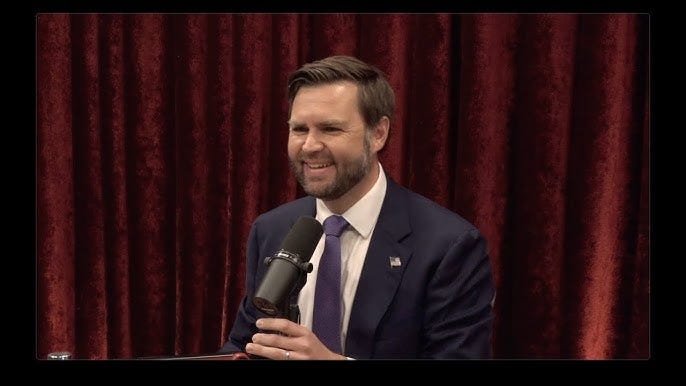
A vice president does not shed the authority of his office when he enters a podcast studio. His words still carry the implied weight of intelligence briefings, classified information and proximity to power. Listeners naturally assume that he knows more than they do.
That is what made JD Vance’s appearance on Joe Rogan’s show more than an embarrassing performance. It was an abuse of public trust. Vance used the loose, clown-show atmosphere of the program to make grave claims about Israeli manipulation, divided loyalty and Jeffrey Epstein’s supposed intelligence connections. He spoke with the authority of the vice presidency, then took refuge in the casual evasions of an ordinary podcast guest.
The legitimate issue was foreign influence. Time reported that Israel hired Brad Parscale’s Clock Tower X for a $1.5 million monthly digital campaign. Such activity deserves scrutiny, and criticism of Israel is not inherently antisemitic.
Vance went well beyond the reporting. He described a “very discreet, extremely well-funded campaign” against the administration’s Iran policy. He claimed that American influencers had “quite literally” been paid through an operative funded by elements of the Israeli government. Yet the article said the amount received by creators remained unclear. Parscale denied that Israeli contract money paid influencers or financed opposition to the Iran agreement.
The Israeli Foreign Ministry denied interfering in American policy. Senator Tom Cotton’s response was harder to dismiss. Asked about Vance’s charge, he said, “I’m not aware of any intelligence regarding a secret influence operation aimed at changing American public opinion on negotiations under the MOU.”
Vance named no Americans supposedly purchased by this operation. He relied instead on phrases such as “certain elements” and “some people.” This is the coward’s form of accusation. No name to defend. No claim precise enough to test. Only a cloud of suspicion cast over anyone who disagrees.
Rogan then suggested that Israel spies on American politicians and that some of those politicians are aligned with Israel rather than the United States. Vance said he “definitely” understood the concern. He did not accuse American Jews as a group of disloyalty. He did something more practiced. He accepted the frame of espionage, money and divided allegiance, added a few qualifications and allowed the audience to draw the ugliest conclusion for itself.
At a time when antisemitic incidents remain at historic levels, a vice president should understand the danger of scattering the old clues of secret money, hidden control and dual loyalty. He need not utter the crudest version. The audience knows how the story ends.
When challenged, Vance cast himself as the victim. Accusations of antisemitism were “insane,” he said, because he had “a ton of respect for the Jewish religion.” That is not an answer. It is a gaslight. Jewish listeners are expected to ignore the insinuations they have heard for generations and accept a profession of respect as absolution. Respect is measured by conduct, not by a disclaimer attached after the damage is done.
Defenders said Vance was meeting a conspiracy-curious audience where it lives and guiding it back toward reason. He guided no one back. A vice president may answer foolish questions. He may not validate their premises for political effect. The office demands a clear line between knowledge and suspicion. Vance blurred it because the blur served him.
The Epstein exchange made the method impossible to miss. Vance proudly called himself “one of the OG Epstein conspiracy theorists.” When Rogan said most people believed Epstein was Mossad, Vance answered, “Yeah, Mossad or CIA or some other deep state,” perhaps both. He said Epstein “clearly had connections to the highest levels of Israeli intelligence” and speculated about a left-of-center “Israeli deep state.”
Epstein cultivated powerful people. His relationship with former Israeli prime minister Ehud Barak was extensive and discrediting. Released records document contact with Yoni Koren, an Israeli intelligence veteran. An FBI memo records an informant’s belief that Epstein was a “co-opted Mossad agent.” But the memo records an allegation. It does not establish an FBI conclusion, and none of the millions of released documents proves that Epstein was an intelligence asset.
Vance admitted that he had asked whether there were “documents connecting Jeffrey Epstein directly to our intelligence agencies or anybody else’s.” The answer was no. That should have settled the matter. Instead, he argued that if such proof had existed, “it wouldn’t exist in 2026.”
There is no argument that can survive that logic because there is no evidence that can defeat it. Documents would prove the conspiracy. Their absence proves the cover-up. A relationship becomes a connection, the connection becomes an operation, and the operation becomes a “deep state.” When pressed on what his own allegation meant, Vance shrugged: “I don’t know what that means.”
He also reminded listeners that he has “effectively unlimited access to information.” That boast makes the performance worse. He invoked extraordinary access while admitting he lacked direct proof. He could only insist, “I will go to my deathbed believing there’s a story there.” Belief is not intelligence. Suspicion is not evidence. A vice president has no moral right to pretend otherwise.
Vance’s offense was not criticism of Israel. It was using the vice presidency to launder rumor into something that sounded like official knowledge. He gave prejudice the language of patriotism and conjecture the authority of the state. Then he relied on the podcast’s unseriousness to escape responsibility for what he had said.
He knew where the evidence ended. He kept talking. That is not candor, and it is not courage. It is a failure of judgment unworthy of the office he holds.