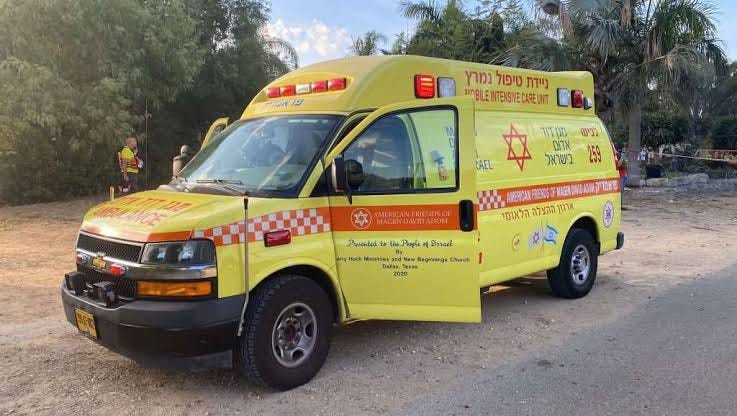
Magen David Adom has officially welcomed the publication of the State Comptroller’s report examining how Israel’s national emergency medical service evacuated casualties during the October 7 terrorist attacks. In a statement released following the report’s publication, MDA said it views the review process as “highly important” and is studying its findings and recommendations as part of its ongoing commitment to strengthening operational preparedness and saving lives. The organization made clear it has not shied away from tackling the report’s findings head-on.
The State Comptroller’s review detailed the unprecedented chaos of the attacks and the extreme pressure placed on the national medical system. According to the report, the scale of the emergency meant that during the initial hours, MDA responders often had to make on-the-spot decisions about destination hospitals due to rapidly changing threats, heavy fire, and blocked roads. The report noted that because of these extreme conditions, MDA teams were not always able to reach all casualties at collection points or scene locations in real time, leading some wounded to reach hospitals independently. The Comptroller also concluded that in the earliest stages of the attack, MDA lacked a full real-time operational picture of the scale and distribution of casualties, though it later shifted strategy and stabilized the evacuation effort.
The report shines a light on the extraordinary conditions under which MDA personnel operated that day. Employees and volunteers worked under live fire, at great personal risk, to reach the wounded, administer life-saving treatment, and evacuate casualties under what the organization described as “extremely difficult and unprecedented conditions.” The Comptroller’s findings specifically acknowledged the dedication and courage shown by MDA’s ranks throughout the attack, noting that in some locations, an MDA volunteer provided the sole initial medical response.
MDA used the occasion to pay tribute to those who served. “Their actions during the harrowing hours of the terrorist attack reflect the spirit of the organization and the unwavering commitment of its personnel to saving lives under all circumstances,” an MDA spokesman said. The organization also expressed solidarity with personnel who were injured and mourned those who were killed in the line of duty.
The scale of MDA’s response on October 7 was immense. Throughout that single day, the organization evacuated hundreds of casualties using a combination of standard ambulances, bulletproof ambulances, and helicopters, while simultaneously responding to thousands of additional emergency calls from across the country. It was, by any measure, the most demanding operational day in the organization’s history. The report noted that the heaviest burden fell on hospitals in the south, with Soroka, Barzilai, and Assuta Ashdod handling roughly 70 percent of the wounded who arrived via MDA evacuation.
Immediately following the attacks, MDA launched what it described as a comprehensive process of lessons learned, operational adaptation, and organizational expansion, directly addressing the operational gaps identified in the review. The ambulance fleet was significantly expanded, with a particular emphasis on bulletproof vehicles suited for conflict zones and high-threat environments. The National Dispatch Center was strengthened, command-and-control systems were upgraded to improve coordination and situational awareness during mass-casualty events, and new operational protocols were introduced, field-tested, and refined throughout the Iron Swords War and the emergency incidents that followed.
The breadth of the overhaul is notable not only for its scope but for how it was financed. A significant portion of the force-expansion initiatives, including the procurement of bulletproof ambulances, advanced medical equipment, and protective gear, was carried out without dedicated government funding. Instead, MDA relied heavily on the generosity of donors in Israel and around the world to make those enhancements possible. “MDA deeply appreciates their commitment, the trust they place in the organization, and their direct contribution to saving lives and strengthening the State of Israel’s emergency preparedness,” the spokesman said. The acknowledgment underscores a recurring reality in Israeli civil society: that critical national infrastructure often depends as much on philanthropic support as on public budgets.
MDA framed its response to the Comptroller’s report not as a defensive exercise but as an affirmation of its institutional culture, embracing the hard lessons of October 7. The organization said it will continue working in cooperation with partners across the healthcare and security systems to implement the lessons learned, strengthen national preparedness, and fulfill what it called its central mission: “saving lives anywhere, at any time, and under any circumstances.” The State Comptroller’s report is part of a broader governmental reckoning with the failures and responses of October 7, a process that has touched virtually every branch of Israel’s security and emergency apparatus. For MDA, the review appears to have validated much of what its personnel did under fire, while also pointing toward the vital work that remains.