


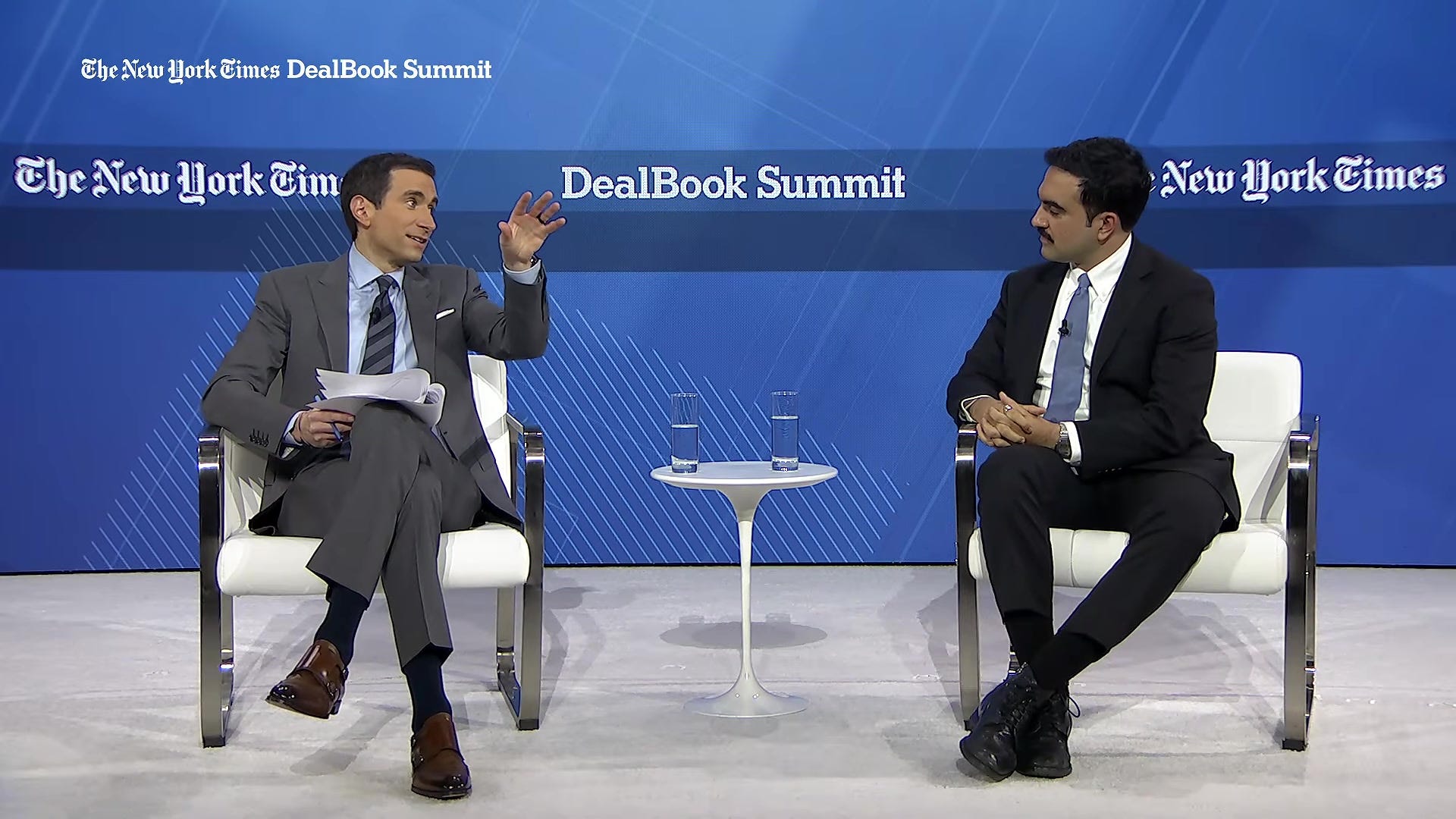
Andrew Ross Sorkin put a question to New York’s mayor on Wednesday that most politicians could answer in their sleep. He asked whether Zohran Mamdani would consider sending one message on October 7 about the horror of October 7, and waiting until October 8 to say what he thinks of Israel. The crowd at the DealBook Summit applauded the question. It needed no explanation, which was the point of the applause.
Mamdani needed a good deal of explanation, and it was worse than silence. After a false start, he said: “When the Israeli government is conducting a genocide of Palestinians, oftentimes the defense that will be given, no matter what day that it’s asked about, will be the relationship to October 7.”
The mayor objects to a day of undivided mourning because undivided mourning might help Israel. Left alone on its anniversary, October 7 makes an argument of its own, namely that a nation whose citizens were butchered in their homes had the right to go after the butchers. That argument must be smothered on the very day it is strongest. To treat the murder of Israeli Jews chiefly as a public relations problem for Israel is a moral obscenity, and it is where the mayor’s logic leads. The dead may not be left alone. Their memory needs a chaperone, posted at the graves to keep anyone from drawing the obvious conclusion.
He went on to call the day “a horrific war crime” and “a day that has been used as a justification for all that followed it.” In that formulation the crime simply occurs, like weather. A war crime without criminals is the easiest thing in the world to condemn. The justifying, meanwhile, is done by Israel. Hamas planned the massacre and carried it out, yet it has vanished from the sentence, and the only party left with any agency is the country that buried the victims.
His statement on the third anniversary followed the same blueprint. It gave the murdered four sentences, 49 words in all. Then: “The suffering did not begin nor end that day.” What followed ran about three times as long. It accused Israel of a “devastating, ongoing genocide” and assured readers that “our tax dollars fund these war crimes.” The word “Jews” appears nowhere. The Palestinian death toll he cited matches the count published by Gaza’s Hamas-run Health Ministry, so the terrorist group served as the killer in the first paragraph and the statistician for the second.
On October 8, 2023, with Israeli families still searching for the missing, Assemblyman Mamdani mourned “the hundreds of people killed across Israel and Palestine” and warned that “Netanyahu’s declaration of war” would bring more suffering. He did not mention Hamas. He prescribed “ending the occupation and dismantling apartheid.” Twenty months later, asked about the slogan “globalize the intifada,” he heard in it “a desperate desire for equality and equal rights in standing up for Palestinian human rights.” A man who hears a plea for equality in a call for intifada will naturally hear an Israeli talking point in a moment of silence.
His defense at DealBook was “a politics of universality” and the conviction that “there has to be room to mourn everyone.” The formula works like a solvent, dissolving the distinctions on which moral judgment depends. The man who sets a fire and the man who breaks down the door to put it out both leave damage behind. A sufficiently universal mourner can lament the two in one breath and call it compassion. Compassion that refuses to distinguish the murderer’s cause from the victim’s nation is indifference with a vocabulary.
Moral seriousness runs on the opposite instinct. It insists that certain days belong to certain dead. No mayor of New York marks September 11 with a review of American conduct in Iraq and Afghanistan, and any mayor who tried would be finished by lunch. Grief that arrives with a policy brief stapled to it has become a press release. New Yorkers would never accept that treatment of their own dead. Every October, their mayor asks the city’s Jews to accept it of theirs.
Mamdani reminded Sorkin that he attended a vigil that night and “was protested at that vigil for attending.” He held up the heckling as a credential, as if abuse from his own admirers were evidence of sympathy for the dead. Showing up at a vigil costs a politician very little. Mourners learn where he stands from what he says the other 364 days. The protesters who chanted “Long Live Hamas” and branded him a traitor had heard for years, from him among others, that Israel commits genocide and practices apartheid. They drew the logical conclusion that mourning Israelis is collaboration. They had applied his words with more consistency than he does.
Mamdani declared himself “proud to be the mayor of the most Jewish city in the United States of America.” He called it unacceptable that Jewish New Yorkers, by his own figures 10 to 12 percent of the population, make up more than half the victims of the city’s hate crimes. He is right about that, and pride in governing Jews is an easy thing to announce from a stage at Lincoln Center. When the most powerful official in New York cannot let Jewish grief stand on its own for a single day, the lesson does not stay at City Hall.
The rabbi Sorkin quoted, a self-described fan of the mayor, had asked for something modest: “Can we just have one day?” On Wednesday, before the city’s business elite, the mayor of the most Jewish city in America gave his answer. It took him a while to get there, and it was no.