


Mayim Bialik’s recent statement on the Gaza war is the kind of well-intentioned but muddled reflection that reveals more about the perils of moral sentiment than about the realities of war. She speaks of her desire for an end to the fighting, laments the ongoing tragedy, and suggests that the policies of Israel’s government “do not reflect the desires of Jews everywhere.” She further implies that the anger directed at Jews worldwide is really anger at the government of Israel. What sounds compassionate in tone is, upon examination, a collection of evasions that undermine the very cause she surely believes she is serving.
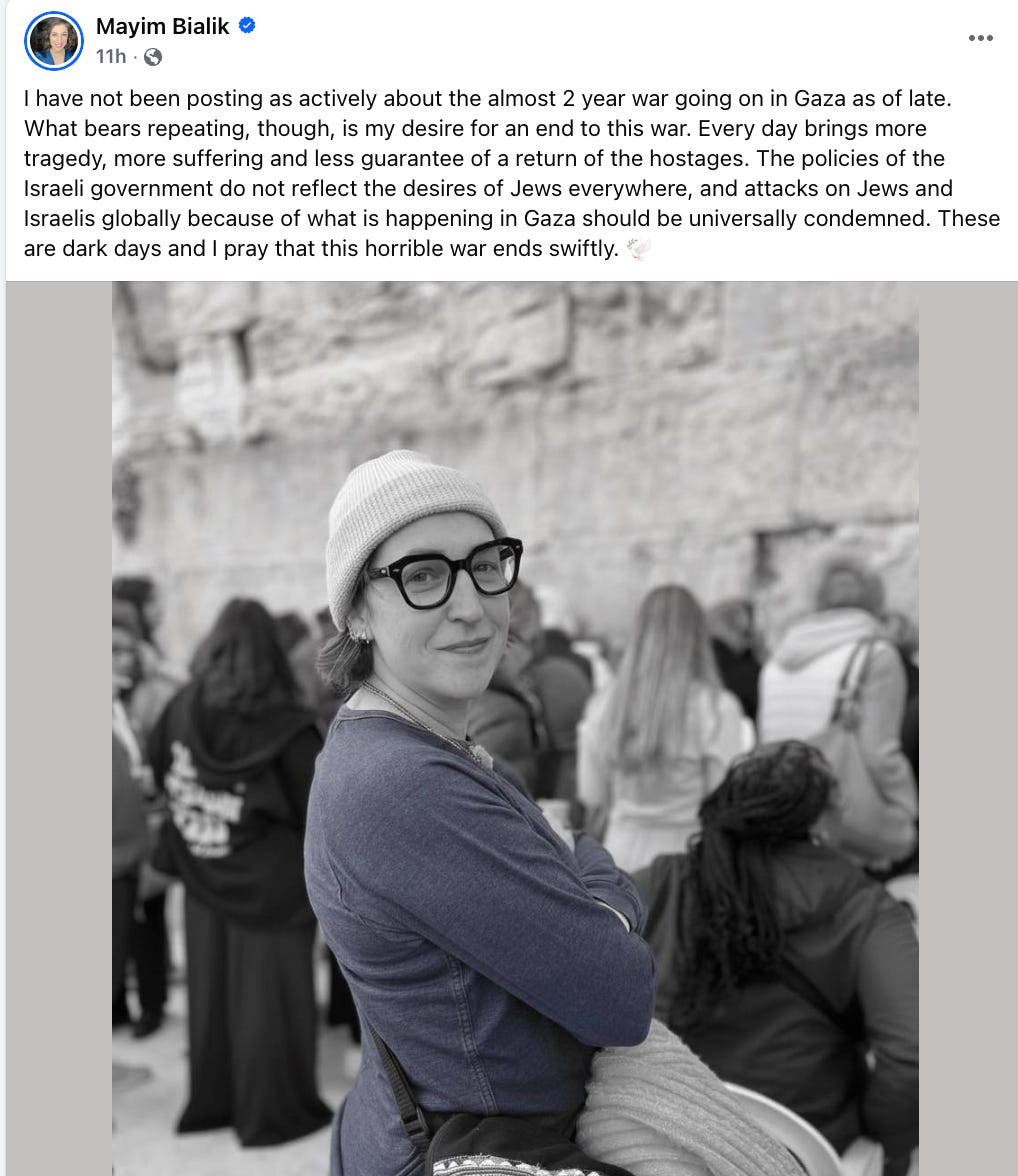
The longing for an end to war is not a policy. It is an obvious wish. Everyone, especially Israelis who live under constant threat, wants the war to end. The real question is: under what conditions? Hamas shattered the ceasefire on October 7th with a barbaric assault that murdered families in their homes, kidnapped children and grandparents, and declared an open campaign of annihilation. To call for an end to war without acknowledging that Hamas’s destruction is a prerequisite is to ask Israel to surrender to a terrorist army that has vowed to repeat October 7th again and again. That is not peace. It is an invitation to further massacres.
Bialik speaks of tragedy, suffering, and diminishing prospects for the return of the hostages. All of that is true, but her words suggest that the primary driver of suffering is the continuation of Israeli military action. This misses the essential fact that the humanitarian crisis exists because Hamas built its war machine inside schools, hospitals, and homes. Hamas’s strategy depends on civilian misery. To assign responsibility wrongly is to relieve the actual perpetrators of blame. One need only ask: if Israel stopped fighting tomorrow, would the hostages be released and the rockets cease? Or would Hamas declare victory, regroup, and strike again? The answer is obvious.
Her insistence that Israeli policies do not reflect “the desires of Jews everywhere” is equally misplaced. No government in history has reflected the views of all people who share its religion or heritage. The United States did not pause in World War II to check if every American of German ancestry supported its actions. Britain did not consult Canadian or Australian citizens before bombing German cities. Israel is not waging war on behalf of a worldwide referendum of Jews. It is fighting for the survival of its citizens, who overwhelmingly support the war effort precisely because they understand what defeat would mean.
The most troubling implication of her remarks is that the rising hostility toward Jews abroad is a kind of misplaced fury at Israel’s government. This is an old fallacy dressed up in contemporary language. Antisemitism has never needed Israeli policies as an excuse. It flourished long before the state of Israel existed and will outlive whatever government sits in Jerusalem. To suggest that today’s harassment of Jews in New York or Paris is primarily a reaction to Israeli decision-making is to shift the onus from the persecutors to the persecuted. It is not only historically false, it is morally dangerous. It feeds the poisonous idea that Jews could avoid hatred if only Israel behaved differently.
Finally, Bialik concludes by calling these “dark days” and praying that the war ends swiftly. No one can quarrel with the hope. But wars do not end because public figures pray them away. They end when aggressors are defeated. In 1945, peace did not arrive through mutual goodwill; it arrived through the unconditional surrender of Nazi Germany and Imperial Japan. In Gaza, peace will not come until Hamas is driven from power, stripped of governance, and completely disarmed. Anything less guarantees that its leaders will regroup, rearm, and plan the next massacre.
What is required now is not celebrity soundbites or emotional appeals but moral clarity. Israel is not waging war because it wishes to. It is waging war because it has no choice. To pray for peace while denying the conditions for peace is to indulge in sentimentality at the expense of truth. The sober truth is that Israel’s war is just, necessary, and unavoidable. Peace will not come when Israel stops fighting. Peace will come when Hamas no longer governs Gaza, no longer wields weapons, and no longer has the power to threaten Jewish life.

Ms Bialik is uninformed as to why this war was started and why it is not merely a hostage rescue mission and why it Hamas must be eradicated
Wow - I often wonder how it is possible that we can read the same article & arrive at diametrically opposed conclusions. Having said that philosophy classes taught me that very lesson. For me history has come full circle & returned to the cradle of antisemitism the Middle East & so to not see the how recurring patterns of antisemitism bubble up & regurgitate old antisemitic tropes is an obtuse way of saying - I’m a good Jew - my mother always said It doesn’t matter what you believe someone else will decide for you & when it comes to being Jewish that’s all they see. The Sunshine Family History illustrates that perfectly