When a nonprofit asks for public trust, especially one tied to the defense of a nation, it must speak in facts, not slogans. Friends of the Israel Defense Forces (FIDF) promotes its IMPACT! Scholarship Program as a core pillar of its mission: helping Israeli veterans transition from combat to campus. It’s a compelling story. But when the numbers don’t add up, the story demands scrutiny.
According to FIDF’s 2023 audited financial statements, “In 2023, FIDF had granted approximately $16.9 million of scholarship assistance.” These funds supported 3,382 former soldiers, which implies an average of about $4,998 per recipient. The scholarships target disadvantaged combat veterans and require annual community service. It is a program that is both inspiring and impactful.
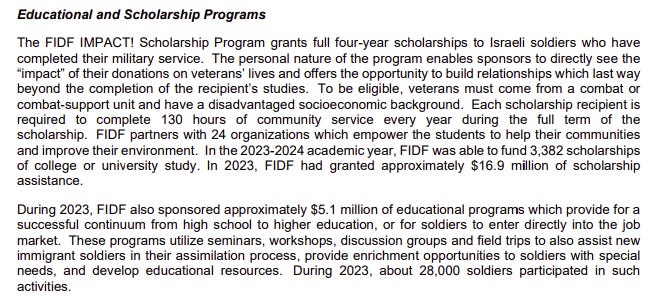
But the official IRS filing tells a different story. On Schedule F, Part III of FIDF’s Form 990, the number of scholarship recipients is exactly the same, 3,382, yet the reported amount is only $13,742,301. That translates to about $4,064 per soldier. In other words, there's a discrepancy of nearly $934 per recipient and more than $3.1 million in total.

Why?
One possibility is that the financial statements include indirect costs, such as overhead, administrative allocations, or in-kind support, that are not reflected in the IRS filing. Another is that the Form 990 omits certain disbursements. Either way, something doesn’t align. And when a nonprofit’s internal narrative diverges from what it reports under penalty of perjury to the federal government, it demands scrutiny.
Let me be absolutely clear: I fully support the concept of FIDF’s mission of helping former soldiers access higher education. The IMPACT! Scholarship Program is one of the most worthy investments a donor can make within the FIDF’s choice of offerings. That is precisely why this issue matters. When it comes to those who have worn the uniform and sacrificed for their country, there should be no ambiguity. Only transparency.
This isn’t a hostile critique. It is a fair, non-confrontational question. Why does the most clearly measurable and publicly celebrated program have a multimillion-dollar discrepancy between the signed financials and the IRS filing?
And if that gap exists here, where both the number of recipients and intended purpose are explicitly stated, what should we assume about the rest of FIDF’s operations?
Consider, for example, the $153 million wire transfer disclosed in the same Form 990, labeled only as “programming.” There is no detail, no recipient name, no breakdown of use, just a nine-figure grant to a single entity overseas.
This is not a quibble over numbers. It is a matter of moral consistency. If FIDF wishes to be the bridge between American generosity and Israeli resilience, it must treat every dollar with the same discipline it expects of the soldiers it honors.
Donors deserve transparency. Soldiers deserve the truth.