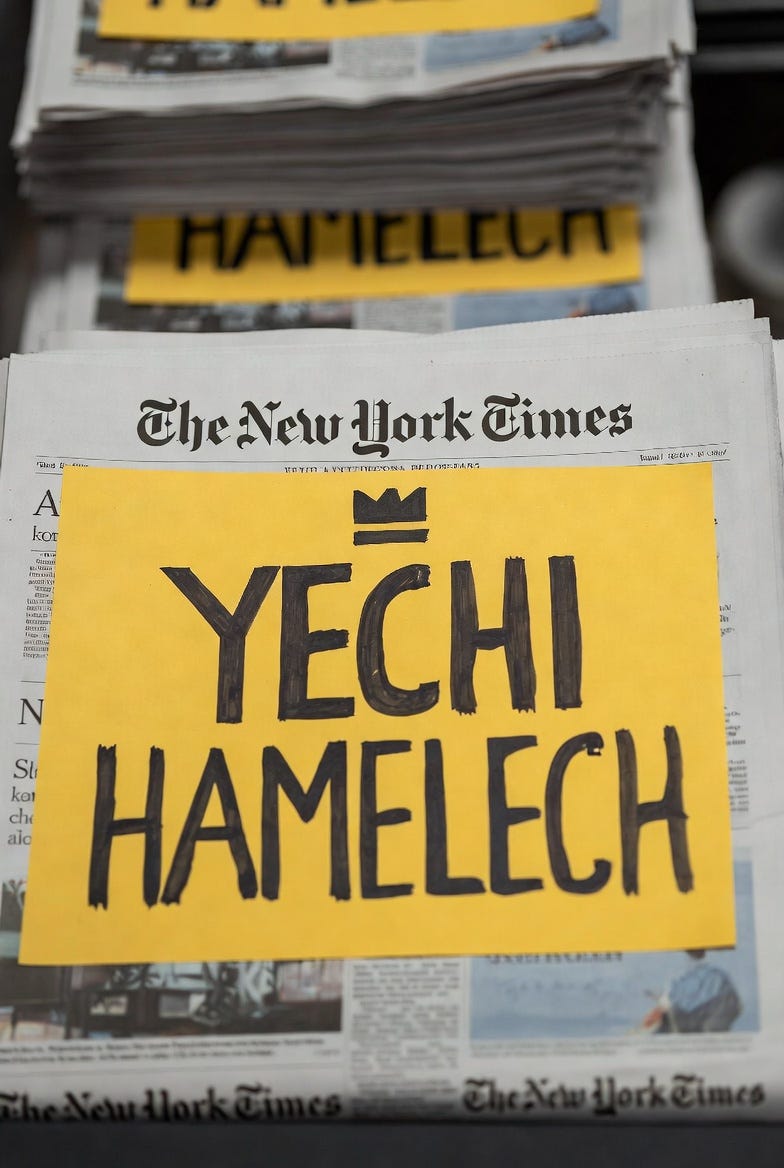
Every now and then, a small moment tells you more than a long investigation ever could. We got one of those moments this week, courtesy of The New York Times, an institution that too often mistakes procedure for understanding.
The scene was a chaotic Brooklyn street after a car-ramming incident in which a deranged man attempted to drive his vehicle into 770, the world headquarters of Chabad-Lubavitch. A Times reporter, doing what reporters often do in moments like this, stopped a 15-year-old boy for a quick quote. Asked for his name, the boy replied with two words that were very obviously not a name: “Yechi Hamelech.”
The Times printed it.
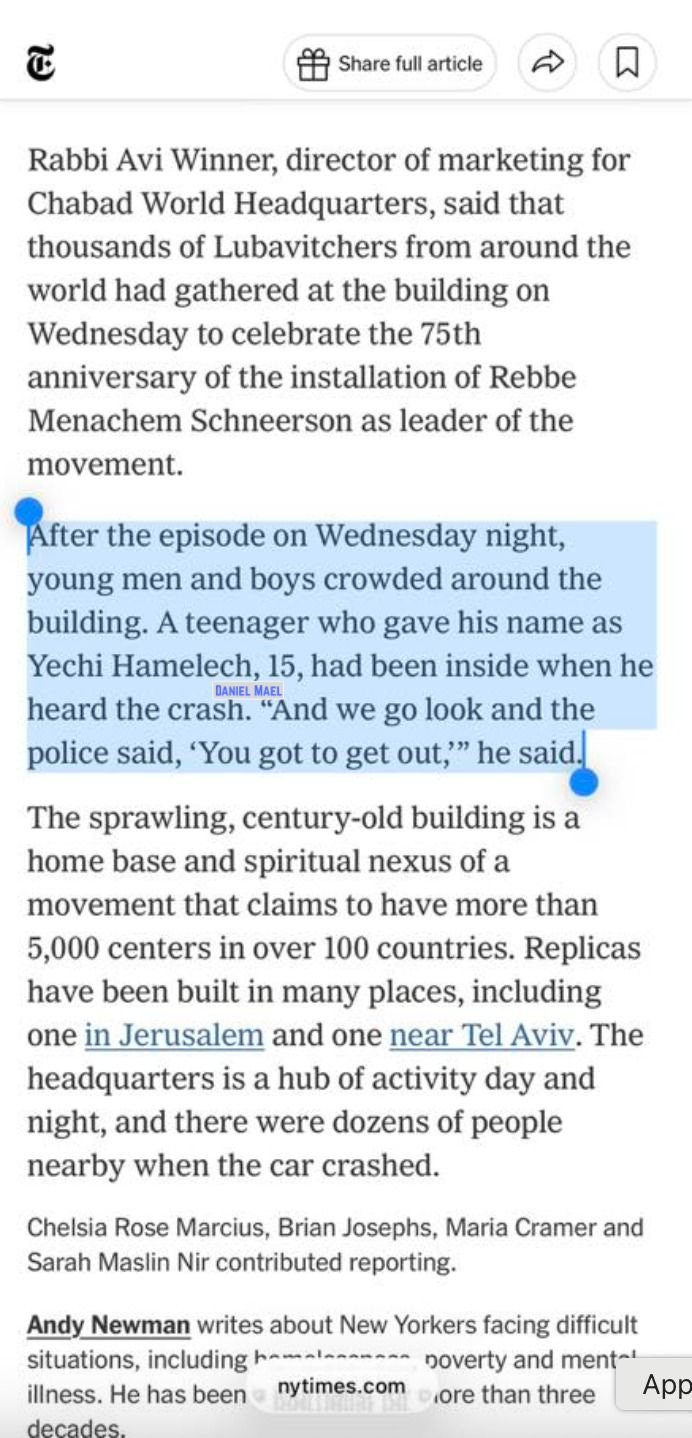
Not as a slogan. Not as context. As the boy’s name.
This wasn’t a typo or a minor slip. It was a basic failure of comprehension. “Yechi Hamelech” means “Long live the King.” It’s a chant associated with a small but loud messianic fringe within the Chabad world — a group most Chabadniks neither belong to nor take particularly seriously. You don’t need to grasp the internal theology to understand that it’s not how people introduce themselves.
Which is precisely why the boy used it.
He wasn’t answering honestly; he was trolling. Perhaps not maliciously, and not cleverly for its own sake, but knowingly. Maybe he understood he was speaking to someone parachuted into a moment and a culture they didn’t really understand. So he gave them a phrase that would only make sense if the reporter had even a minimal grasp of where he was standing.
No one did.
Imagine covering a political rally and quoting someone identified as “Build the Wall” without stopping to ask a single follow-up question. That’s the level of detachment on display here.
What this episode exposes is the hollowness of process-driven journalism. The reporter didn’t just drop into a neighborhood; he dropped into a culture and treated it as a backdrop. The quote was collected. The box was checked. Editors moved it along. The machine did exactly what it was designed to do.
And when the error became public, the response followed a familiar pattern. No clarification. No correction. The words were simply removed from the article, quietly erased, as if the problem were the visibility of the mistake rather than the mistake itself.
But it happened.
In a single, avoidable moment, a paper that prides itself on seriousness showed how thin its understanding can be when it relies on ritual instead of curiosity. A teenager didn’t expose that through protest or ideology. He did it by trolling — and letting the system reveal itself.