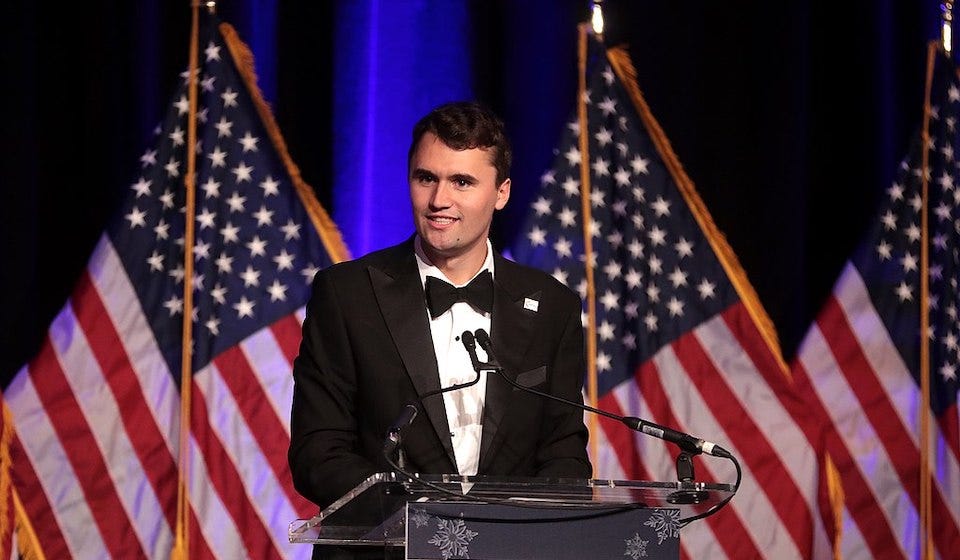
Symbols matter. A society reveals its moral seriousness not in the slogans of its leaders but in the small rituals it performs without hesitation. Among them, few are as sacred as the lowering of the American flag to half-staff. It is a gesture of collective mourning, not of partisanship. It honors not a platform, not a program, not the totality of a man’s opinions, but the stark and tragic fact that an American life has been extinguished in the service, or in the struggle, of public life.
When President Trump issued his directive that flags be lowered nationwide for Charlie Kirk, he did not demand fealty to Kirk’s politics. He demanded recognition of the larger wound: the assassination of a political speaker, in broad daylight, on an American campus. The flag comes down not to sanctify everything Kirk ever said, but to solemnize the principle that in this Republic ideas are contested with argument, not bullets.
Yet New York and New Jersey declined to comply. Their flags stayed aloft, business as usual, as if nothing of constitutional consequence had occurred. In New Jersey, the official state guidance that very day listed “full staff” on its Department of State website, and Bergen County followed that guidance. New York also kept its flags high. At the same time, Delaware and Pennsylvania complied with the federal proclamation and lowered theirs.
This refusal was not legal. It was political. And that is what makes it chilling.
By refusing, the states sent an unmistakable signal: that Charlie Kirk’s murder is not a matter for collective national mourning, not a moment demanding civic solidarity. Their silence implies that because he was the wrong kind of victim, a conservative, a Trump ally, his death does not merit the universal language of half-staff grief.
This was the easiest way for a left-leaning political body in New York or New Jersey to reach across the aisle and say, we care about you, and this was too much. It would have cost nothing. It would have carried no partisan risk. It would have shown the country that even in our divisions there remains a common boundary against political murder. Yet they refused to do so.
That refusal is a profound abdication. For if the flag cannot come down for an American citizen killed for his words, then for what does it come down at all.
The lowering of the flag is one of the few civic rituals left that transcends ideology. When it is politicized, when governors treat it as a partisan endorsement rather than a universal marker of loss, it corrodes its meaning. Worse, it tells the next would-be assassin that political murder is not a wound to the nation’s conscience but merely another skirmish in the partisan wars.
That lesson will corrode the Republic.
The point is not Charlie Kirk. It is not whether you cheered him or scorned him, admired him or abhorred him. It is that he was shot in cold blood for speaking in America. That is the crime. That is the danger. The flag lowered at half-staff is the warning flare: that we recognize this as an assault on democracy itself, and that future generations must see in our response the gravity of that assault.
Instead, in New York and New Jersey, the flags stayed high. The message to history: ambivalence.
What would Abraham Lincoln say. He suspended habeas corpus to preserve the Union, yet when soldiers on both sides fell, he asked for silence, for reverence, for the recognition that Americans, regardless of cause, had perished. What would John F. Kennedy say, who reminded us that in America, civility is not a sign of weakness.
The governors of New York and New Jersey failed not in law but in spirit. They declined to mourn with the nation. They shrank the meaning of the flag to the size of a partisan preference. And in so doing, they diminished us all.
There will be other moments, other tragedies, other proclamations. But the precedent set here is corrosive. Once the flag is reserved only for the approved, the admired, the ideologically pure, it ceases to be the flag of all. It becomes a banner of factions, raised and lowered at the pleasure of politics.
The flag at half-staff is not an endorsement. It is a warning. It tells the living that when speech is met with violence, the Republic itself is in danger. It tells the future that political murder is a line that cannot be crossed. By refusing to lower it for Charlie Kirk, New York and New Jersey sent a different message. They showed that even a simple gesture of shared mourning can be consumed by partisanship. They showed that the symbols that once bound us together are now treated as weapons in the endless political struggle.
History will not forget the murder. But it will also remember the silence of those who could not bring themselves to honor a fallen citizen whose politics they disliked. In that silence lies a warning of its own: that our ability to mourn across divides, to affirm the humanity of those with whom we disagree, is eroding. Civil dialogue cannot survive in such a climate. Mutual understanding cannot grow in such barren soil. The refusal to lower the flag did not just miss a moment of unity. It signaled to the next generation that even the most basic expressions of national solidarity are negotiable. That is how a society forgets how to live together.