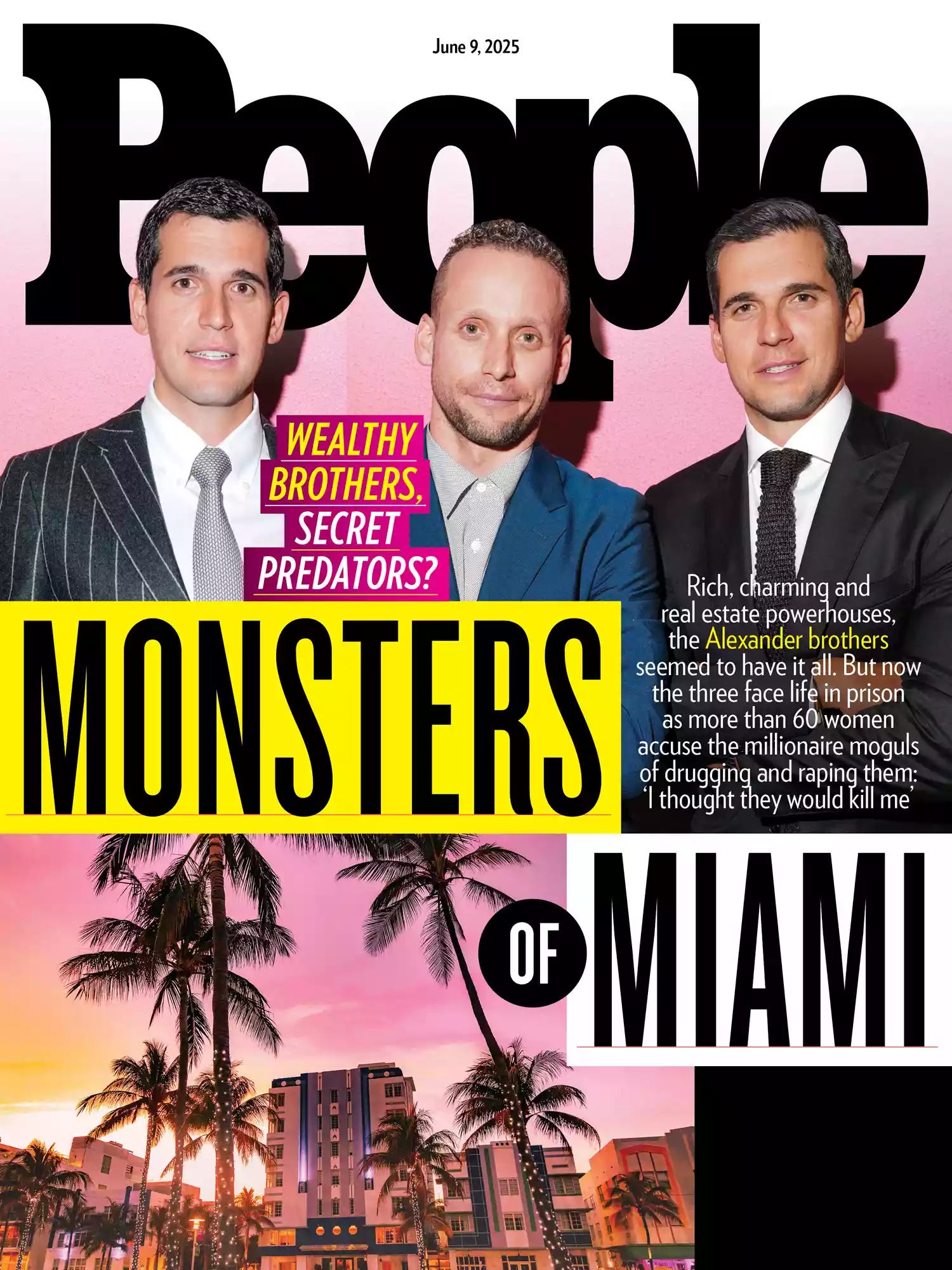
In late May 2025, ahead of its June 9 issue, People magazine published a bombshell cover featuring the Alexander brothers—well-known figures in the luxury real estate and security industries—with the inflammatory headline: “MONSTERS OF MIAMI.” Just beside it, in bold, attention-grabbing text, appeared the explosive claim: “More than 60 women accuse the millionaire moguls of drugging and raping them.” That single sentence, as worded, carries serious legal and reputational consequences.
Yes, the media has every right to report on serious allegations. But there’s a difference between responsible journalism and publishing language so loaded, so suggestive, that it borders on defamatory. This may be one of those moments where the line was crossed—and the legal fallout could be severe.
The heart of the issue is that single sentence: “more than 60 women accuse the millionaire moguls of drugging and raping them.” To the average reader, there’s no ambiguity here. It sounds like over 60 women have each accused the brothers of both drugging and raping them. No caveats. No nuance. No mention of allegations tied to parties, or indirect claims involving social circles. Just a blunt assertion of coordinated criminal conduct by two named men. That’s where this gets dangerous.
Based on all the publicly available reporting—legal filings, media investigations, and interviews—there is simply no evidence to support the idea that over 60 women have accused the Alexanders of that specific conduct. Some women have described uncomfortable experiences at events linked to the brothers. A much smaller group has alleged misconduct, and only a subset of that involves anything resembling criminal accusations — and absolutely nothing is proven. What People did was collapse all of that into a single, damning, and—in all likelihood—false headline.
Even more baffling is how thin the article’s own narrative becomes upon closer inspection. One of People’s featured sources, Maria Suska, recounts an alleged incident involving Oren Alexander at a Miami building. But she offers no firsthand knowledge about Alon or Tal, nor any claims of direct interaction with them. So when she declares, “Finally, they will get what they deserve,” it raises serious questions: What does she actually know about the other brothers? What basis does she have for making such a sweeping statement implicating all three? This kind of rhetorical overreach isn’t just sloppy—it highlights how People magazine appears to be relying on implication and innuendo rather than solid, verifiable facts.
In defamation law, the bar is high, especially for public figures. But it’s not insurmountable. A statement has to be false, published to a third party, made with some level of fault—negligence at minimum, actual malice in cases like this—and it has to cause harm. If People can’t back up that sentence with credible documentation that more than 60 women accused the brothers of both drugging and raping them, then the claim is provably false. The magazine’s circulation ensures it was widely published. Harm is almost guaranteed. The question becomes whether the magazine acted with “actual malice”—either knowing the claim was false or recklessly disregarding the truth.
That standard includes relying on shaky sources or ignoring basic facts. If the magazine’s editors ran with the most salacious framing possible without verifying the exact nature of the accusations, they may have crossed into liability. And the cost of that could be tens of millions.
Even if People tries to walk it back and argue the wording is technically accurate—say, that over 60 women have raised complaints tied to events the brothers attended or hosted—the way the cover presents it strips away any meaningful distinction. It doesn’t read like reporting; it reads like a verdict. The design, the fonts, the colors—phrases like “Wealthy Brothers, Secret Predators?” splashed in neon, and “MONSTERS OF MIAMI” in all caps—it’s all meant to drive home one thing: these men are guilty. The quote “I thought they would kill me” takes it a step further, locking the reader into a presumption of monstrous violence.
And here’s a deeper, more troubling question: how are the Alexander brothers supposed to receive a fair trial when one of the most widely read magazines in the country has already tried and convicted them on the cover? Media trials have real consequences. Jurors don’t live in a vacuum. When the public narrative is shaped by sensationalist headlines and distorted facts, it becomes nearly impossible to find an impartial jury—let alone have faith in a just outcome. Reckless reporting like this doesn’t just damage reputations; it threatens the very foundation of due process.
If this case goes to court, People may be forced to disclose its editorial process—fact-checking, sourcing, internal emails, and editorial deliberations. That could reveal whether this was just a sloppy mistake or a calculated effort to juice sales and social engagement by exaggerating the allegations beyond what the facts support.
There’s also a deeper issue here. When media outlets blur the line between allegation and fact, it doesn’t just harm the accused—it chips away at public trust and risks undermining real victims. If readers start doubting the truth of every accusation because they’ve been burned by sensationalism, that helps no one.
People’s June cover isn’t just irresponsible. It may be actionable. And if the Alexander brothers decide to fight back, they might have a real case. Accuracy still matters. And when the press crosses the line from reporting into character assassination, consequences should follow.