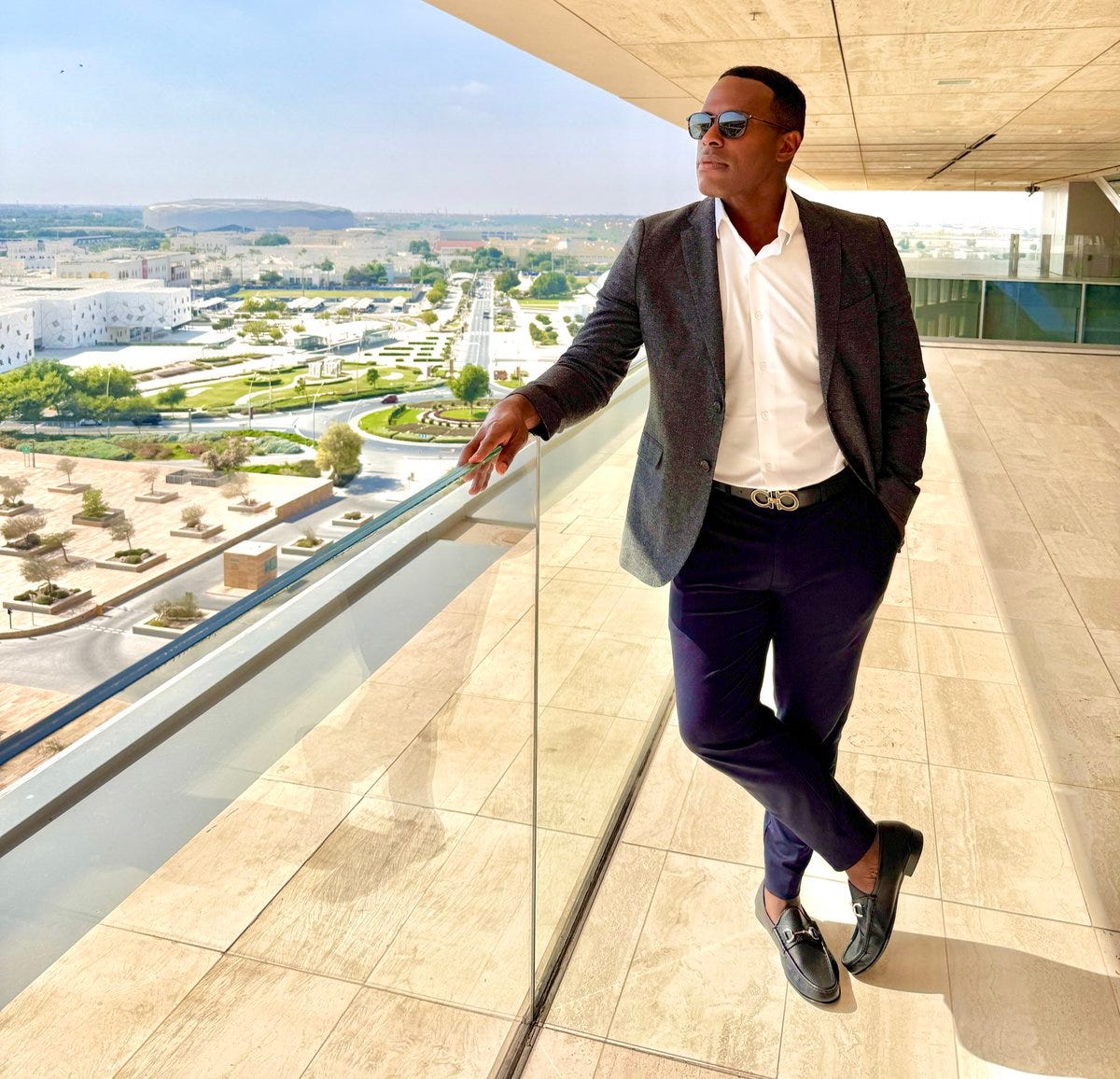
American politics produces hypocrisy in abundance, but Rob Smith’s recent praise for Qatar stands out for its almost comic inversion of principle.
Smith—an openly gay conservative veteran whose brand rests on truth-telling and patriotic conviction—has now published an earnest travelogue celebrating a regime that criminalizes the very identity he lives openly in the United States.
His post begins with wide-eyed astonishment: “My first trip to Qatar has been eye-opening… I wasn’t aware of a great deal of things about Qatar, only misperceptions and half-truths I’d read about online.” What follows is not hard-earned insight but a guided tour masquerading as revelation.
He marvels: “Did you know there’s a U.S. Air Force Base in Qatar that hosts 10,000 Active Duty American soldiers? I did not.”
Most adults did. More importantly, they also know that Qatar’s cooperation is transactional, not ideological. Qatar hosts our troops; Qatar also criminalizes homosexuality. Both facts can coexist. Only one seems to have captured Smith’s attention.
In nearly every line, Smith praises meetings with Qatari officials, visits to American institutions on Qatari soil, polite conversations with diplomats—all framed as proof that Qatar is “misunderstood.” Not a single acknowledgment that homosexuality is punishable by imprisonment under Qatari law, or that in the system’s religious courts, the penalties can be far worse.
He writes: “I decided to risk any potential criticism and travel and experience it for myself.”
Risk? Qatar would imprison an openly gay Qatari for the life Smith lives in public every day. Smith, protected by his passport and platform, flies in and out freely. The people who face real risk—LGBTQ Qataris—do not appear in his account at all.
He then situates himself among prominent Americans who have visited Qatar, calling them “patriotic American servants” and invoking the 47th president. Diplomats travel to Qatar because geopolitics requires it. Smith’s attempt to conflate diplomatic necessity with moral endorsement is self-serving and transparent.
The most revealing line appears near the end: “I am proud… to help our various Ambassadors and American officials understand and highlight the unique and mutually beneficial military and financial partnerships we share with Qatar.”
Translation: he sees himself as a messenger for Qatar’s preferred narrative. The country’s criminalization of homosexuality vanishes from his field of vision, replaced by talking points about partnerships and understanding.
The irony is glaring: a gay conservative famous for denouncing Western institutions as insufficiently courageous suddenly loses his own courage the moment he steps onto Qatari soil. The man who lectures Americans about standing firm against ideological enemies now softens at the sight of Doha’s skyline.
He concludes: “It has been an eye-opening few days, and I cannot wait to share more with you!”
If anything has been opened, it is not his eyes but his willingness to excuse a regime that would arrest him for living as himself.
Smith is free to travel and free to speak. But when a man praises a government that criminalizes his own identity—while ignoring those who suffer under it—the hypocrisy is not incidental. It is defining.
Qatar did not change. Only Rob Smith did.