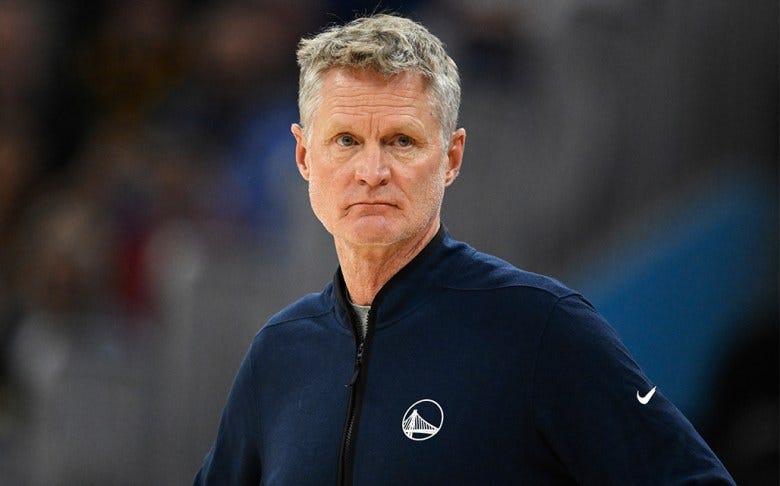
Steve Kerr is a brilliant basketball coach. Nine NBA championships, as a player and a coach. He understands the geometry of the court, the psychology of elite athletes, and the mechanics of the pick-and-roll better than almost anyone alive. That is not a small thing, and it deserves genuine respect.
But success in one field is not a license for authority in all others. When Kerr steps off the hardwood and into the realm of geopolitics and national morality, as he did at length in a recent interview with The New Yorker, the results are not pretty. His comments on Israel and Donald Trump reveal a man who has confused passion for clarity, and celebrity for wisdom.
It is worth acknowledging, before anything else, that Kerr carries a real and painful history. His father, Malcolm Kerr, was a distinguished academic who devoted his life to building bridges between America and the Arab world. He was assassinated in Beirut in 1984 by the Islamic Jihad Organization, an Iranian proxy. That grief is real, and it deserves respect. But grief is not a credential. Suffering a loss at the hands of terrorism, however shattering, does not confer expertise in the causes, consequences, or proper responses to terrorism. The people who understand this distinction most acutely are Israelis. Israel is a nation that has buried its children, its parents, and its grandparents to terrorism for generations. Israelis have endured more collective grief from political violence than perhaps any people on earth, and yet no serious person argues that their suffering alone settles the question of what their government should do. Policy must be argued on the merits. Kerr’s pain earns him sympathy. It does not earn him a pass on the quality of his reasoning.
When asked about the war, Kerr said this:
“My dad was killed by Iranian proxies forty-two years ago. I have no regard for the Iranian regime whatsoever. But the answer does not lie in starting a war and killing innocent people. Imagine being a parent of one of the one hundred and seventy-five girls who died when their school was bombed. Their loss, their suffering... How are they going to feel about America? Violence begets violence. We’ve seen it in Israel and Lebanon as well. There was an opening for Israel to handle their business with the Palestinians diplomatically that would have solidified the Abraham Accords and allowed stronger alliances with Arab countries that would have really cornered Iran. Instead, Israel sought revenge for October 7th and now seventy-two thousand Palestinians have been killed and Israeli settlers are taking over the West Bank illegally, with the approval of Israel’s government and the U.S. Ambassador, Mike Huckabee. That’s not a path to any sort of peace or security for Israel or the rest of the Middle East.”
The suggestion that Israel had a diplomatic “opening” on October 8th reflects a fundamental misunderstanding of the enemy it faces. Hamas did not launch a border dispute on October 7th. It launched a pogrom. It slaughtered, raped, and kidnapped innocent civilians with deliberate, gleeful barbarity. One does not negotiate with a death cult whose founding charter calls for the annihilation of the Jewish state. To demand diplomacy in the face of that kind of evil is not moral sophistication. It is moral abdication.
Kerr’s framing that Israel “sought revenge” is equally wrong. Israel is not seeking revenge. It is seeking survival. It is fighting to dismantle a terrorist infrastructure that deliberately embeds itself within civilian populations, using its own people as human shields. The loss of civilian life in Gaza is a tragedy. It is also the direct, intended result of Hamas’s strategy, not of Israeli malice. Placing the moral burden on the nation defending its citizens, rather than on the organization that initiated the slaughter, is not nuance. It is an inversion of justice.
Kerr does not mention the roughly 1,200 Israelis massacred on October 7th. He does not mention the 251 people taken hostage into Gaza. He says nothing about the paragliders, the music festival, the kibbutzim, the babies, the elderly, the families burned in their homes. His moral accounting starts the clock only after Israel responds. That is not balance. That is a verdict dressed up as concern.
His confusion carries over into his views on American politics. Kerr laments the loss of “decorum” and “dignity” in American life. He invokes Ronald Reagan and Tip O’Neill as a lost standard of civility. He says Trump has “taken advantage” of division “to gain and to consolidate power” and is using it “to drive a wedge between all of us.” He calls Trump a “buffoon” and says what “really got” him was watching the 2016 debates, where Trump “stalked” Hillary Clinton from behind in a scene that reminded Kerr of “The Jerry Springer Show.”
Kerr is entitled to his political views. But his argument collapses under the weight of his own conduct.
In 2019, Kerr went completely silent when the NBA capitulated to the Chinese Communist Party after Daryl Morey tweeted in support of pro-democracy protesters in Hong Kong. Not a word about decorum. Not a word about dignity. Not a word about the millions of Uyghurs in concentration camps or the extinguishing of Hong Kong’s freedoms. When the interviewer pressed him on it, Kerr did not defend himself. He confessed: “I gave a really weak answer. I was trying to walk the line... I was wrong. We had a lot of players on our team that were doing business in China... The N.B.A. just got caught up in all of this and I didn’t handle it well. I was trying to walk the company line and not make the N.B.A. mad.”
The man who cannot get through a press conference without a political sermon, who calls the President of the United States a “buffoon” on camera, went mute when the oppressor was Beijing rather than Washington. He chose his wallet over his principles. Then he dressed it up as nuance.
Criticizing Trump and Israel costs Kerr nothing. It is the applauded, expected stance of the world he inhabits. Criticizing China threatened the NBA’s revenues and, by extension, his own livelihood. So he said nothing. That is not moral courage. That is moral calculation.
The defining test of whether someone is serious about their convictions is not whether they condemn what everyone around them already condemns. It is whether they speak the truth when it costs them something. Kerr failed that test in 2019. His subsequent confession in this interview, offered years after the controversy faded, does not rehabilitate him. Moral courage is not retroactive. Admitting your cowardice from the comfort of a New Yorker profile is not penance. It is just better public relations.
Steve Kerr is a great basketball coach. He should stay one. The court rewards preparation, discipline, and competitive fire. It does not reward the particular skill he has cultivated off it, which is the ability to sound righteous while being selective, to invoke principle while following money, and to speak loudly about the suffering that costs him nothing to acknowledge while going quiet about the suffering that might.
That is the tell. Not the opinions themselves, but what is consistently missing from them. A man genuinely serious about confronting terrorism and its consequences would not find it so easy to dismiss the nation most actively fighting it. He would wrestle with the hard questions rather than recite the comfortable answers. He would know better. He would have to.