For years, a set of damaging rumors followed Oren and Alon Alexander. Oren had graduated from the University of Colorado in the summer of 2008 and started at Prudential Douglas Elliman in December of that year, beginning what would become one of the most decorated careers in New York luxury real estate. Alon had graduated from the University of Maryland in the winter of 2009, gone on to law school, and eventually became Vice President at Kent Security, the family’s security business. Both were building careers and reputations. And yet, in certain circles, their names came attached to a story about a rape, a party, a 15-year-old girl, and a 2003 incident that supposedly ended in an acquittal.
The article that circulated as the basis for those rumors was not real. It was not published by the Associated Press. It was not published by the Miami Herald. It was posted to a free Google Blogspot page by someone, or a group of people, who used an anonymous email address to conceal their identity. For anyone who searched Oren Alexander’s name in those years, it was the first thing that came up.
What began as a fabricated internet post eventually metastasized into something far more destructive. It became the foundation for a sprawling extortion campaign, weaponized in civil litigation that demanded tens of millions of dollars. The true story of how that fake article was used to leverage astronomical financial demands against the Alexander brothers has never been seriously reported.
The Blog
On December 12, 2009, a post went up at newsmiamiflorida.blogspot.com. The site was a free Google Blogspot page, formatted to look like a legitimate local news outlet. The post opened with a question designed to immediately plant a seed of doubt in the reader’s mind: “Does anyone know what ever happened to Oren and Alon Alexander, the two twins who raped that girl in that party back in 2003?”
It then presented what it claimed was a Miami Herald wire story from February 2, 2004. The fabricated article claimed the brothers had been acquitted of raping a 15-year-old girl at a high school party in North Miami Beach. Oren and Alon Alexander were born on July 2, 1987, which would have made them 15 years old at the time of the alleged 2003 incident. It claimed they had drugged her with Xanax, that she had escaped barefoot, and that a Sexual Assault Nurse Examiner had confirmed her injuries. It even included fabricated quotes from “the sheriff.”
The article was never published anywhere except that blog.
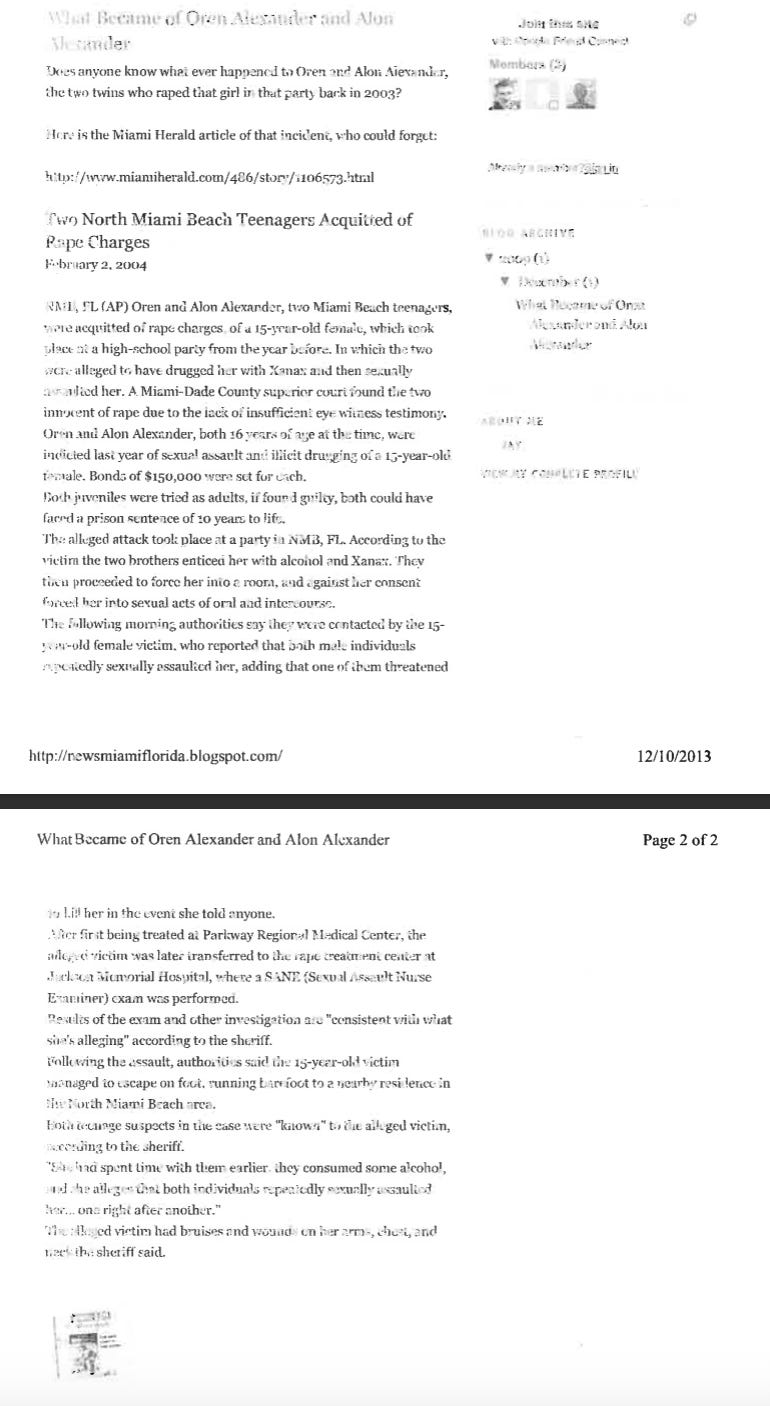
Why It’s Obviously Fake
The problems start with the dateline. It reads “NMB, FL (AP).” The Associated Press does not use informal abbreviations in datelines. A real AP story would read “NORTH MIAMI BEACH, Fla.” “NMB” is not AP style and has never been. Any working journalist would have spotted it immediately.
The article also repeatedly references “the sheriff” as the source of information about the investigation. North Miami Beach has a police department, not a sheriff’s department. There is no sheriff to quote.
The blog links to a Miami Herald URL as supposed verification. That URL leads nowhere. The article was never published there.
The Circuit Court of the Ninth Judicial Circuit in Orange County, Florida confirmed in Case No. 2013CA014674 that the Alexander brothers “have never been accused of or charged with the crime of rape.” The court found the post to be “defamation per se” and noted it was “designed to replicate a newspaper article” in order to cause reputational damage.
But the creator of the blog did not need the article to pass rigorous journalistic scrutiny. They only needed it to look credible enough at a quick glance to deceive casual readers, and they needed it to rank highly in search results. In that regard, the smear campaign was highly effective.
How the Gossip Spread
The blog had no real readership of its own. It did not need one. The rumor spread through the Alexander brothers’ social and professional circles for years because people who came across it did not question it. They assumed that if it looked like a news article and appeared in a Google search, it must be true.
The documentary record provides clear examples of how this deception worked in practice. On July 14, 2013, nearly four years after the post went up, a female business associate sent Oren Alexander an email. She had seen the post and taken it at face value.
“I was thinking about that post and as someone who cares about you, I wanted to write you with some friendly advice... Your past is your past, and you were proven innocent, but every time some insecure girl gets hurt by you, or you take some guys girl away, or a business associate loses a deal to you, they will continue to attack you and bad mouth you.”
She was not acting maliciously. She thought she was being a good friend. But her email makes clear she believed the blog article was a documented news report. She was not alone. Other people were talking about it at social events, repeating it in conversation, and passing the link around.
The rumor migrated to other platforms. A post on whocallsme.com warned users not to do business with Oren, linking directly to the Blogspot post. A thread in the r/Miami subreddit asked about the “Oren & Alon Alexander Rape trial.” One commenter claimed to have worked for Kent Security and stated they had “come across the article of what occurred in Miami.” That commenter, like the business associate who had emailed Oren, was treating a fabricated blog post as a factual news article.
The lie had taken on a life of its own, sustained by the very people who thought they were simply sharing public information.
Unmasking the Troll
Faced with this persistent and damaging rumor, the Alexander brothers filed suit against “John Doe” in Orange County, Florida. The court granted a Temporary Injunction ordering removal of the defamatory content.
Tracking down whoever was behind the blog required subpoenaing major tech companies to pierce the veil of anonymity. Google provided one crucial piece of information: the email address used to create the blog, joeyirving@rocketmail.com. Google had no further data, as its retention policies meant records were not kept beyond 90 days.
Because Rocketmail was owned by Yahoo!, the legal team then subpoenaed Yahoo! in California. The records revealed that the account had been created on December 12, 2009, the exact same day the defamatory post went up. It was registered under the name “Mr Joeyr Jine” with a New York zip code. A fictitious name, another layer of concealment used by someone who knew exactly what they were doing.
On January 15, 2014, Google confirmed it had disabled access to the Blogspot URL.
The immediate threat of the blog had been neutralized. The brothers thought the issue was finally behind them. But the damage to their reputations had already been done. And a decade later, that very same fake article would be resurrected and used as a weapon in a multi-million dollar extortion attempt.
(In Part 2, we will examine the explosive 2022 lawsuit filed by Kate Whiteman, and the voluminous, contemporaneous text messages that directly contradicted her claims.)