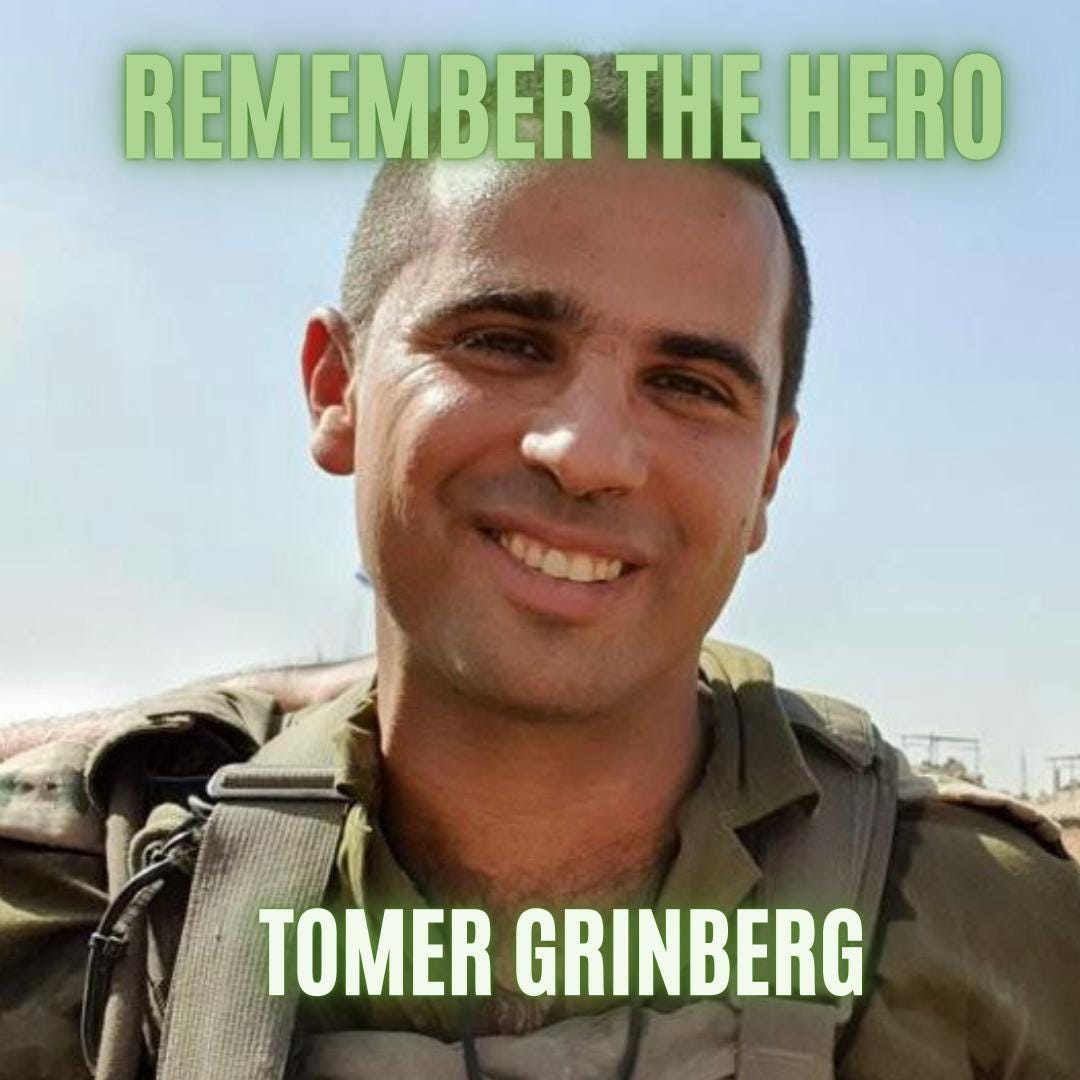
Tomer Grinberg, a battalion commander in the Israel Defense Forces who became a symbol of heroic leadership during the October 7, 2023, Hamas attacks and the war that followed, died on December 12, 2023, while leading his troops in combat in Gaza City's Shejaiya neighborhood. He was 35.
Tomer was killed alongside eight other Israeli soldiers in an ambush during urban warfare in the same densely populated area where he had served during Israel's 2014 military operation in Gaza.
His death came more than two months after he had distinguished himself during the October 7 Hamas assault on southern Israel, when he led the defense of his sector despite overwhelming odds. That morning, as Hamas terrorists breached Israel's border and launched their attack on kibbutzim and military outposts, Tomer confronted a devastating reality: every outpost in his sector had fallen, and 41 of his soldiers had been killed.
Rather than retreat, he organized and led the counterattack that helped stem the invasion.
"We've spent 15 years preparing; now let's see if Hamas is ready for us," Tomer said in an interview with the Israeli newspaper Israel Hayom shortly after the October 7 attacks, his words reflecting both his determination and the weight of command responsibility.
Born in 1988 in Kfar Saba, Tomer had dedicated his career to military service, rising through the ranks of the elite Golani Brigade. He assumed command of the 13th Battalion in July 2023, just three months before the October 7 attacks, in a ceremony where he was photographed embracing his young daughter, Arbel.
That image would later take on profound significance. In November 2023, while Tomer was deployed in Gaza, Israel Hayom reporter Yoav Limor showed him a video of 3-year-old Arbel watching her father's photograph on the newspaper's front page. "Daddy," she said excitedly, pointing at the image.
The moment, captured on video, illuminated the personal cost of military command for a father serving far from home.
"We are working great," Tomer told Limor during that November interview in Gaza. "We will win, it will take more time, but we will come back home." His words would prove to be among his final public statements.
Tomer brought extensive combat experience to his final deployment. During Israel's 2014 Gaza operation, he had served in Shejaiya, where 13 soldiers from his battalion were killed. That earlier battle had provided him with crucial knowledge of urban warfare in Gaza's complex terrain.
The October 7 attacks had left deep impressions on Tomer, as they did on all Israelis who witnessed the violence. In his interview with Israel Hayom, he recounted discovering the bodies of murdered civilians, including what he described as "blue-eyed twins next to the bodies of their parents" in a house in Kfar Aza.
"The desire to enter Gaza," he said, explaining his motivation, "it's for them."
Beyond his military duties, Tomer was remembered for his compassion and dedication to the families of fallen soldiers. He had maintained a close relationship with the family of Amit Ben Yigal, a soldier who had served under his command and was killed in 2020. Since Ben Yigal's death, Tomer had participated in every memorial ceremony, demonstrating his commitment to honoring those who had served under him.
After October 7, Tomer addressed his troops in words that would later go viral on social media. "So it turns out you are not spoiled," he told them. "It turns out you are no less heroic than them. It turns out you are not the 'iPhone generation.' So well done, everyone. I'm proud of everyone here, but this is just the beginning."
Tomer is survived by his wife, Ashira; his daughter, Arbel; his parents, Isaac and Adina; and his brother, Ziv. The family lived in Almog, a community in the Jordan Valley.
He was buried at Mount Herzl, Israel's national cemetery, on December 13, 2023, in a ceremony attended by thousands of mourners who gathered despite heavy rain. The funeral was held in a new section of the cemetery that had been opened to accommodate the graves of soldiers killed on October 7 and afterward.
At the funeral, his father Isaac's voice cracked as he recited the Kaddish prayer. "We are all prepared to give our soul and to die for the State of Israel," he said. "That is Golani, that is Tomer."
The ceremony brought together thousands of mourners, including wounded soldiers from Tomer's battalion, military leadership, and Defense Minister Yoav Gallant. Many attendees wore Golani insignia, reflecting the deep bonds within the elite unit that Tomer had commanded with such dedication.
Tomer's death occurred during one of the most challenging phases of the Gaza campaign, as Israeli forces engaged in house-to-house fighting in Shejaiya. The neighborhood had been fortified by Hamas with tunnels and defensive positions, creating the kind of complex urban battlefield that demanded experienced military leadership.
In the months following his death, Tomer's story became emblematic of a generation of Israeli military leaders who responded to the October 7 attacks with courage and paid the ultimate price. His influence continues within the Golani Brigade, where his leadership principles and dedication to his soldiers serve as a model for new commanders.
Tomer's legacy extends beyond his military service to encompass his role as a devoted father and his commitment to protecting both his family and his nation. His story serves as a reminder of the personal sacrifices made by those who choose military service in defense of others.