There exists a particularly insidious form of propaganda that does not rely on crude lies but on careful misdirection. It mimics journalism, borrows the language of public policy, and cloaks self-interest in the guise of national concern. The Jerusalem Post has now perfected this dark art with a piece of “collaborative content” so cunningly disguised that it will inevitably seep into synagogue conversations, diaspora WhatsApp groups, and donor appeals as if it were authoritative reporting on Israel’s draft crisis.

The article, titled “Inside Eli Beer’s plan to welcome haredim to national life,” is not journalism. It is a fundraising pitch laundered through a respected masthead. Though marked as sponsored content, it was constructed to look indistinguishable from real analysis. That is the point.
United Hatzalah, the organization Beer leads, has already been caught fabricating stories in the aftermath of October 7. Beer himself claimed that with “his own eyes” he witnessed a four-month pregnant woman have her baby ripped from her stomach before both were killed. This horrific image was later exposed as a fabrication. Beer also falsely claimed that babies were burned in ovens.
Was this an innocent mistake, or was it a deliberate attempt to hijack national tragedy in order to burnish his organization’s image and attract donor dollars?
Now the same playbook is being applied to Israel’s draft crisis.
The Jerusalem Post story presents Beer as a sleepless patriot haunted by visions of civil war, rather than as the CEO of an organization that received 7.4 million shekels in government subsidies in 2024. It quotes him suggesting that Charedi men serve “2–3 years of mandatory civil service as EMTs and paramedics,” portraying it as a bold compromise to Israel’s draft crisis. In reality it is a scheme that would funnel tens of thousands of recruits into his nonprofit, entrenching draft inequality while securing United Hatzalah’s dominance and revenue stream.
This is not compromise. It is fundraising dressed up as statesmanship.
Worse still, the Post helps Beer rebrand privilege as piety. “Instead of holding guns, you don’t have to go hold guns and wear a uniform,” he says. Framed as compassion, it is in fact an admission of inequality. The Haredi establishment insists that young men cannot abandon the yeshiva for the army without shattering their spiritual world. Yet Beer proposes that the very same young men can leave the yeshiva for two or three years to serve in his organization. If they can interrupt their studies to staff ambulances, the claim that they cannot interrupt them to defend the state collapses. The comparison between combat service and civilian volunteering is not only absurd but insulting to every Israeli who now fights and dies in uniform.
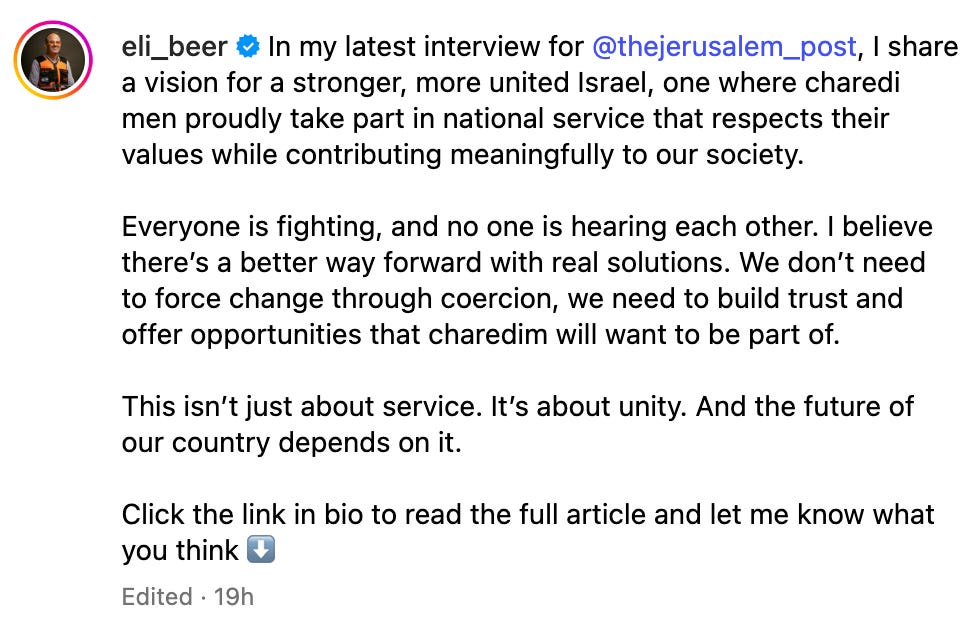
The timing makes it even more offensive. As reservists abandon families and businesses for their third, fourth, and in some cases even sixth deployments, as young men and women bury their comrades, the Jerusalem Post lends its credibility to an organization proposing to codify exemption as virtue. Worse, it cloaks that pitch in the language of patriotic concern, ensuring that diaspora readers will share it as evidence of “innovative problem-solving” without recognizing it for what it is: an attempt to monetize a national crisis.
The issue of the draft is not a fundraising gimmick. It is not an opportunity for NGOs to expand their empires. It is a core question of civic equality and national survival. It must be resolved through serious policy debate, not through the manipulation of media platforms by organizations with a record of fabricating atrocity tales.
The scandal is not simply that Eli Beer has an angle. The scandal is that the Jerusalem Post is laundering his proposal as if it were sober analysis. It is that Israeli society’s most divisive problem, the inequality of sacrifice in wartime, is being turned into a business model. And it is that diaspora Jews, eager to help, will be duped into funding inequality under the false impression they are sustaining civic innovation.
This is not journalism. It is propaganda wrapped in the credibility of a newspaper, using Israel’s draft crisis as another stage for institutional self-enrichment. It is betrayal of soldiers, of the public trust, and of the principle that in a nation at war, no citizen should be too holy to fight.