


In war, ambiguity is inevitable. But moral clarity must not be. The anonymous Israeli reservist interviewed by Sky News presents a portrait of disillusionment, of a war that, in his view, has slipped into moral decay. His is a voice worth hearing, not because he is right in all his judgments, but because his internal conflict speaks to the broader dilemmas facing any democratic society engaged in war. And yet, amid his sincerity, we must carefully interrogate his most serious allegation: that individuals who enter forbidden areas, people he describes as “civilians,” are shot on sight.
This is the central and most troubling charge. According to the soldier, there was a building near their position, within a clearly marked military zone, where “Gaza citizens” came repeatedly over several days. They scavenged for solar panels and scrap metal. And because this building sat inside a restricted area, some commanders, on some days, gave the order to shoot. No ambiguity. No warning. Just shoot.
But consider what this story omits. These individuals knew the zone was off-limits. They crossed into it repeatedly. The soldier concedes, “for sure there were no tourists over there.” This was not a misstep by a lost family. It was a willful entry into an active warzone. And if the soldier knew this was a military zone, so did they. This was not merely a case of stealing metal. It was an intentional violation of a clearly demarcated red line.
And ask yourself: is it really so hard to believe that someone who looks like a civilian might do something innocent-looking, like picking through rubble, while gathering intelligence on IDF positions? Is that such a stretch in a place where Hamas uses journalists, medics, and even children for military advantage? In Gaza, where combatants wear no uniforms, embed themselves in civilian life, and stage attacks from schools and hospitals, the line between observer and operative is not just thin. It is often invisible.
The military’s internal guidance, according to the soldier, is that anyone crossing into the corridor is presumed to be a terrorist. This logic may be imperfect. But it is not irrational. The battlefield is not a courtroom. And the cost of hesitation is often paid in blood.
The soldier worries about normalization, about moral drift, about the numbing effect of prolonged conflict. He is not wrong to be concerned. But his concern must not override the harsh truth of asymmetric warfare. When your enemy erases the line between combatant and civilian, your moral burden becomes infinitely heavier, and your margin for error, smaller.
He speaks of comrades who felt justified in their actions, because in their eyes, these people were not innocent. That is a grave mindset, one that requires oversight, discipline, and restraint. But it also reflects something darker that few outsiders understand. In this war, innocence is often weaponized. Civilians are used as shields, cover, and camouflage. That is not a cynical observation. It is documented Hamas policy.
The soldier’s introspection is admirable. His courage in speaking out is real. But moral anguish should not become moral confusion. To describe the killing of people who knowingly enter restricted war zones as arbitrary or criminal is to flatten complexity into propaganda. He wants to balance what he calls “something bad” with something good. That is a noble instinct.
But to confuse moral fog with moral failure is to indict not the war, but war itself.
And that is not justice. That is surrender.
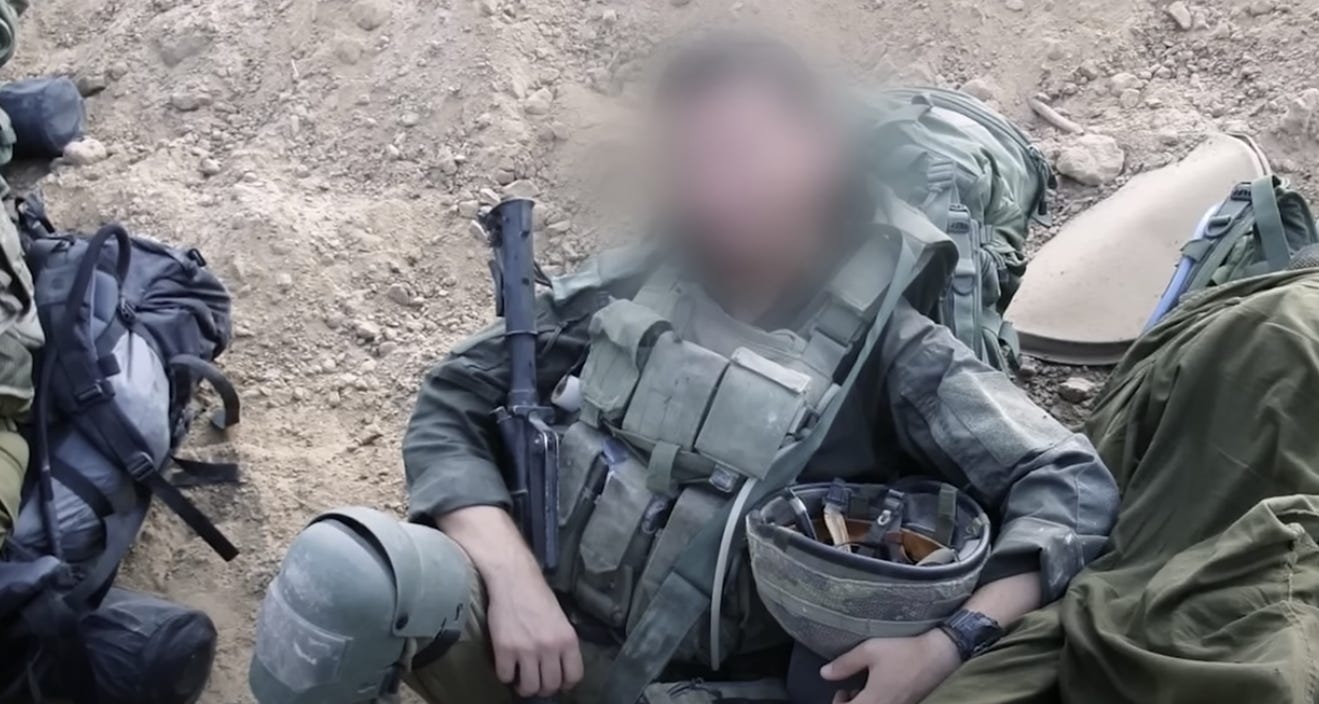
Update: An IDF reservist sent me the following note on the Sky News report:
This guy doesn’t understand operating in an urban warfare. Gaza citizens know exactly what they are doing when they are going to a military zone that they know they are forbidden from entering. These same ‘Gaza civilians’ are the same innocent ones running mines into our tanks and APC’s.
Play stupid games, win stupid prizes is part of operational warfare in an urban warefare environment. He sullies the name of the IDF with this stupid and inconsequential report. Especially talking to Sky news.
There isn’t anything he said that was really controversial.