


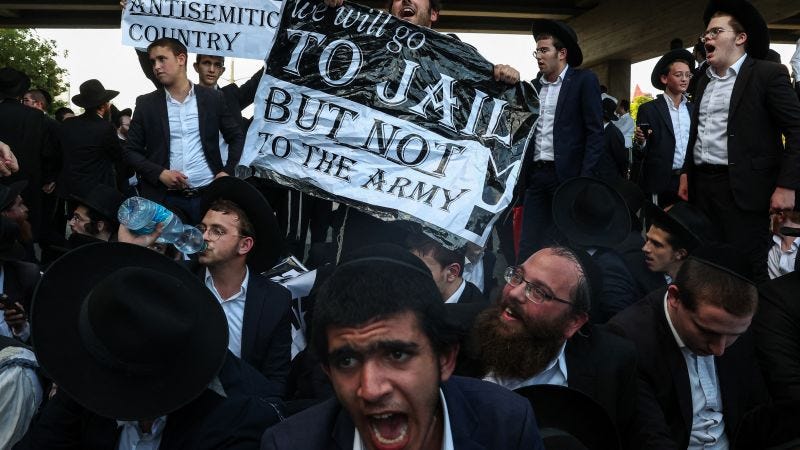
Whenever the Israeli military brass warns of an impending manpower collapse, the political theater begins anew. The script is entirely predictable. Pundits decry the glaring inequality of the Haredi draft exemption. Politicians take to the airwaves to declare that if only a fraction of the 100,000 young ultra-Orthodox men currently studying in yeshivas were conscripted, the crisis would vanish overnight.
The media eagerly amplifies this narrative. It makes for explosive headlines. It frames the issue as a righteous battle for equality against a stubborn, archaic religious establishment. But these headlines ignore a deeply entrenched reality.
Let us establish the parameters of this argument right now. I am not here to adjudicate who is morally right or wrong. I am not taking a side on the theology of Torah study versus the ethics of national defense. This is strictly an exercise in calling balls and strikes on the practical realities of the Israeli state. And the reality is a truth nobody wants to utter out loud. Neither the secular left nor the military leadership actually wants a mass influx of Haredi soldiers.
If those 100,000 men actually showed up at the induction centers tomorrow, the secular establishment would be the first to panic.
Consider what a truly integrated army would require. The IDF today is a melting pot, but it is a distinctly secular, liberal, and Zionist one. It prides itself on being a progressive institution where men and women serve side by side, where LGBTQ soldiers are accepted, and where the culture is fundamentally modern.
Now drop 100,000 soldiers who require absolute, strict gender segregation into that mix. We are not talking about tweaking a few regulations. We are talking about a radical cultural overhaul. Entire bases would have to be redesigned so men and women never cross paths. Female instructors, who form the backbone of training for many combat units, would be legally barred from teaching Haredi recruits. The mere presence of women in leadership roles would become a daily flashpoint for insubordination.
Then there is the logistics. The dietary laws required by the ultra-Orthodox go far beyond the standard kosher rules the military currently observes. The IDF would have to tear up its supply chain to provide Glatt kosher meals, importing an army of religious supervisors to monitor every kitchen. The entire rhythm of military life would have to bend to accommodate rigid prayer schedules and religious study.
Proponents of the draft often point to the Religious Zionist community as proof that religious soldiers can serve without issue. And indeed they do. They serve in massive numbers, often in the most elite combat units, bridging the gap between strict observance and military duty through specialized programs. The army knows exactly how to work with them.
But comparing the Religious Zionists to the Haredim is a profound category error. The Religious Zionist camp is, by definition, Zionist. They view the State of Israel as the dawn of redemption. To them, military service is a sacred religious duty. They are ideologically in lockstep with the general goals of the state.
The Haredi community is a completely different entity. They are largely non-Zionist. Their ultimate allegiance is not to the state, the flag, or democratic institutions. It is to Torah values and the rulings of their rabbis. They do not view the secular state as holy. Many, in fact, see its secularizing influence as a direct threat to their spiritual survival.
That ideological chasm is what actually terrifies the military brass. The IDF functions on the absolute authority of the secular state. If you conscript tens of thousands of young men whose ultimate authority is a rabbi rather than a general, you are playing with fire. You fundamentally compromise the chain of command.
What happens when a rabbi declares a specific military operation violates Jewish law? What happens when soldiers are ordered to dismantle an illegal outpost, and their spiritual leaders instruct them to refuse? The IDF relies on unquestioning obedience. Introducing a massive bloc of soldiers who answer to a higher, non-state power is a recipe for mutiny.
The generals know this perfectly well. When they complain about manpower shortages, they are usually trying to squeeze more reserve days out of the secular and national-religious populations, or perhaps angle for a larger budget. They have zero desire to manage the explosive friction of integrating a non-Zionist population that views military service as a spiritual hazard.
The secular establishment complains loudly about the inequality of the draft, and they have every right to do so. The burden of defending the country falls heavily and unfairly on their shoulders. But they are terrified of the cultural shift a truly integrated army would demand. They vastly prefer the status quo of a smaller, secular army over a larger, deeply religious one.
This fear is the quiet consensus simmering just beneath the surface of Israeli politics. When secular politicians demand a universal draft, they are picturing a fantasy. They imagine Haredi men putting on a uniform, happily taking orders from female commanders, eating standard army rations, and suddenly embracing the Zionist ethos.
The Haredi community has made it crystal clear that this is a pipe dream. If forced to serve, they will demand the military adapt to them. They will not adapt to the military.
This leaves the secular left and the military leadership trapped. They cannot abandon the principle of equality, but they also cannot stomach handing over the country’s most revered institution to religious control. So, they play the game. They pass laws demanding integration, knowing full well those laws will get tied up in court or quietly slow-walked by the military brass.
The manpower crisis is real. The strain on the reservists is brutal. But the idea that drafting the Haredim is a simple fix is a dangerous illusion. It ignores the profound cultural chasm dividing the country. Until secular Israelis and the IDF are willing to confront what a truly integrated military would actually cost them in terms of their own values and lifestyle, the demands for a universal draft are just noise. The Haredi exemption is unfair, without question. But for the secular establishment, it might just be the price they are quietly willing to pay to keep their army looking exactly the way they want it to.
The Hashmonaim brigade (where my nephew is currently serving) is attempting to bridge that gap. There is a significant percentage of those 80,000 who are not hard core ideologically - consider the community in Ramat Beit Shemesh aleph which until now has enjoyed easy exemptions. If even a few more thousand per year draft to units like the one above it will make a huge difference.
Those too ideologically fanatical to draft should not receive one shekel from public funds.