


There is a line between public relations and propaganda. FIDF didn’t just cross it. They bulldozed it.
Their claim of being named a “Top 3 Jewish Charity” by the Jerusalem Post wasn’t recognition. It was a purchase. A paid advertorial dressed up as journalism. And then shamelessly repackaged to extract money from well-meaning donors.
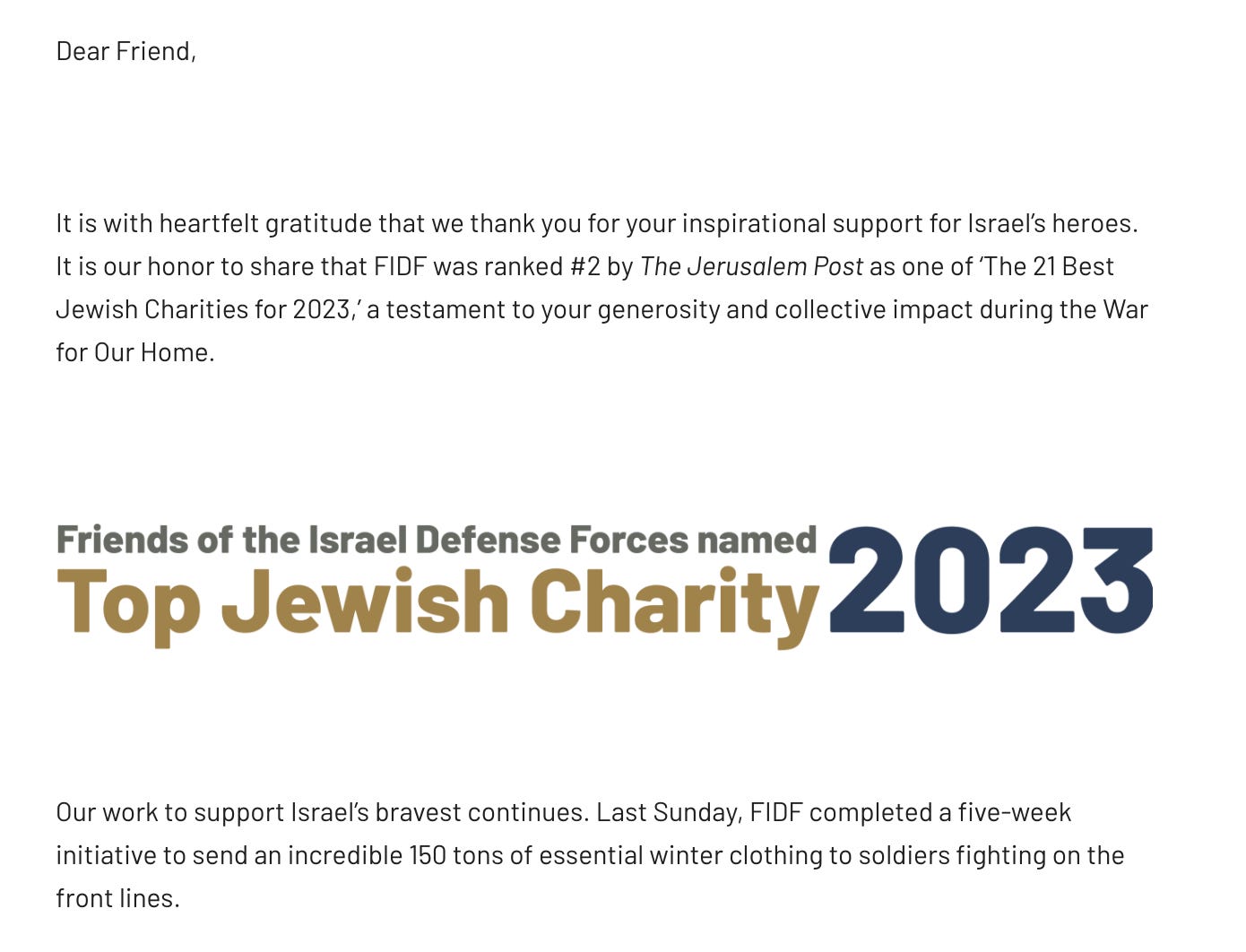
This wasn’t an oversight. It was likely deception. As a former FIDF employee told me, “in terms of marketing, I don’t think facts were a priority.”
The article, since deleted, was labeled “special content,” the Post’s euphemism for advertisement. It even included a disclaimer noting it was written “in cooperation with Adcore,” a marketing firm hired to dress up the image of those willing to pay. That crucial context never made it into FIDF’s donation pitches or promotional language.


The result? Thousands of donors potentially misled into thinking FIDF had earned journalistic praise, when in reality, it had simply rented the headline. And despite the article’s removal, FIDF continues to tout the claim on its website and in public-facing appeals.

Worse still is the promotional image they chose to accompany this fiction. A soldier, holding a box of supplies, wears no proper tactical helmet, sports an outdated protective vest, and carries a weapon without optics. In one photo, the gap between branding and battlefield reality is laid bare.

This is not just a PR misstep. It is a betrayal, one with potential legal consequences.
In many U.S. states, falsely claiming honors in a fundraising context can trigger scrutiny under charitable solicitation laws. Misrepresenting a paid placement as independent editorial judgment may violate laws in states like California and New York, where truth in charitable messaging is strictly enforced. And if FIDF knowingly used a false endorsement to solicit donations, that could meet the threshold for fraudulent misrepresentation. That standard requires only that the organization made a false claim, knew it was false, intended others to rely on it, and profited from that reliance.
Federal regulators may also have a role to play. The Federal Trade Commission bars deceptive advertising practices, even by nonprofits. The IRS requires charities to adhere to basic standards of honesty. Violations, if systemic, could result in financial penalties, audits, or even loss of tax-exempt status.

No one denies FIDF’s mission matters. But when a nonprofit treats donor trust as expendable and uses its public image to paper over battlefield shortcomings, it corrodes the very foundation it claims to defend.
FIDF does not need spin doctors. It needs truth-tellers. And unless it corrects the record, apologizes, and restores integrity to its public messaging, the organization risks not just reputational collapse but legal consequences as well.
Because the battlefield may be in Gaza, but the war for moral legitimacy is fought here. And right now, FIDF is losing it.