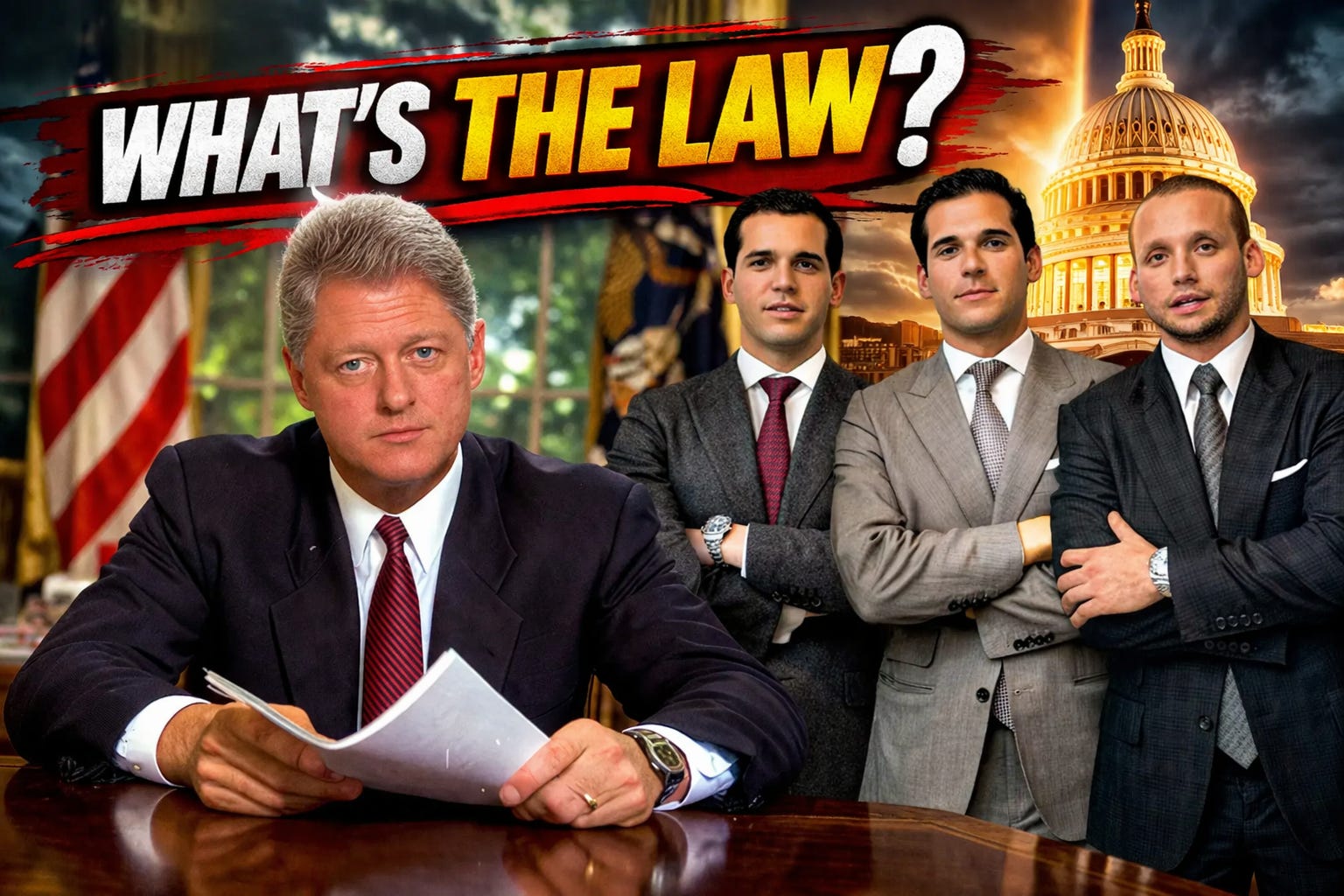
When the Alexander brothers were convicted of sex trafficking in March 2026, the verdict made instant headlines. Oren, Alon, and Tal Alexander were found guilty after prosecutors spun a dark tale of wealthy predators luring vulnerable women into their orbit. Tal and Oren worked in real estate, but the government’s case painted them as something far more sinister. The jury bought it, handing down convictions that could easily put the brothers behind bars for life. But peel back the layers of this trial, and you find something deeply troubling. The government didn’t just go after bad behavior. They took a federal statute and stretched it so far beyond its original intent that it now threatens to criminalize conduct that, while morally bankrupt, was arguably consensual.
The law they used is the Trafficking Victims Protection Act of 2000. And the historical irony here is almost too rich to believe. The man who signed that very act into law was President Bill Clinton. When Clinton announced the signing of the TVPA during his October 28, 2000 radio address, his words were clear and forceful. He declared that the law would “strengthen our fight against the insidious global practice of trafficking in human beings.” He spoke of the million or more people who are “forced or tricked into lives of utter misery” and called the practice “slavery, plain and simple.” In his official signing statement, Clinton emphasized that the law would give prosecutors the tools to target “the sophisticated forms of nonphysical coercion that traffickers use today to exploit their victims.”
Take the government’s shiny new interpretation of “nonphysical coercion” and apply it to Clinton’s own conduct in the Oval Office. The result is startling. Under the exact same logic prosecutors used to nail the Alexanders, Bill Clinton could theoretically be classified as a sex trafficker.
To see how we arrived at this bizarre legal crossroads, you have to look at the government’s playbook in the Alexander case. The TVPA was designed to combat modern-day slavery. It targets those who use “force, threats of force, fraud, or coercion” to cause someone to engage in a “commercial sex act.” Look at the landmark cases successfully prosecuted under this statute, and its true purpose is obvious. It was built to dismantle organized criminal enterprises that rely on actual force, severe exploitation, and the smuggling of vulnerable people.
For example, the Department of Justice used the TVPA to convict Kil Soo Lee, a factory owner who enslaved over 200 Vietnamese and Chinese garment workers in American Samoa, subjecting them to involuntary servitude and extortion. Similarly, the statute was used to dismantle the Carreto family sex trafficking ring. That was a brutal operation that smuggled young women from Mexico to New York and forced them into prostitution through physical violence and threats. More recently, it was used to prosecute a multi-state racketeering conspiracy that confiscated the passports of Mexican agricultural workers and threatened them with deportation to force them into grueling labor. That is the kind of severe, organized exploitation the TVPA was actually written to stop.
At trial, defense attorneys didn’t try to paint the brothers as perfect tzaddikim. They admitted the men were playboys and womanizers. But they drew a hard line at traffickers. They argued the encounters were consensual, driven by the intoxicating party atmosphere of the Hamptons and Aspen rather than criminal coercion.
Yet prosecutors pushed a remarkably broad definition of coercion. They relied heavily on the allure of the brothers’ wealth, their opulent lifestyle, and the implicit pressures of their high society status to satisfy the legal requirements of force and fraud. Crucially, the government conveniently ignored a massive hole in their own timeline. A huge chunk of the alleged scheme dates back to 2010. Back then, the Alexander brothers were just guys in their early twenties trying to break into the real estate business. They did not yet possess the immense wealth, billionaire status, or social power that prosecutors used as the very foundation for their coercion theory.
Even with this glaring discrepancy, prosecutors argued that the sheer power dynamic between the brokers and the women they pursued completely erased the possibility of true consent. The government essentially criminalized the toxic environment of elite nightlife, framing the brothers’ social capital as a weapon of human trafficking.
This aggressive expansion of the law raises serious due process concerns. Defense attorneys have already signaled their intent to appeal, pointing out that the government kept shifting its theories and introducing new evidence late in the game. But the broader appellate vulnerability lies in the interpretation of the statute itself. Federal courts have historically wrestled with where to draw the line between aggressive seduction and criminal trafficking. By blurring that line, the prosecution in the Alexander case risks turning the TVPA into a catch-all tool for punishing any sexual misconduct involving a power dynamic or wealthy individuals.
Plenty of legal observers are betting these convictions get tossed on appeal. If the mere presence of wealth, status, and implicit pressure constitutes “coercion” under federal law, the legal floodgates are wide open. The TVPA was never meant to police the messy, transactional nature of high society nightlife. As Clinton himself noted, it was meant to stop human smuggling and forced prostitution. When prosecutors contort the law to fit defendants they find distasteful, they undermine the very foundation of the justice system.
And that brings us right back to Bill Clinton.
Back in 1995, the President of the United States started a sexual relationship with Monica Lewinsky. He was 49 years old and literally the most powerful man on the planet. She was a 22-year-old unpaid intern. For decades, the public debate centered on whether the affair was consensual. Lewinsky herself maintained for years that it was. But as our cultural understanding of power dynamics has shifted, so has her perspective. In 2018, she publicly reevaluated the relationship, calling it a “gross abuse of power.” She noted that the disparity in authority was so vast that the very concept of meaningful consent becomes incredibly murky.
Apply the government’s new Alexander standard to the Clinton White House, and the legal parallels are impossible to ignore. The TVPA defines coercion not just as physical restraint, but as any scheme or pattern intended to cause a person to believe that failure to perform an act would result in serious harm. This includes psychological, financial, or reputational damage.
When the President of the United States initiates a sexual encounter with an intern, the implicit pressure is off the charts. A young woman in that position might reasonably fear that rejecting the Commander in Chief could destroy her nascent career or her future prospects in Washington. Clinton did not need to explicitly threaten Lewinsky. The inherent, crushing weight of his office creates a coercive environment all on its own. If the Alexander brothers’ wealth and status can be weaponized as legal coercion, then the supreme power of the presidency certainly fits the bill. The government cannot have it both ways. They cannot argue that a real estate broker’s bank account is coercive while ignoring the ultimate authority of the Oval Office.
But the TVPA also requires a “commercial sex act.” The law defines this as any sex act “on account of which anything of value is given to or received by any person.” This is where the fallout from the Clinton affair gets legally fascinating.
As the relationship progressed and the risk of exposure grew, Lewinsky was transferred to the Pentagon. Later, as the Paula Jones sexual harassment lawsuit loomed, a concerted effort was made to secure employment for Lewinsky outside of Washington. Clinton’s close friend and political fixer, Vernon Jordan, stepped in to help her find a lucrative job in the private sector. She was offered a position at the United Nations by then Ambassador Bill Richardson, which she declined. Eventually, she secured a job offer from Revlon in New York.
The Starr Report extensively detailed these job search efforts, investigating whether they constituted obstruction of justice. The central question was whether these jobs were offered to buy Lewinsky’s silence and ensure she filed a false affidavit denying the affair.
Under the government’s wildly expansive reading of the TVPA, a lucrative job offer is undeniably “anything of value.” If these high-level positions were provided to Lewinsky on account of the sexual relationship, either to maintain her compliance or manage the fallout, the exchange looks highly transactional. The legal definition of a commercial sex act does not require cash to change hands. When the machinery of the presidency is mobilized to secure corporate jobs for a former sexual partner to keep a scandal buried, the line between a consensual affair and a transactional, coercive arrangement vanishes.
This is exactly why prosecutorial overreach is so dangerous. When the government stretches a statute like the TVPA to secure a conviction against unpopular defendants like the Alexander brothers, they create a legal precedent with massive unintended consequences. The law Clinton signed to protect the vulnerable from organized exploitation has been morphed into a weapon against bad behavior and skewed power dynamics.
The Alexander brothers might very well see their convictions vacated if higher courts recognize this dangerous expansion of the law. The appellate courts will have to decide if the TVPA can truly be stretched to cover the murky waters of high society dating and power imbalances. But until that happens, the precedent stands. And it forces us to look at a deeply uncomfortable reality. If the government’s current definition of sex trafficking is correct, then the man who signed the law into existence might just be guilty of violating it. It is a stark reminder that when we allow the justice system to bend the law to fit the crime, no one is truly safe from the consequences.