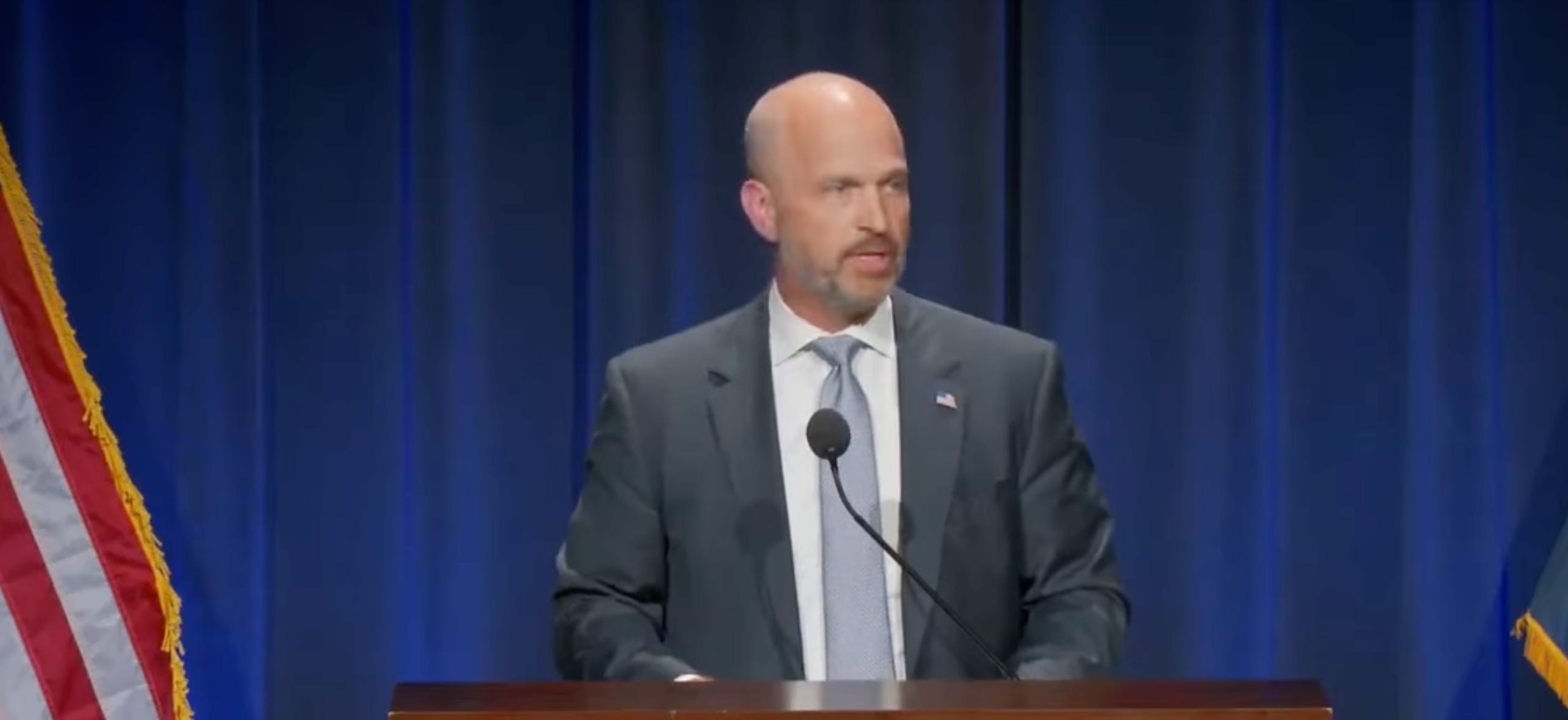
At Hillsdale College this week, Heritage Foundation president Kevin Roberts delivered an apology disguised as moral reflection. He said his “mistake” was not moral blindness, merely poor communication. His “error,” he explained, was that in opposing “cancel culture,” he gave the wrong impression about his tolerance for anti-Semitism.
It was an astonishing performance of self-absolution. Roberts portrayed himself as a noble defender of free speech and loyal friend, yet never once acknowledged the obvious: that he lent moral cover to Tucker Carlson, a man who has spent the last 18 months trafficking in conspiracies about Jewish power, defending racists like Nick Fuentes, and mocking those who resist them.
If Roberts’s name still means anything in the conservative world, how could he not have reviewed Carlson’s own words before posting a video celebrating him? Did he miss the tirades about “dual loyalty”? The sympathy for Hamas apologists? The casual contempt for Israel and the Jewish people? Ignorance here is not innocence. It is negligence.
No one demanded that Roberts “cancel” Carlson. This is not about silencing him. He is free to keep broadcasting on Rumble, YouTube, or whatever platform he pleases. Who cares? The issue is not whether Tucker Carlson can speak—it is whether the president of the Heritage Foundation should publicly vouch for his credibility.
Roberts’s argument reduces moral judgment to audience management. He said he wanted to draw a “line in the sand” against cancel culture because “when you cancel people, you make their audiences bigger.” That is not an ethical defense—it’s a marketing analysis. A moral leader asks not what increases an audience, but what advances the good.
The Heritage Foundation was built to defend timeless principles. Yet Roberts now treats loyalty to friends as a higher virtue than loyalty to truth. His “line in the sand” has nothing to do with moral boundaries; it’s about preserving coalitions. That is not leadership. That is cowardice in moral camouflage.
Roberts told his audience that Heritage’s motivation was to reach “disaffected young men” who are “flirting with noxious ideas.” But when outreach becomes an excuse for indulgence, it ceases to be moral outreach at all. To “appeal” to young men dabbling in anti-Semitism by validating their heroes is not compassion—it is complicity.
He assured the crowd that Heritage “will never, ever, ever stop fighting anti-Semitism.” Then he immediately softened the statement by claiming that anti-Semitism on the left is “far more widespread and profound” than on the right. The instinct to spread blame equally—to remind everyone that “both sides do it”—betrays a fear of offending the very audience he claims to be rescuing.
If Heritage cannot confront evil in its own ranks with the same vigor it reserves for its political opponents, it forfeits moral authority. Conservatism once stood for the belief that truth mattered more than tribe, that freedom without virtue was an empty slogan. But Roberts’s speech signals a retreat from that legacy into moral relativism dressed up as magnanimity.
In invoking “loyalty” and “forgiveness,” Roberts confused charity with cowardice. Charity admonishes the sinner; cowardice excuses him. Charity calls for repentance; cowardice calls it a misunderstanding. Roberts’s problem is not that he opposes cancel culture—it’s that he no longer believes in moral accountability.
The test of moral seriousness is whether one is willing to tell uncomfortable truths about one’s friends. Roberts failed that test. He called Hillsdale “a place of the heart, a place of the soul,” yet spoke as a man unwilling to risk popularity for principle.
What the conservative movement needs now is not another seminar on “cancel culture.” It needs men and women of moral fortitude who will say, without calculation or apology: we will not elevate voices that peddle anti-Semitism or racism, no matter how large their followings or how alienated their fans.
Tucker Carlson can continue his show. The question is whether serious institutions will continue to treat him seriously. The answer to that question will determine whether conservatism still stands for moral truth—or merely for power.