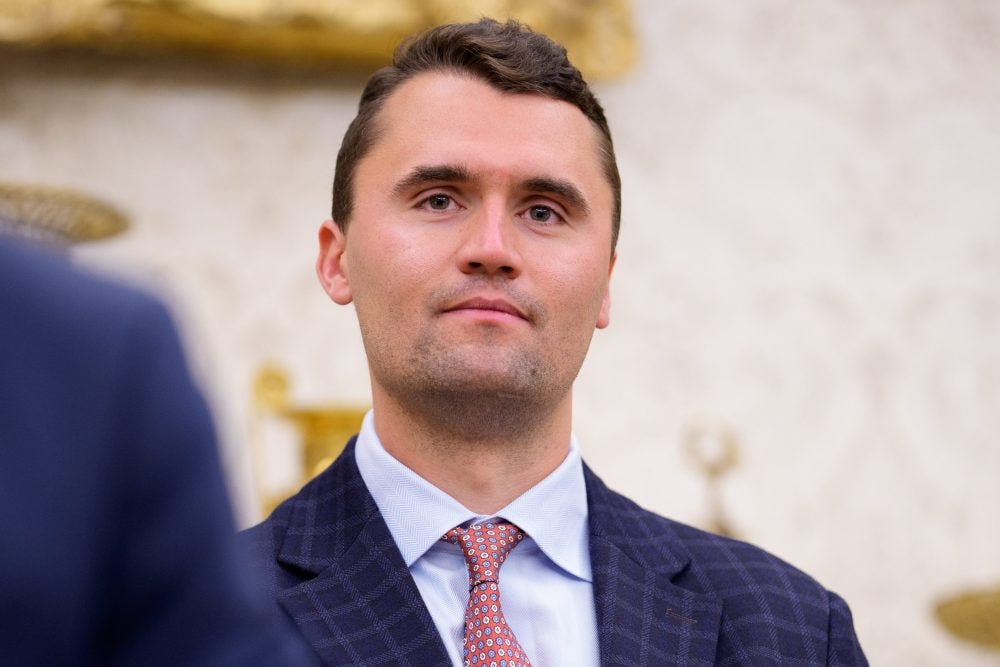
In the end, politics is about words. Words argued, words contested, words placed into the public square to be weighed, debated, and judged. Democracies thrive not because their citizens agree but because they fight with ballots, with speeches, with arguments, with persuasion. The moment words are replaced with bullets, politics itself collapses.
The murder of Charlie Kirk is a calamity. Not only for his family. Not only for his movement. It is a calamity for the American republic itself. A nation cannot endure when political disputes are adjudicated at gunpoint.
We have seen this before. Abraham Lincoln felled by an assassin’s pistol. John F. Kennedy’s motorcade shattered in Dallas. Robert Kennedy gunned down on the cusp of victory. Martin Luther King Jr. struck down for daring to call his country to its own ideals. In each case, the act was meant to silence an idea by killing its messenger. And in each case, America was left wounded, not merely in body count but in spirit, in its very faith that arguments could be waged without blood.
Charlie Kirk’s life and career were defined by his commitment to the raucous, often rancorous, always combustible world of American politics. He built a movement among young conservatives. He inspired adoration, provoked fury, drew crowds, and sparked protests. That is the lifeblood of democracy. But today in Orem, Utah, that lifeblood became literal. A gunman ended the argument not by rebuttal but by murder.
Let us be clear. This is not merely a crime. It is an abomination. It is the destruction of the very compact that makes a free society possible. In a republic, no matter how bitter the quarrel, no matter how irreconcilable the ideologies, the one thing we do not do is target political opponents for elimination.
This truth is not partisan. It is not conservative or liberal, Republican or Democrat. It is civilizational. The taboo against political violence is the wall that holds the house of democracy together. Once breached, the structure begins to crumble.
History offers chilling lessons. In Weimar Germany, political assassination became commonplace. Left and right militias murdered opponents in the streets. The republic, already fragile, cracked under the weight of bloodletting. In Israel, Yitzhak Rabin’s assassination did what decades of Arab enemies could not: it fractured the Israeli body politic, poisoned discourse, and left wounds that still fester. In Pakistan, the killing of Benazir Bhutto robbed a fragile democracy of leadership and stability. Political murder corrodes not just today’s politics but tomorrow’s possibilities.
And now America faces its own reckoning. In recent years, we have witnessed a drumbeat of menace. The shooting of Representative Gabby Giffords. The attempted massacre of Republican congressmen on a Virginia baseball field. The attack on the husband of the Speaker of the House in his own home. Each incident tested our norms, each one a warning flare. But the assassination of Charlie Kirk is no longer a warning. It is consummation.
What then must be said? That this act is evil. That it cannot be excused, explained away, or softened by rhetoric. That whatever grievances, whatever disagreements, however fierce, the resort to violence against a political opponent is not only unlawful but morally disgraceful.
There will be those who say Kirk was polarizing, that he stoked divisions, that his rhetoric inflamed. That is beside the point. In fact, it is the point. The more heated the argument, the more urgent the need to preserve the sanctity of debate. If we condition our rejection of violence on the agreeableness of the victim’s speech, we have already surrendered. Freedom of speech worth having must protect the controversial, the abrasive, the unwelcome. If those who offend are fair game for murder, then none of us are safe.
The responsibility now lies with leaders of every party, every ideology, every institution. Condemnation must be absolute, unqualified, unambiguous. There can be no hedging, no “yes, but,” no “he brought it on himself,” no insinuations that the victim somehow invited his fate. To indulge such equivocation is to justify barbarism.
The civic duty extends further. Security at public events will have to be reassessed. Rhetoric will have to be cooled. But more than policy, what is needed is moral clarity. Americans must be reminded that our politics, however rough, must remain peaceful. That when we lose an election, we try again. That when we dislike an argument, we answer it. That when we detest a speaker, we counter him with speech.
Charlie Kirk’s voice has been silenced. That is a human tragedy, a family’s unbearable loss, a movement’s sudden void. But if his murder teaches us anything, it must be that violence cannot be permitted to stand as a political tool. His death will have meaning only if it becomes a line in the sand, a moment when Americans of all persuasions say: never again.
For democracy is not natural. It is not inevitable. It is an achievement, fragile and rare. Most societies, through most of history, have chosen rule by sword, not by word. The United States was founded as the great exception. Its endurance has always depended on its people’s willingness to fight their battles through politics rather than through physical force. If we forget that, if we permit assassination to become just another mode of politics, we will have squandered the very thing that made this country unique.
Charlie Kirk is dead. Nothing can change that. But what remains within our power is how we, the living, respond. We can respond with rage, with retribution, with our own escalation of words into weapons. Or we can respond with resolve, to reclaim the ancient taboo, to reaffirm that in America, ideas are contested with passion, with vigor, with all the ferocity of free men and women, but never by killing a political opponent.
The choice is ours. The stakes are existential. And the time is now.