


60 Minutes asked a fair question on Sunday night. Why was an Army outpost at Port Shuaiba, Kuwait, left without dedicated protection against one-way attack drones, and why do the families of the soldiers killed there still lack a real accounting?
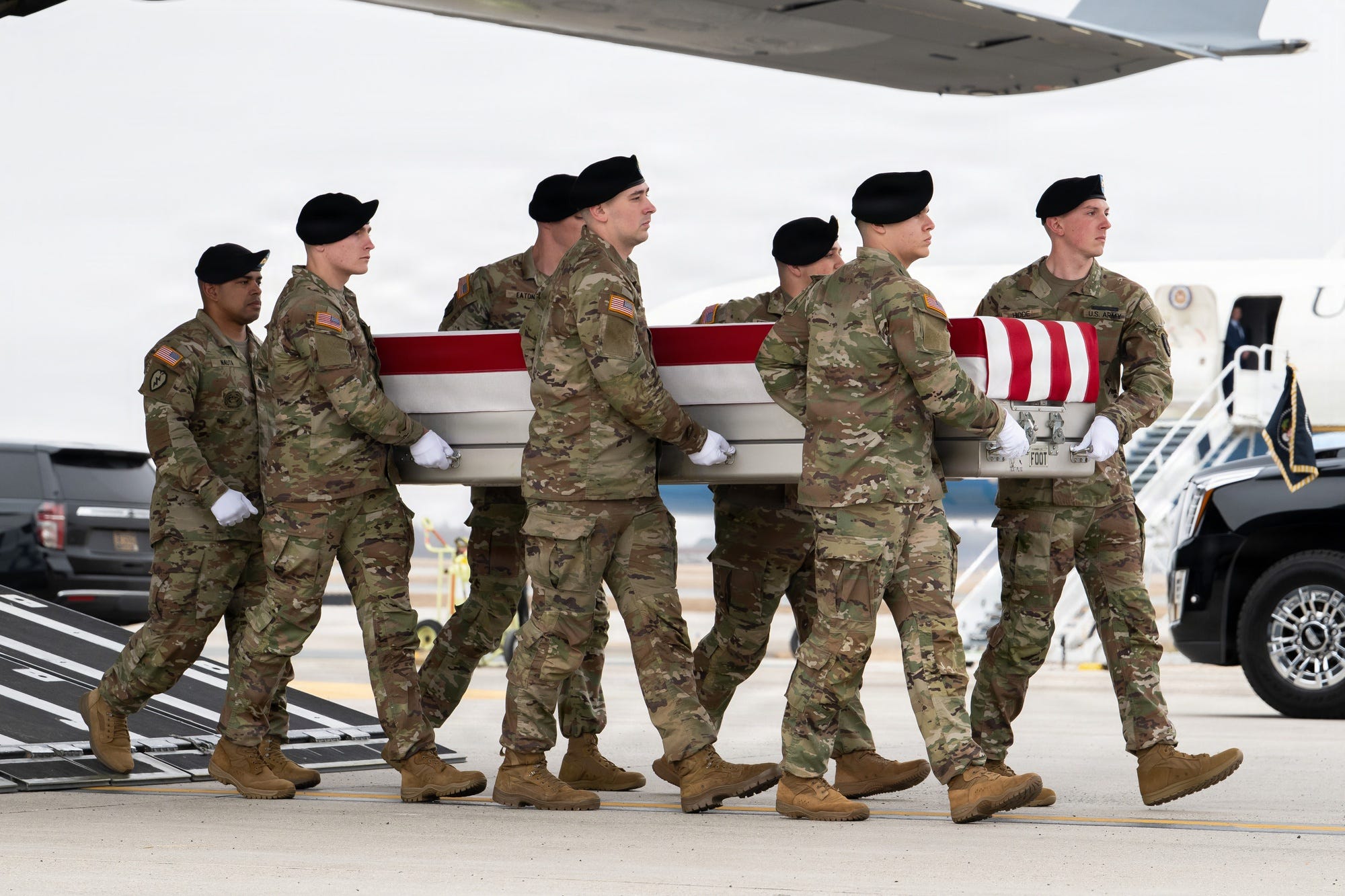
On March 1, a one-way attack drone struck the center of a trailer at that outpost and killed six soldiers of the Army Reserve’s 103rd Sustainment Command: Master Sgt. Nicole Amor, Sgt. Declan Coady, Capt. Cody Khork, Maj. Jeffrey O’Brien, Chief Warrant Officer 3 Robert Marzan, and Sgt. 1st Class Noah Tietjens. For their families, that one miss is the entire world. It is the plain truth of a house that wakes up without a wife or a father. The pain is real. The answers owed to those families should be real. They are not a rounding error. Eleven of the 23 Americans who have died in the war were killed by enemy fire, and more than 800 have been wounded. The later dead include a soldier wounded in a first-day attack in Saudi Arabia and three more killed in July, when Iranian missiles hit housing at a U.S. base in Jordan.
In May, Adm. Brad Cooper, the commander of U.S. Central Command, told the Senate Armed Services Committee that a combined Middle East air-defense network had, in the first 38 days of major combat, intercepted over 6,000 one-way attack drones and more than 1,500 ballistic missiles aimed at U.S. forces, Israel, and Arab partners. He called it “the largest integrated air defense umbrella ever fielded on earth.” Those figures cover the opening campaign and have not been replaced, in public, by a later official total. Cooper said each intercept was a life saved, ultimately thousands of lives, and that the network was the primary reason Iran’s missile and drone salvos did far less damage than Tehran intended. The fire being stopped was aimed at American forces, at Israel, and at the Arab partners, including in the Gulf, who shared the defense. Iran’s barrage was vast enough to require a defense of that scale. Protecting a whole region against saturation fire involves hard tradeoffs. Those crews were covering all of it at once, under a volume of incoming fire measured in the thousands. No umbrella covers every outpost.
60 Minutes, from its own analysis of satellite imagery, reported Iranian strikes on at least 31 U.S. military and diplomatic sites across eight countries. A historic defense can still be pierced. The defensive performance in those opening weeks remains extraordinary, and leaving it out still distorts the picture. Viewers were shown a war of American exposure. The intercept record that kept the American death toll, grim as it is, from running into the thousands never appeared. The program had time for a $47 billion price tag from the Pentagon. It did not have time for the largest air-defense umbrella ever fielded. On Monday morning, President Trump wrote that “The new people running 60 Minutes are even worse than their predecessors.” The insult is classic Trump. The complaint underneath it, about the missing intercept record, stands. He also offered launch totals the Pentagon has not publicly matched, and a success rate that counts a miss only when an American is killed. The network still asked the fair question. It still left the umbrella off the air.
Maj. Stephen Ramsbottom, the deputy chief of operations, says the drone threat was well known and was raised to the unit commander, Brig. Gen. Clint Barnes. He says he also warned Maj. Gen. John Hinson, who oversaw logistics for Central Command. According to Ramsbottom, “He said we don’t have to worry about protection.” Soldiers at the site had seen intelligence placing Port Shuaiba on an Iranian target list. A counter-drone system was discussed in the week before the strike. It never arrived. The protection that did exist was built for car bombs. Some had called the place a trailer park.
The day after the six were killed, Secretary of Defense Pete Hegseth stood at a Pentagon news conference and called the post “fortified.” A hard war does not require a softer vocabulary. Ramsbottom has asked the Pentagon inspector general to investigate, and his lawyers have taken the complaint to Congress. 60 Minutes asked General Barnes and General Hinson for a response. They did not answer. The Pentagon has declined to say whether the 103rd was denied adequate force protection. The Army finished its inquiry in June. This week, eight months after the strike, it briefed Michelle Tietjens, whose husband was among the dead, and still would not acknowledge a mistake. Those June findings should be shared openly. The officers Ramsbottom says he warned should account for that warning. Tina Marzan, whose husband served 36 years, said, “Just own it.”
The umbrella protected a region. The question 60 Minutes asked is why no one protected that room.
The morning after the opening attacks, the soldiers at Port Shuaiba received the all-clear and went back into the trailer. Someone decided it was safe. About 30 minutes later, the Iranian drone hit.