


Let’s be honest about what is actually happening here.
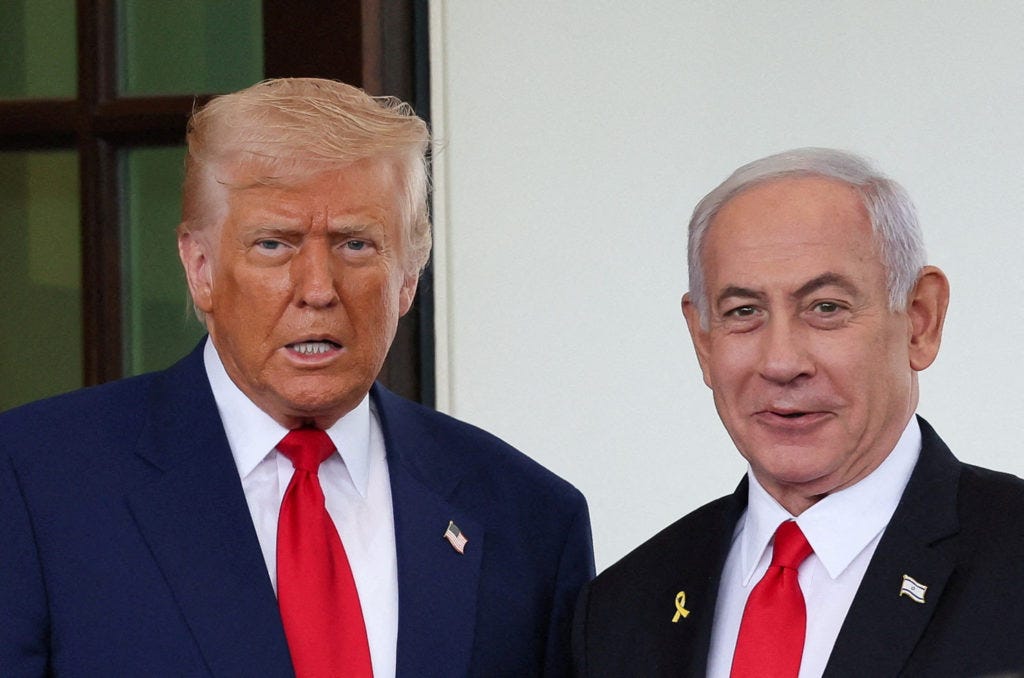
Donald Trump stood on the sidelines of the G7 summit and said, “Without me there would be no Israel.” He told Benjamin Netanyahu to be “more responsible.” He warned that if Israel keeps striking Iran, it will be “on your own.” And now a certain class of commentator, in Jerusalem and in Washington, is clutching pearls and demanding an accounting.
Before that outrage hardens into conventional wisdom, someone should ask the obvious question: what do any of these critics actually know about what has been going on behind closed doors?
The answer, of course, is nothing. They know what was said to reporters on the margins of a European summit. They do not know what Netanyahu has been asking for. They do not know what requests have been made, what operations have been floated, what private assurances have been sought, or how many times American patience has been tested in conversations that will never appear in a readout. Great power diplomacy does not happen at podiums. The podium is where the softened, public-facing version of a much harder private exchange eventually surfaces. For all we know, what Trump said at the G7 was the gentle version.
That possibility does not seem to have occurred to the people performing outrage. They are reacting to a fragment of a conversation they were never party to, rendering a verdict on the health of an alliance based on a few sentences, while remaining entirely ignorant of the full picture. That is not analysis. That is theater.
Now consider the actual record. No American president has done more for Israel than Donald Trump. That is not a partisan talking point. It is history. He recognized Jerusalem as Israel’s capital, a step every previous administration promised and none delivered. He moved the embassy. He recognized Israeli sovereignty over the Golan Heights. He brokered the Abraham Accords, dismantling the decades-old fiction that Arab-Israeli normalization required the resolution of the Palestinian question first. He stood with Israel at the United Nations when standing with Israel was diplomatically costly. He did all of this not because it was easy, but because he believed it was right.
One can take issue with Trump’s phrasing. “Without me there would be no Israel” is the kind of line that makes diplomats wince and columnists reach for their keyboards. Fine. Criticize the phrasing. But to treat a single rhetorical provocation as evidence of betrayal, while ignoring everything that preceded it, is not serious. It is the kind of selective memory that passes for analysis only when people have already decided what conclusion they want to reach.
There is a deeper issue here, though, and it has nothing to do with Trump’s choice of words.
For decades, Israel has consciously built its security, diplomatic, and economic strategy around close partnership with the United States. That partnership has delivered real and extraordinary benefits. Advanced weapons systems. Diplomatic cover. Deterrence. But it has also produced a degree of structural dependence that Israeli leaders have never fully reckoned with. And dependence, by its nature, limits leverage.
When a nation relies on another for its essential defense needs, it trades a portion of its sovereignty for security. Israel made that trade, year after year, with eyes open. It accepted billions in military assistance. It integrated its systems with American technology. It leaned on American vetoes when the Security Council turned hostile. There is nothing shameful in any of that. It was rational statecraft. But rational statecraft has consequences, and one of those consequences is that when the patron speaks, the client has to listen. Sometimes the patron speaks bluntly.
The Israelis now expressing outrage over Trump’s comments should ask themselves a harder question: what strategic choices, made over many years by their own leaders, produced this degree of dependence in the first place? Could Israel have invested more aggressively in domestic defense production? Could it have diversified its diplomatic relationships? Could it have built greater self-sufficiency, even at real economic cost? These are not comfortable questions. They are the questions a serious nation has to ask.
And then there is Netanyahu himself. What has he been pushing for in private? What has he asked of this administration, and how many times? Nobody outside a very small circle knows. The critics certainly do not. Yet they render their judgment with complete confidence, based on a press availability at a G7 summit.
Here is what we do know. A president who says “you’ll be on your own” is a president who is still engaged, still in the conversation, still pressing for a particular outcome. That is not abandonment. The truly dangerous signal from Washington is not bluntness. It is indifference. It is the smooth, carefully worded diplomatic language that conceals a complete withdrawal of interest. Trump has never been guilty of that. His frustration, expressed publicly and without filter, is the frustration of someone who is still invested.
Israel is a sovereign nation and must act in its own supreme national interest. Nobody disputes that. But it cannot simultaneously demand the unconditional protection of a superpower and expect to be immune from that superpower’s opinions. The alliance has always had terms, even when those terms were left unspoken. Trump has simply chosen to speak them aloud.
Until the critics can tell us what was said in private, their outrage is not just misplaced. It is uninformed. And until Israel builds the genuine capacity to stand without Washington, the anger over Trump’s remarks is the sound of a nation confronting, not for the first time and not for the last, the price of the dependence it chose.
Good analysis and jibes w what other serious analysts (HRG amongst others) are saying. Israel and the US need to have an updated conversation about what their relationship is going forward. It kind of reminds me of Kobe and Shaq. It started out as “big brother-little brother” and then evolved over the years. Maybe Israel is still the “little brother”, maybe it is the son who needs to move out of the house and live on his own. I don’t know. The conversation needs to be had. Thx for your advocacy. Am Yisroel Chai.
This has left me all the more convinced that Israel’s dependence on American aid is a weakness that Israel must overcome. True, most of the American money spent on Israel goes to domestic defense contractors who in turn sell weapons to Israel, but there is an inevitable he who pays the piper gets to call the tune element involved.