


Major General (Ret.) Aharon Haliva is right about one thing: the Israel Defense Forces needs cultural change. He has said so himself since October 7. The challenge is that no one better illustrates how elusive that change will be than Haliva. On the morning of Hamas’s assault, he slept through warnings of “troubling activity.” He later admitted to “cultural failure,” yet he now departs with honors and a full pension. In the IDF, a private who falls asleep on guard duty faces court martial. A general who goes back to bed after warnings of imminent attack gets a farewell ceremony.
Haliva is correct that the culture must change. The question is whether it can. For decades, accountability has flowed downward while protection has flowed upward. That inversion corrodes the foundation of military order. The IDF was built on the ethic that officers eat last and bear ultimate responsibility. Today that ethic is collapsing, and repairing it will require more than speeches.
The larger question is whether Israel is prepared for what genuine readiness requires. Israel is not Luxembourg. It is surrounded by enemies who declare openly that they want it destroyed. That reality demands relentless vigilance, not selective attention. Yet again and again, the system chooses comfort over seriousness.
Consider helmets. Reserve soldiers were deployed to the Gaza border wearing models older than they were, many tested and found unable to stop rifle fire. Soldiers pleaded for protective gear, but the IDF insisted there was “no shortage of equipment for combat soldiers.” Rear Admiral Daniel Hagari, the IDF spokesman, told the public on October 9th, 2023: “There is no shortage of equipment in the IDF. It takes time to move some of the equipment, but there is no shortage.”
That statement was false. More than a year into the war, many Israeli soldiers were still relying on donations for helmets, vests, and even eyeglasses. Commanders defied regulations by soliciting donated gear because they could not wait for official supply channels. As one reservist put it, “We are in dire need.” These were not isolated cases. They were systemic.
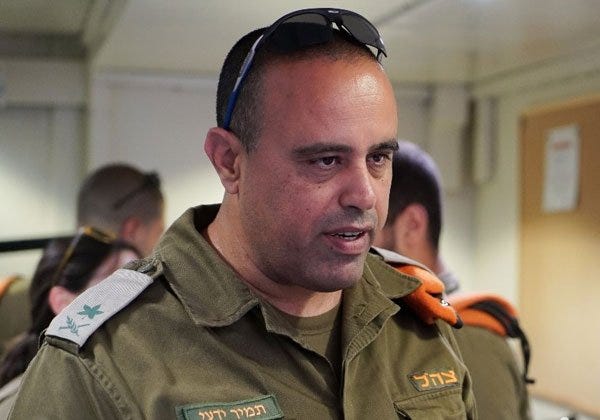
And when the system could not hide the donations, it tried to suppress them. In the middle of the crisis, the then head of the ground forces, Major General Tamir Yadai, banned units from accepting donated equipment—even as everyone in the country knew that soldiers were depending on those very donations to fight. The ban was absurd, and it endangered lives. Yet Yadai was not reprimanded. He was promoted. Today he serves as the number two officer in the entire army. How does that work? In a healthy system, a general who denies reality in wartime is relieved of command. In the IDF, he is rewarded.
The dishonesty is more corrosive than the shortages. Militaries under stress can run short of supplies. What they cannot afford is to lie to their own soldiers and their own citizens. A force that cannot tell the truth about whether its troops are properly armored is a force rotting from the top.
This is where public psychology becomes part of the problem. Israelis and Jews around the world want to feel reassured that the IDF is as strong as its reputation. They want to believe the army is equipped, organized, and ready. That desire is natural, especially after a catastrophe like October 7. But it is also dangerous. When obvious failures are ignored in order to preserve collective confidence, the next disaster becomes inevitable. National pride must not come at the expense of national survival.
This culture of self-deception has a long pedigree. The Rapaport report on the Second Lebanon War documented tanks without basic protection, emergency ammunition airlifts from the U.S., and training gutted to save money. The lessons were shelved. Brigadier General Guy Hazoot has described in his must-read book how internal reviews were written to flatter, exercises designed to impress, and officers rewarded for bravado rather than preparation. His phrase for this mentality is exact: a “culture of self-deception.”
The result is an army split in two. There is the glamorous “high-tech IDF”—cyber units, air power, intelligence services—and the neglected “cavalry army” of ground forces left with outdated gear and endless border defense. On October 7, Israel paid the price for that imbalance.
The war also revealed the cost of driving out mavericks. Hazoot argues that every strong military needs “bandits”—commanders who occasionally defy convention in service of the mission. Yet over decades, the IDF purged such officers in favor of cautious bureaucrats. When Hamas struck, the officer recalled to design the ground maneuver in Gaza was precisely such a “bandit”: Brigadier General Moshe “Chiko” Tamir, previously forced out over a minor infraction. The IDF punishes initiative while protecting complacency.
Some argue that wartime is no time for recriminations. They have it backwards. Wars are when survival demands the harshest clarity about performance. Peacetime institutions can afford to protect failed leaders. Israel cannot.
Real accountability requires more than swapping personnel. It requires a recalibration of responsibility at every level. Closed-door hearings with cleared oversight, delayed publication of findings when necessary, real consequences for failure—these are compatible with security. What is not compatible is using “classified” to shield reputations while leaking selectively to polish careers.
Haliva is right to say that the IDF needs cultural change. But his own career, and Yadai’s promotion, illustrate how difficult that change will be. A system that allows generals to admit “cultural failure” while escaping the consequences is not on the path to reform. It is on the path to repetition.
Enemies probe relentlessly, waiting for vigilance to slip. If generals can diagnose the disease while embodying it, then October 7 will not be the last catastrophe. It will be the precedent.
Israel must choose: protect the comfort of failed leaders, or protect the survival of the state. It cannot do both.
Excellent post The current IDF brass could not shine the shoes of Dayan and Sharon and was grossly unprepared for 10/7
Daniel, Good post. I just published my latest which touches on some of the same issues, from a different angle.
https://www.pisgahsite.com/p/the-seeds-of-oct-7