


(This is Part Three of a four-part series examining the allegations against Oren and Alon Alexander, the fake blog that seeded a decade of rumors, and the legal campaign that followed.)
The Facebook messages were a problem. Dozens of them, spanning years, sent by Kate Whiteman to the Alexander brothers under her alias Kaitie Louiss. Nude photographs. Invitations to come over. Requests for gifts. A message asking Oren to take her to Aspen. Another suggesting they all go to Sir Ivan’s Castle together, the same Castle where she claimed she had been raped. Whiteman’s legal team knew what those messages showed. So did she. She had already tried to delete them.
With the exculpatory record sitting there in the background, her attorneys needed something else. Something that could shift the conversation, raise the stakes, and make the brothers think twice about fighting back. As detailed in Part 2, they found it in the fake 2009 Blogspot article. In their August 30, 2022 mediation statement, the Derek Smith Law Group invoked the fabricated post as if it were a real piece of journalism, threatening to introduce it as evidence and use it to track down and produce a witness. The message was clear: pay up, or watch this fake article get attached to a public lawsuit with your names on it.
The Psychological Evaluation
The fake blog did not just appear in legal threats. It also made it into the medical record.
As part of the litigation, Whiteman underwent a psychological evaluation with “Dr. Frankel,” a retained expert. The resulting report was meant to document the trauma she claimed to have suffered from the alleged 2012 assault. But the evaluation did not limit itself to Whiteman’s account of that night. It also drew on what she had read online.
The Derek Smith Law Group’s August 30, 2022 mediation statement included extensive excerpts from that evaluation. One passage stands out. In her own words, as quoted in the report, Whiteman said: “I read that they did it to some fifteen-year-old and I wonder if she is okay. There was a comment that said stay away from Oren Alexander, he raped a fifteen-year-old girl. Saw it on a blog. I think about her often. I wonder how badly her life has been affected by it. I feel really sad. I feel she should get good justice too. I feel bad for her. I wonder how many people they did this to? Makes me feel really sad.”
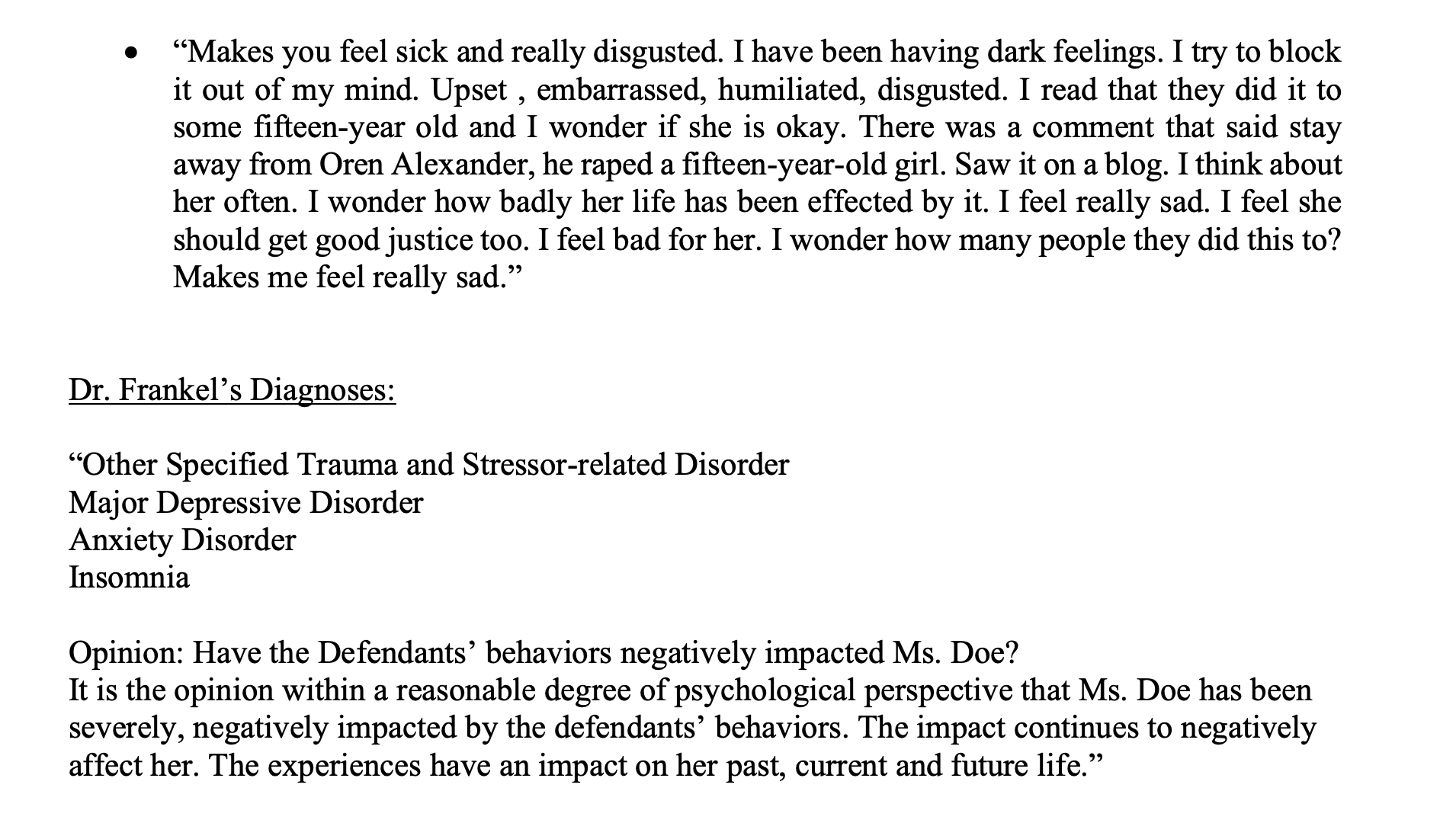
The blog she was reading was the fake 2009 Blogspot post, the same anonymous fabrication that a court had already traced to a Rocketmail account registered under a fictitious name. There was no fifteen-year-old. There was no prior victim. There was no pattern. There was a troll with a fake email address and a story that had been scrubbed from Google a decade earlier. And yet it had worked its way into Whiteman’s clinical evaluation, been cited as part of her documented trauma, and been submitted as evidence in a $50 million lawsuit. A piece of internet fiction had been laundered into the medical record.
“A Sham Litigation”
The Alexanders were not the only ones who saw the lawsuit for what it was. Ivan Wilzig, the billionaire host of the Hamptons party where the alleged assault took place, was also named as a defendant. His legal team at Greenberg Traurig came out swinging.

They called the case a “sham litigation” and said Wilzig would not allow himself to be “extorted in this manner.” The submission stated that Wilzig would hold all responsible parties accountable for “frivolously asserting specious claims against him, and abusing the litigation process to try to extort him.” It also pointed out that in the ten years since the alleged incident, Whiteman had never once reached out to Wilzig directly. Not a single message, not a single complaint. The idea that he had stood by and watched or condoned an assault in his own home, the submission said, was a “damnable lie.”
The Alexanders’ attorneys said much the same thing in their own mediation statement, describing the entire campaign as a “frivolous attempt [to] extort a financial windfall” built on the threat of reputational destruction.
The Media Pile-On
When the lawsuits finally hit the public docket in the spring of 2024, the coverage came fast. And almost none of it asked the obvious questions.
The article that set the tone ran in The Real Deal on June 8, 2024, under the bylines of Katherine Kallergis and Sheridan Wall. It was the piece that put the Alexanders’ names into wide circulation on this subject, and it was picked up and amplified across real estate media, social platforms, and general news aggregators within hours.

The Real Deal ran to roughly 700 words. It described the allegations in detail, quoted the Alexanders’ attorney Jim Ferraro calling the filing a “total shakedown” and saying he had “very powerful” evidence the case was “totally made up,” and noted that Whiteman had “tried to wipe her text history clean.” Those were meaningful details. But the piece stopped well short of the story those details were pointing toward.

The article noted that the complaints were “filed in March” and that “attorneys initiated the cases just as a New York State law eliminating the civil statute of limitations for sexual assault lawsuits was set to expire.” That part is accurate. But it did not ask why both complaints were filed by the same law firm on the same day. It did not mention that the demand in the Whiteman case had already hit $35 million before the public filing. And it did not mention that by June 8, 2024, the day the article ran, the demand had already been revised upward to $50 million. That revision had been filed nearly two months earlier, on April 10, 2024, when Torgan Cooper & Aaron submitted a one-page supplemental demand stating that Whiteman “deems herself entitled to an amount not less than $50 million.” The article did not mention it. It also said nothing about Whiteman having already burned through one law firm, the lien letter the Derek Smith Law Group sent after parting ways with her, or the fact that the mediation had collapsed entirely.
The piece described Rebecca Mandel’s complaint in some detail, reporting that she alleged she was drugged and assaulted at the brothers’ apartment “around September 2010.” It did not seriously challenge that the complaint gave no specific date, no account of any prior relationship between Mandel and the brothers, and no reference to any communications before or after the alleged incident.
The article also misrepresented the complaint itself. The Real Deal reported that “in 2012, Oren texted Whiteman to see if she would be going to the Hamptons for Memorial Day weekend.” But the complaint does not say he texted her. Paragraph 19 reads: “In or around May 2012, Memorial Day weekend, Oren asked Plaintiff if she was going to the Hamptons for Memorial Day weekend.” The word “texted” does not appear anywhere in the filing. The Real Deal added a specific mode of communication that the complaint never alleged.


More to the point, no such communication exists at all. The Facebook message archive, including the records Whiteman tried to delete, contains no exchange about Memorial Day 2012 in any form. No text. No Facebook message. No email. The claim appeared in a legal filing, was published as part of the narrative, and was never checked against the actual record.
What the archive does contain is a message about coordinating a Hamptons trip. It just runs in the opposite direction. On June 22, 2013, more than a year after the alleged assault, Whiteman sent Oren a Facebook message under her alias Kaitie Louiss: “Heya! On way out to Hamptons now. We got a [place] in watermill. What’s happening tonight? Come have a party at ours then castle maybe?!” Oren replied “Yes.” Whiteman followed up: “What’s ur cell?” and “Yes let’s go...” It was Whiteman reaching out to Oren, not the other way around, inviting him to her rental and suggesting they go to Sir Ivan’s Castle together. The complaint had the dynamic exactly backwards.
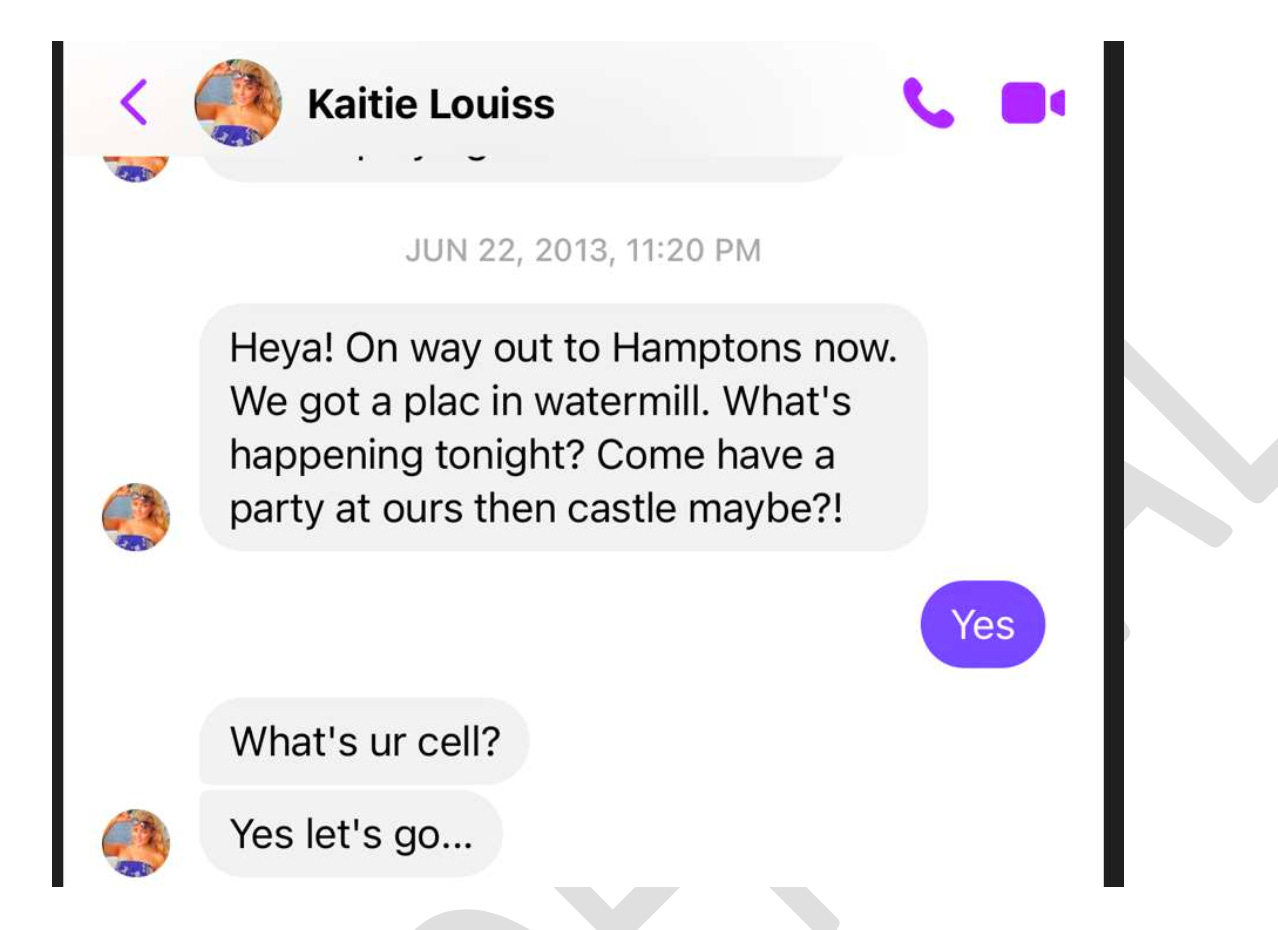
The article also covered Whiteman’s allegation that she was grabbed outside a nightclub and taken to Sir Ivan’s Castle. It did not mention the Facebook messages she had sent the brothers in the months and years after the alleged assault. It did not mention the lingerie photographs, the Aspen invitation, or Oren’s response asking her whether she was delusional. Ferraro told the reporters he had documents, telephone records, and emails proving the case was “totally made up.”
The Real Deal is a real estate trade publication, not an investigative outlet, and it is worth being clear about that. But the piece was treated as a fully reported account by the outlets and commentators who picked it up. The allegations were repeated as established fact. The fake blog post, which had been doing its work quietly inside the mediation proceedings for two years, suddenly had a new audience. People pointed to the old rumors as evidence of a pattern, with no way of knowing that a court had already determined the “pattern” was a fabrication.
The pile-on fed itself. Each new article cited the last. What circulated was not even the story the complaints told. It was the story the newspapers wanted the complaints to tell, which was already a step removed from what the complaints actually alleged, which was itself a step removed from what the underlying documents and evidence showed. By the time the narrative reached social media and real estate forums, it had traveled three layers from anything verifiable. The exculpatory evidence the Alexanders had placed on the record, the deleted messages, the lien letter, the $50 million demand, the fake blog, none of it made it into the coverage.
(In Part 4, we will examine the flood of additional unverified allegations that followed the media coverage, how the Daily Mail’s publication of the exculpatory texts changed the conversation, the fractures within the accuser coalition, and the tragic conclusion of Whiteman’s life.)