


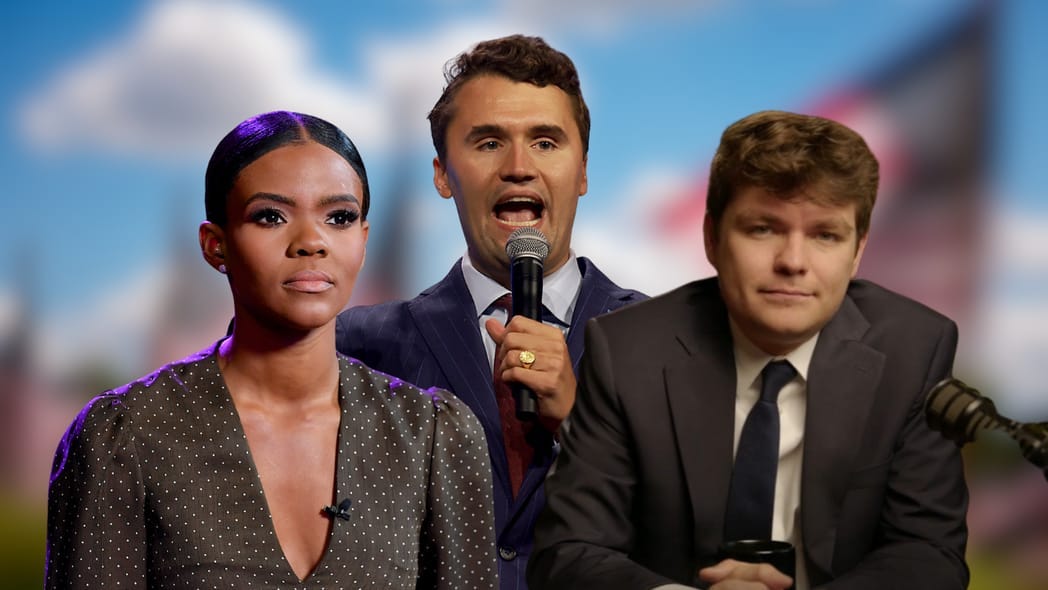
The American right is splintering. The old arguments about taxes or foreign policy no longer set the terms. What dominates today is personality, spectacle, and provocation. Nowhere is this clearer than on the so-called “woke right,” where influencers fight not over ideas but over ownership of resentment. The aftermath of Charlie Kirk’s assassination has revealed the ugliest split of all: a civil war over how antisemitism should look, sound, and sell.
Candace Owens has chosen the entrepreneurial path. She insists that billionaire Bill Ackman staged a private “intervention” in the Hamptons to pressure Kirk to soften his views on Israel, complete with threats and an offer of money. Ackman flatly denies it. No evidence has surfaced to support her. Yet the allegation did its job. It seeded doubt, racked up clicks, and kept Owens in the spotlight. Hers is antisemitism as performance: a provocation dressed up as courage, then monetized for an audience hungry for drama.
Tucker Carlson prefers insinuation. He did not say Israel pulled a trigger. He did say that Benjamin Netanyahu “hijacked Charlie’s memory” to advance Israel’s cause, and he painted Kirk as disillusioned with Netanyahu and appalled by Gaza. The message is familiar. Plant suspicion, never cross the line into outright accusation, and let others do the rest. This is the polished version: respectable, delivered in the language of moral outrage. Carlson is not a fringe actor shouting on a livestream. He is still accepted in mainstream conservative circles, and his own son works for the Vice President of the United States. That makes him far more dangerous than the rest. When doubt is laundered through legitimacy, it spreads further and faster than anything a fringe provocateur can muster.
Nick Fuentes plays a different role. He does not bother with innuendo. He mocks Owens as a “grifting dummy” peddling “low-IQ antisemitism.” He sneers at Carlson for hiding behind implication. He demands evidence for Owens’s claim about a letter Kirk supposedly sent to Netanyahu, then compares her evasions to the “lying Jewish media.” A few months earlier, he declared Jews a “fifth column” and a “threat to national security.” Fuentes is explicit, doctrinaire, and proud of it.
But his fury is not only ideological. He seethes at the unfairness of it all. Owens and Carlson can profit from their antisemitism while he has been deplatformed and ostracized. He has paid the price; they have collected the checks. His self-image is that of a martyr: punished for saying out loud what others only hint at. That grievance fuels his insistence that his version is “high-IQ,” untainted by money, unsoftened by euphemism.
Together, they represent three strands of the same poison. Owens packages antisemitism for sale. Carlson launders it for respectability. Fuentes sanctifies it as doctrine, laced with resentment. They do not fight over whether antisemitism belongs in the movement. They fight over style — how loudly to say it, how carefully to phrase it, and how much money or credibility can be wrung from it.
The differences matter less than the common effect. Opportunism normalizes suspicion. Insinuation embeds it in mainstream debate. Fanaticism builds an identity around it. Each corrodes democratic life in its own way, and each pushes the boundaries further than the last.
Conservatism once knew how to police this line. In the 1960s, William F. Buckley exiled the John Birch Society when it slid into conspiracy. That gatekeeping preserved the movement’s integrity. Today, no such discipline exists. The silence of respectable figures lets Owens thrive, Carlson posture as a statesman, and Fuentes crown himself prophet of the pure.
And so the right is being hollowed out from within. It is no longer about whether to indulge antisemitism but which version to prefer. Owens the populist, Carlson the insider, Fuentes the zealot — each competing for ownership of a toxin that once lived on the margins.
There is no “better” version of antisemitism. There is no hierarchy of legitimacy. There is only poison, poured into different glasses. To imagine that one form is authentic and another fake is to fall into the absurd logic of extremism, where hatreds fight over purity instead of being condemned.
Kirk’s death became the stage for this rivalry. But the story is bigger than one man. The “woke right” is fighting itself, and its weapon of choice is antisemitism. The danger is immediate. When Owens sells suspicion, when Carlson smuggles it into mainstream respectability, and when Fuentes preaches it as creed, ideas that once belonged to the fringe take root in American politics.
If conservatives do not draw firm boundaries, the movement will not be defined by liberty or policy but by the feuds of grifters, insinuators, and zealots. That would poison the culture of the right and distort the larger civic life of the nation. The choice is not complicated. Either antisemitism is pushed back to the margins, or it will end up defining the right itself.
Hey Daniel, your breakdown of the "woke right's" antisemitism civil war is a brutal, necessary mirror—exposing how Owens's clickbait conspiracies, Carlson's sly insinuations, and Fuentes's outright venom aren't clashing over principles but over who gets to monetize the hate. That Buckley parallel hits hard; without gatekeepers, this poison seeps in unchecked, redefining conservatism around resentment instead of ideas. I’m Eric, writing at sleuthfox.substack.com, where I unpack these societal fractures too. In my post “Echoes of the 1930s” (https://sleuthfox.substack.com/p/echoes-of-the-1930s), I explore how propaganda and scapegoating normalized bigotry back then, much like today's boundary-pushing in right-wing circles erodes civic guardrails. Spot on: no "better" flavor of antisemitism, just varying toxicity. What's one sign you'd watch for that this war starts turning outward? If you like this post, please follow me! #WokeRightWars #PushBackHate
Your best yet. Very scary times.