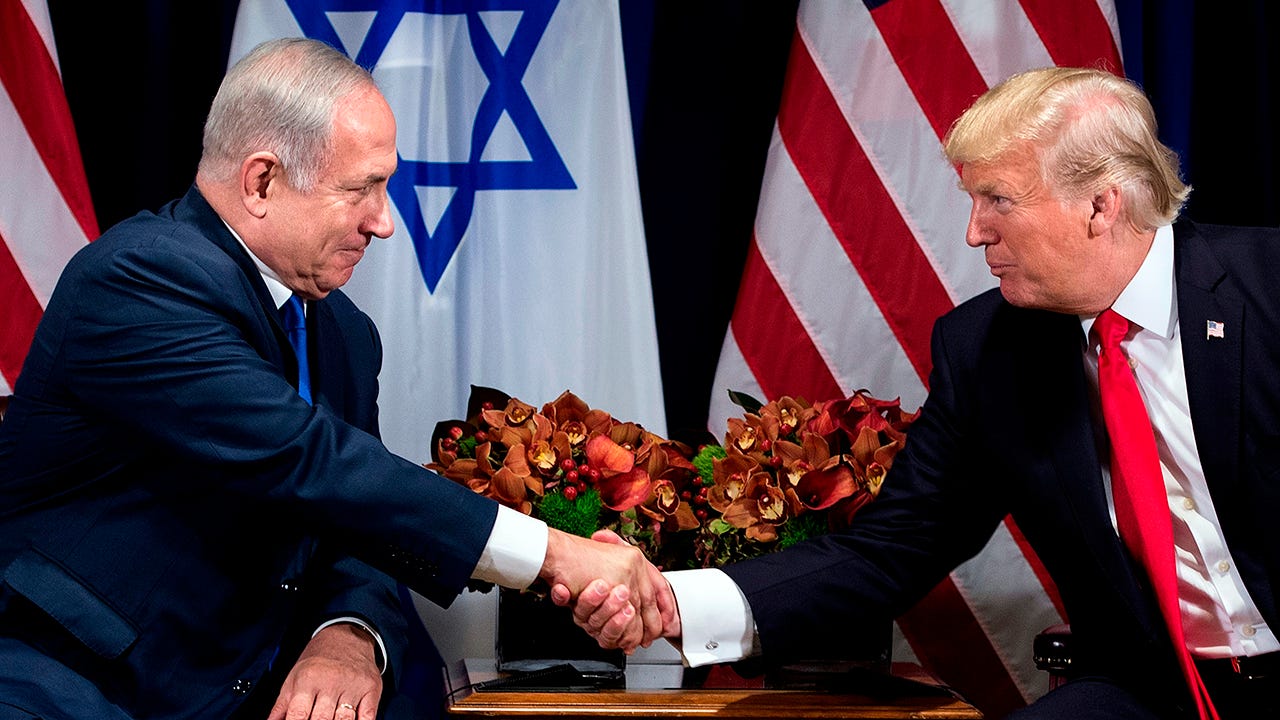
President Donald Trump told reporters in the Oval Office that he “will not allow Israel to annex the West Bank.” Pressed further, he repeated it with emphasis: “It’s not gonna happen.” For the first time, Trump set a public boundary on Israeli sovereignty in Judea and Samaria.
The comment highlights one of the central dilemmas of the Israeli state. Judea and Samaria are not incidental pieces of territory. They are the landscape of Jewish history, home to Hebron, Shiloh, and Beit El. To many Israelis, particularly on the right, sovereignty there is not exclusively a matter of security. It is a matter of national fulfillment. To others, it represents a potential diplomatic and demographic trap. The line Trump drew does not decide this argument, but it throws it into sharper relief.
What makes the statement more striking is its timing. Only months ago Trump spoke of Gaza in entirely different terms. He described the Strip as territory to be cleared, rebuilt, and reimagined. He even encouraged talk of annexation, a concept that took the form of a “Trump Gaza” video showing skyscrapers and resorts where Hamas once ruled. That posture suggested boldness and an openness to radical solutions. Now, with Judea and Samaria, the same president insists there will be no annexation.
The contrast is revealing. Gaza, a coastal enclave peripheral from biblical memory, could be treated as a speculative real estate project. Judea and Samaria, the cradle of Jewish history, are treated as untouchable. The inconsistency is not merely tactical. It underscores the difficulty of aligning American policy with Israeli aspirations. What appears imaginative one month is condemned as destabilizing the next.
For the Israeli right, this is disappointing but not surprising. American administrations, whatever their rhetoric, tend to recoil from the prospect of Israeli sovereignty beyond the Green Line. For the left, it is validation. Even the friendliest White House cannot support unilateral annexation.
Yet there is a deeper complexity. Israel often insists that sovereignty is its decision alone, a matter of national self-determination. But the reality is that its strategic security rests heavily on American support, whether in the form of military aid, advanced technology, or diplomatic protection in hostile international forums. That dependency makes unilateral moves far more complicated. Sovereignty may be a matter of principle, but principle cannot be separated from the practical constraints of alliance.
The larger lesson is that Israel cannot pin its strategic choices on the words of an American president. Trump’s shifts illustrate how volatile those words can be. Gaza was once to become a Riviera. Now Judea and Samaria are ruled out entirely. For Israel the conclusion is plain. The question of sovereignty will always be a national one, but it will never be decided in isolation.