


There is a particular kind of dishonesty that is more dangerous than an outright lie. It is the lie by implication, the carefully arranged half-truth, the leading question designed to plant a conclusion the speaker would never dare state plainly. Tyler Oliveira has mastered this technique, and in a recent video he has turned it on Hatzalah, the volunteer emergency medical service, with consequences that are as predictable as they are ugly.
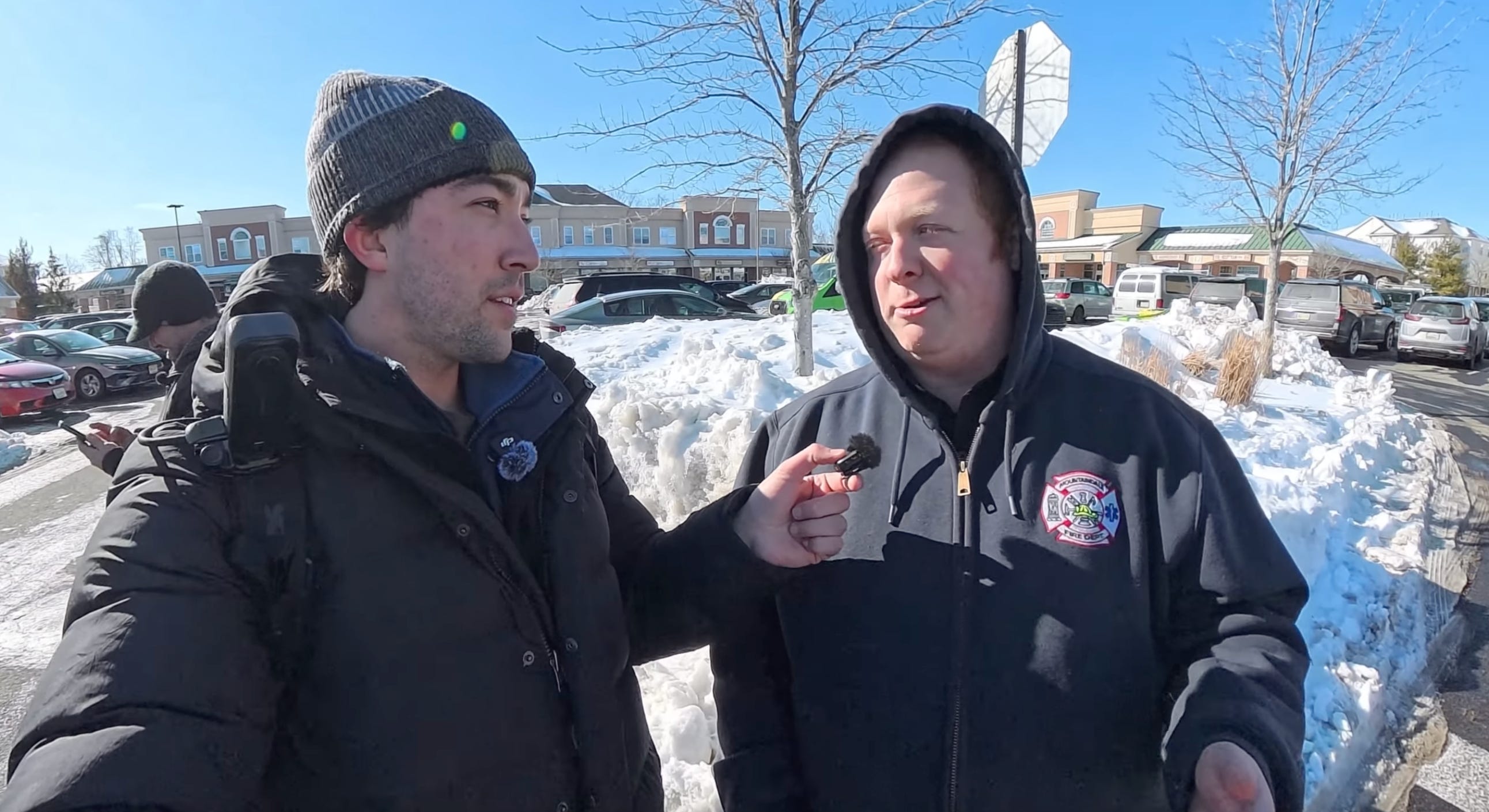
Let us be precise about what Oliveira does in this video. He does not simply report. He manipulates. Through a sequence of loaded framing and sinister narration, he presents Hatzalah vehicles running lights and sirens as though they are a Jewish militia operating outside the law. He lets his interview subjects call it “a community watch that thinks it’s the cops.” He lingers on the imagery. He asks the questions that lead his audience exactly where he wants them to go. The message is unmistakable, even if he never says it outright: Jews have created a parallel power structure that answers only to itself. It is a lie. And Oliveira knows, or should know, that it is a lie.
Here is the truth, and it is not complicated. Hatzalah is a volunteer emergency medical service that responds to everyone who calls. Not just Jews. Everyone. I had the zechus, the merit, to sit personally with Rabbi Hershel Weber, the man who founded Hatzalah in Williamsburg, Brooklyn in 1965. I heard this from his own lips.
Rabbi Weber told me that the mission was shaped from the very beginning by a ruling from Rabbi Moshe Feinstein, the foremost halachic authority of the 20th century. I raised this point directly with Rabbi Weber. He was unequivocal. Rav Feinstein’s directive was grounded in pikuach nefesh, the Jewish legal obligation to save human life, which recognizes no religious boundary. But Rav Feinstein went further than the law required. He specifically instructed that there must not be even a hint, not even the faintest perception, that Hatzalah would limit its response to the Jewish community. The moral standing of the Jewish people demanded nothing less. Whoever calls, Hatzalah comes. That has been the rule since day one.
So when Oliveira insinuates that Hatzalah vehicles are “acting like cops” by using lights and sirens, he is either ignorant of basic facts or he is counting on his audience to be. Hatzalah volunteers are state-certified EMTs and paramedics. Their vehicles are state-certified ambulances. They operate under the exact same New York State Department of Health protocols as any paid municipal service. The lights and sirens are not a privilege. They are the law. They are how you get to someone in time. To frame that as something suspicious, something exclusive, something Jewish in a sinister sense, is not journalism. It is provocation.
Hatzalah was born because city ambulances in the dense Orthodox neighborhoods of Brooklyn were taking twenty minutes or more to arrive. Medical care was dangerously delayed. A community responded by building something. And what they built, guided by the moral vision of Rav Feinstein, was open to all. That is the story Oliveira chose to bury.
He buried it because the truth does not serve his purposes. Oliveira has built an audience on the premise that Jewish communities are a threat, that their institutions are exclusionary, that their presence is an invasion. Over three hundred thousand people watched this video in its first day. They were not watching to learn. They were watching to have their suspicions confirmed. And Oliveira, with a camera and a smirk, was happy to confirm them.
This is the real danger. Not one wrong video, but a content machine that runs on Jew hatred and calls it documentary filmmaking. The algorithm rewards outrage. Clicks pay the bills. And when a sixty-year-old institution built on the principle of saving every human life gets repackaged as a symbol of Jewish supremacy, something has gone badly wrong, not just with one YouTuber, but with the culture that made him possible. That is what we are fighting. And we had better be clear-eyed about it.
“Hatzalah was born because city ambulances in the dense Orthodox neighborhoods of Brooklyn were taking twenty minutes or more to arrive. Medical care was dangerously delayed. A community responded by building something. And what they built, guided by the moral vision of Rav Feinstein, was open to all. That is the story Oliveira chose to bury.”