The Israeli public is being asked to accept a moral sleight of hand, and it should refuse.
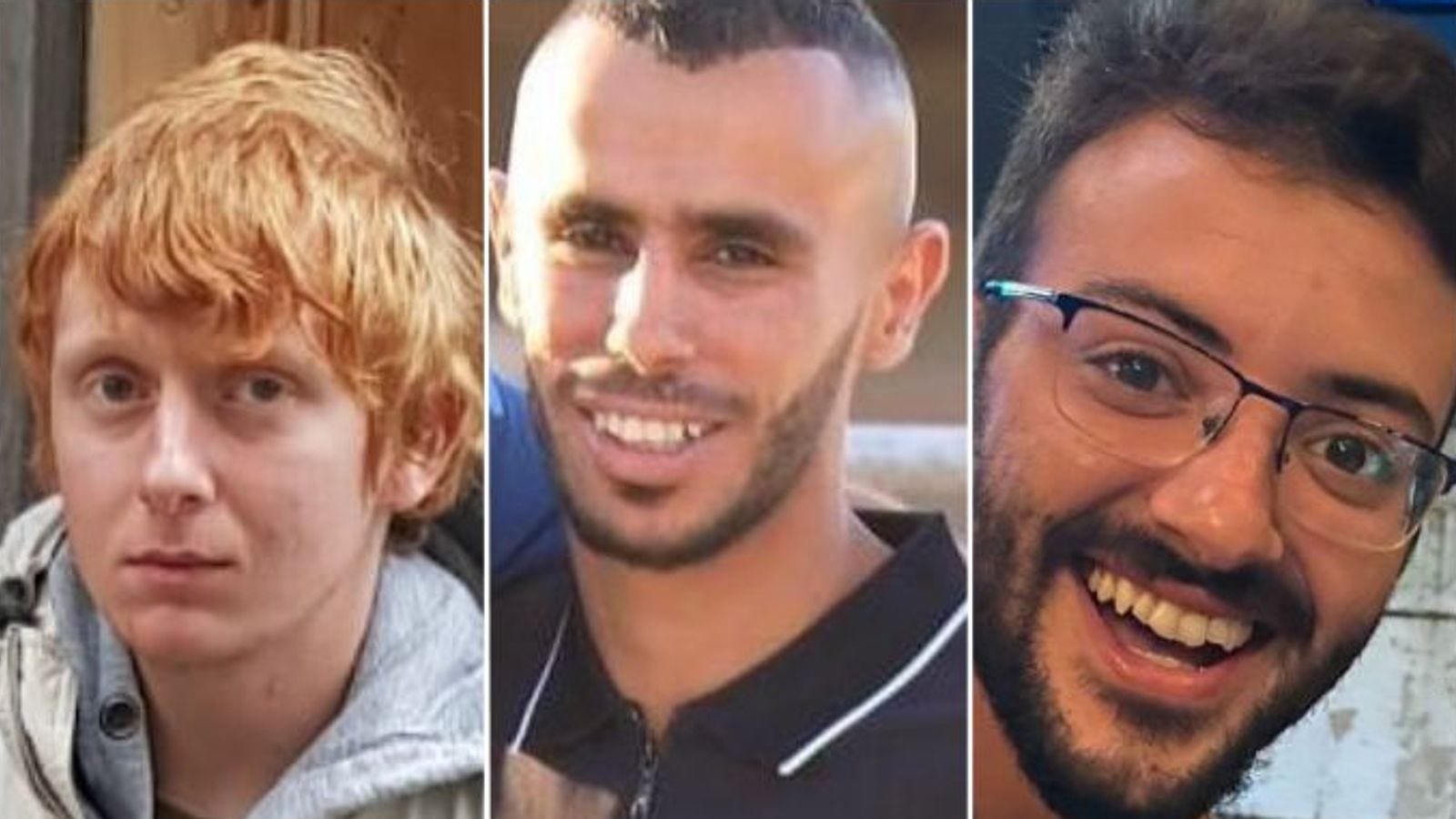
Two years ago, during fighting in Gaza City’s Shejaiya neighborhood, three Israeli hostages who had escaped Hamas captivity were mistakenly shot and killed by IDF troops. Yotam Haim, Alon Shamriz, and Samar Talalka emerged unarmed, shirtless, waving a white flag. They shouted for help in fluent Hebrew. They did what hostages are taught to do, what common sense demands, what every Israeli soldier is supposed to recognize. It did not save them.
According to the IDF’s own investigation, this was not the result of a single panicked moment. After two of the hostages were initially shot, the battalion commander on the scene heard Hebrew shouts of “Help” and “They are shooting at me.” He ordered a ceasefire and called for the third figure to approach. But he did not ensure that the order was clearly received and enforced. Roughly fifteen minutes later, amid the noise of nearby armor, two soldiers who had not heard or absorbed the ceasefire opened fire again, killing Yotam Haim as he walked toward Israeli forces. This unfolded over time. It was a failure of command, not a reflex under fire.
What makes this episode even harder to absorb is what was already known before the shooting, but functionally unavailable. Five days earlier, an IDF military dog had been sent into a building in the same area where the hostages were being held. A camera mounted on the dog recorded the voices of three men speaking Hebrew. The footage captured their presence clearly. But the dog was killed during the operation, and because the video was not transmitted live, no one on the ground knew what the dog had encountered. That gap was not inevitable. It reflected a prior decision that real-time transmission was not essential—raising unavoidable questions about readiness and about who within the Ministry of Defense procurement and planning system deemed it acceptable to deploy such assets without live feeds. The video was only recovered and reviewed days later, after the dog and all three hostages were already dead. The intelligence existed. It simply arrived too late to save lives.
Taken together, these facts point to a pattern, not a freak tragedy. Orders were given but not enforced. Intelligence was gathered but not delivered. Capabilities were deployed without the tools needed to make them effective. Each failure compounded the next. None of this suggests malice. All of it suggests a system that broke down when precision mattered most.
It is against this record that the families of the slain hostages learned that the battalion commander involved, Lt. Col. “Daled,” is slated for promotion. Their response has been disbelief layered on top of grief. They are not alleging bad faith. They are not questioning his courage or devotion to the country. They are pointing to what the facts already show: a commander who presided over repeated breakdowns in judgment, communication, and control.
The IDF’s response to this criticism is telling. Rather than address the substance of these failures, the army offered a character defense:
“Lt. Col. ‘Daled,’ over the past two years, has led hundreds of soldiers under his command, serving as commander of two different battalions, under fire and while risking his life.
He is a principled, professional, and honest commander who works tirelessly and dedicates his life to the security of the State of Israel.”
Every word may be true. None of it answers the charge.
More troubling is what this response reveals about institutional posture. This is not the language of serious contemplation. It is the language of deflection. Faced with specific, documented failures raised by grieving families, the IDF did not engage the questions being asked. It did not explain how orders were allowed to go unenforced, how intelligence failed to reach decision-makers, or why accountability stopped where it did. Instead, it substituted praise for analysis. In doing so, it effectively pushed aside legitimate concerns as if they were misunderstandings rather than moral claims.
When families ask how this could happen, responding with a résumé is not reassurance. It is dismissal. It signals that the institution is more comfortable defending its own than confronting uncomfortable truths. Serious militaries do not confuse loyalty with accountability. They do not treat grief as an inconvenience to be managed. They reckon openly with failure, especially when that failure costs innocent lives.
No one has questioned this officer’s intentions. No one has accused him of cowardice or corruption. The claim is simpler and more serious: he failed at his job when it mattered most. Military command is not measured by devotion or effort alone. It is measured by outcomes. The higher the rank, the less persuasive it is to say, “I gave the order,” and the more damning it is to concede that the order was not carried out.
Ensuring that orders are heard and enforced, ensuring that intelligence reaches decision-makers in time to matter, is not a secondary concern. It is the essence of command. When a commander cannot guarantee a ceasefire is obeyed, cannot close a known intelligence loop, and cannot prevent repeated lethal errors, something fundamental has gone wrong.
Promotions are not expressions of sympathy. They are institutional judgments. They signal what an army rewards and what it is willing to excuse. To promote an officer after such an episode is to say, implicitly, that these failures fall within acceptable bounds. That message does not strengthen the IDF. It weakens it.
There is no dishonor in acknowledging failure. There is dishonor in wrapping it in praise. Transparency without accountability is not justice; it is procedure. The question before the IDF is not whether this officer is a good man. The families already know that he may well be. The question is whether he demonstrated the competence required of command in a moment that allowed no margin for error.
On that question, praise is not an answer. Silence is not an answer. Promotion is the wrong answer.