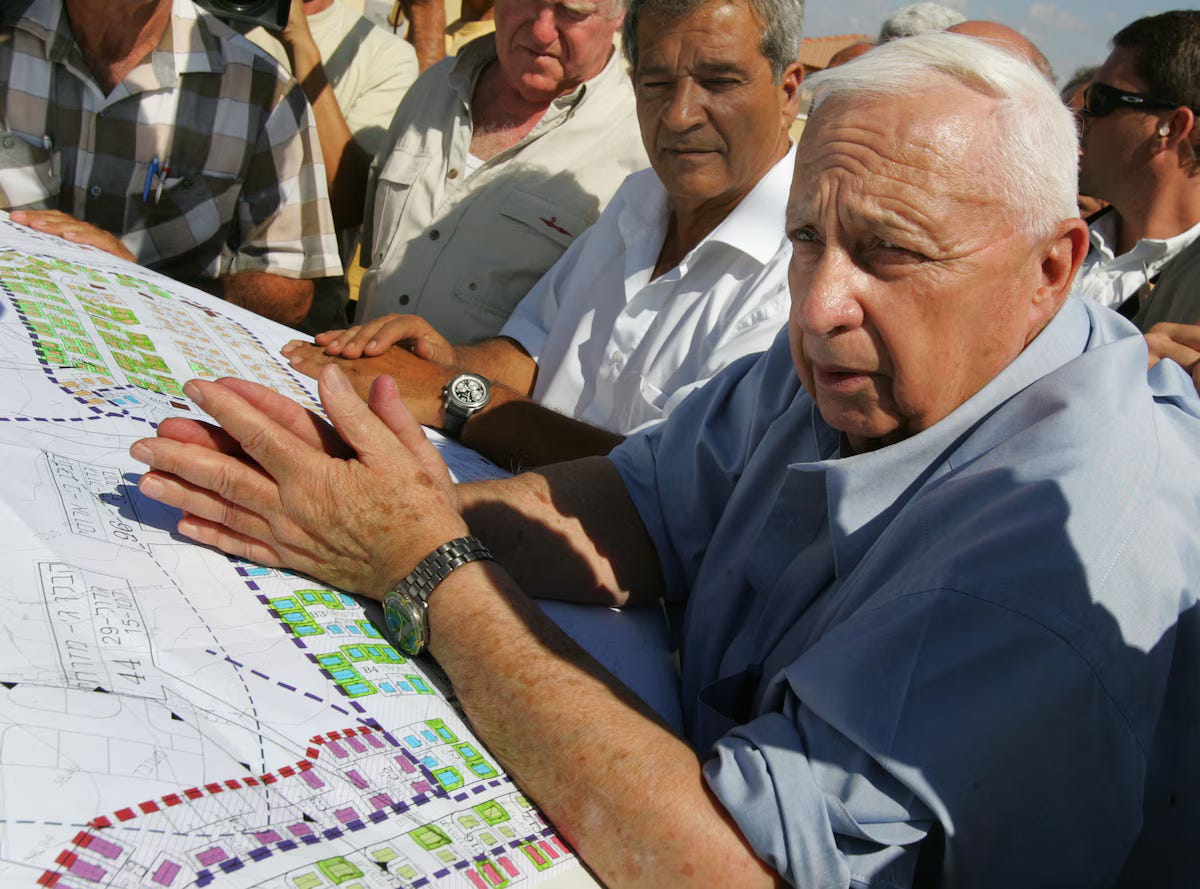
Twenty years ago, Ariel Sharon made what many considered a reasonable decision. Israel would withdraw from Gaza, bringing home 8,000 settlers and ending a costly occupation. To war-weary Israelis and international observers, it felt like the right thing to do. Sharon's catastrophic miscalculation would cost thousands of lives and create the conditions for decades of terror.
The 2005 disengagement was a catastrophic misreading of Middle Eastern realities. As Israel grapples with the aftermath of October 7th, the ghosts of that earlier withdrawal offer a chilling warning about the price of good intentions.
Sharon wasn't militarily naive—he was a battle-hardened general who understood warfare. But politically, he was clueless. Like many Israelis, he was exhausted by “occupation's moral burden” and international criticism. Withdrawal seemed to satisfy Israeli consciences and international opinion.
Every parent could understand the appeal. Why risk your child's life defending remote settlements? These were deeply human feelings. But in the Middle East, human feelings can be deadly luxuries.
Sharon fell victim to political delusion: that good intentions could substitute for hard analysis of outcomes. The Israeli public embraced a policy that felt morally satisfying while being strategically suicidal.
Israel's strategic position allowed no such humanitarian indulgence. The Gaza settlements served a crucial purpose: they provided forward observation posts that disrupted Hamas operations before they could develop into larger attacks, while forcing militants to focus on fortified positions rather than planning operations against population centers.
The withdrawal brought rockets, not peace. Hamas suddenly found itself with free rein to build military infrastructure. Greenhouses meant to symbolize economic future became rocket launching pads. Work permits that Israel hoped would create peace incentives instead allowed Hamas operatives to study Israeli security procedures.
Within two years, Hamas controlled Gaza. The "moderate" Palestinian Authority was driven out. The international community that applauded Israel's withdrawal was essentially silent as Gaza became a terrorist stronghold. In the Middle East, voluntary withdrawal is seen as weakness. And weakness invites aggression.
October 7th was the logical culmination of Hamas's strategy since 2005: use Gaza to plan attacks, then exploit Israeli retaliation to generate international pressure for restraint. The abandoned settlements would have made October 7th impossible—they provided early warning capabilities that could have detected and disrupted the massive planning operation.
Now, as Israeli forces continue their nearly two-year Gaza operation with 50 hostages still captive, the same pressures are building. There are calls for "proportionality," humanitarian pauses, and pressure to find a "conclusion." The emotional appeal is undeniable—soldiers are dying, civilians are suffering. Hamas is publishing videos of hostages that resemble Holocaust victims.
But Hamas counts on this response. They understand Israeli society's greatest vulnerability isn't military capability—it's moral conscience. Every civilian casualty becomes a weapon in the international arena, exploiting Israeli war-weariness for political victories.
So how Israel wraps up this mess matters more than almost anything else. Every hint that they might pack up and leave early sends a telegram to every terrorist from Beirut to Tehran: "Keep pushing—these people crack under pressure." In a neighborhood where showing your throat gets it cut, appearing weak is practically a suicide note.
But here's where things get really twisted. Picture two million people crammed into Gaza, watching their world get blown to pieces for two years running. Their kids are growing up in bomb craters, their homes are rubble, and they're extremely mad. Who wouldn't be? The tragedy isn't their anger—it's that they've been fed a steady diet of lies about who's actually responsible for their misery.
If these families had any sense, they'd be storming Hamas headquarters with pitchforks. They'd be demanding answers from the Palestinian Authority about where aid money went—spoiler alert: it didn't go to schools or hospitals. They'd be asking why the UN has been playing footsie with terrorists for decades, and why their supposed Arab brothers have been content to let them rot in refugee camps for three generations rather than actually help them build normal lives.
Instead? They get Al Jazeera's greatest hits: "Israel equals Nazis, every dead terrorist is a martyr, and resistance is glorious." When you've never cracked open a history book that wasn't written by propagandists, when nobody's bothered to teach you what the Holocaust actually was—and when you've been taught that Hitler was "brave" for dealing with the "Jewish problem"—it's remarkably easy to believe that every Israeli soldier is the enemy of humanity.
This isn't just tragic—it's strategically catastrophic for Israel. They're not dealing with a population that might be reasoned with; they're facing two million people who've been systematically programmed to see Jews as the source of all evil. Every Israeli move, no matter how defensive or justified, gets filtered through this poisonous lens and spat back out as proof of genocidal intent. Every single Israeli decision-maker must consider this reality.
The lesson of 2005 is stark: territorial concessions invite aggression. Where enemies interpret withdrawal as weakness and goodwill as opportunity, "land for peace" is dangerous delusion.
Any "conclusion" leaving Hamas's capabilities intact, preserving their authority, or creating conditions for future attacks isn't solution—it's postponement. The next October 7th is already being planned by those who see Israeli restraint as weakness.
Israel has learned that good intentions are no substitute for strategic clarity. The ghosts of Gaza whisper a warning: the road to hell is paved with good intentions, and weakness's price is measured in blood.