


Public apologies have become civic clutter. They appear, gesture, ask for patience, and disappear. The offense lingers. The apology rarely does. When antisemitism is involved, restraint is wiser than generosity. Jews have learned that belief offered too easily is often returned as insult.
So when Kanye West, now Ye, purchased a full-page advertisement in The Wall Street Journal titled “To Those I’ve Hurt,” the instinctive response was caution. The question was not whether the letter sounded sincere, but whether it was meant to do anything beyond allowing its author to move on.
The letter resists expectation.
It begins not with contrition, but with a medical history. “Twenty-five years ago, I was in a car accident that broke my jaw and caused injury to the right frontal lobe of my brain.” The focus, he writes, was on the visible damage. “The deeper injury, the one inside my skull, went unnoticed.” The injury was not properly diagnosed until 2023.
Such openings often signal deflection. Here the tone is explanatory, almost clinical. “That medical oversight caused serious damage to my mental health,” he writes, “and led to my bipolar type-1 diagnosis.” The explanation is placed in full view, not buried in euphemism.
He goes further. Bipolar disorder, he writes, has “its own defense system. Denial.” During mania, “you don’t think you’re sick. You think everyone else is overreacting.” The condition convinces you that you are seeing clearly “when in reality you’re losing your grip entirely.” These are not the words of minimization, but of loss.
What follows is an account of consequence. “I lost touch with reality,” he writes. “I said and did things I deeply regret.” He describes treating “some of the people I love the most” the worst, and names the wreckage left behind, fear, confusion, humiliation, and the exhaustion of trying to love someone unrecognizable.
Then comes the line that matters most. After describing how, in what he calls a “fractured state,” he “gravitated toward the most destructive symbol I could find, the swastika,” he draws a boundary many never do. “I regret and am deeply mortified by my actions in that state,” he writes, adding, “It does not excuse what I did, though.”
That sentence closes the escape hatch. Diagnosis is presented, then denied its usual function. Responsibility remains intact. In a culture that treats mental illness as a moral solvent, that refusal is notable.
He is explicit. “I am not a Nazi or an antisemite,” he writes. “I love Jewish people.” The claim can be disputed or rejected, but it is stated without qualification. There is no attempt to dilute the harm or reframe it as misunderstanding.
Skepticism remains justified. No community has more reason to withhold trust, and no apology erases the reality that his words fed something old and dangerous. The instinct to close the door is understandable.
But it carries a cost.
Judaism does not sentimentalize repentance. Teshuvah is not a declaration. It is slow, conditional, and uncomfortable. It requires naming wrongdoing, accepting responsibility without qualification, and living differently long enough for change to become visible. There are no guarantees attached. No one is required to trust or forgive. The tradition insists only that a person is not frozen forever at their worst moment.
The Lubavitcher Rebbe spoke often about this. Repentance, he taught, is not repair alone but redirection. A fall, precisely because it is real and owned, can become the force that drives a person somewhere better than where they began. That does not apply to every failure or every apology. It applies only when wrongdoing is faced directly, without theatrics or bargaining.
He went further. Genuine teshuvah does not erase the past. It incorporates it. The descent is neither justified nor denied. It becomes part of the reckoning. This is a harder standard than condemnation, not an easier one. It demands sustained change, not correct language.
A world that refuses this possibility does not become more moral. It becomes narrower. In that world, antisemitism is punished when it appears, but rarely confronted in a way that interrupts its spread. People are discarded, while the ideas that carried them there remain intact.
Ye acknowledges the reach of his voice. “My words as a leader in my community have real global impact and influence,” he writes. “In my mania, I lost complete sight of that.” He does not ask for absolution. “I’m not asking for sympathy, or a free pass,” he says. “I write today simply to ask for your patience and understanding as I find my way home.”
Whether that request deserves a response cannot be decided now. It cannot be decided by tone or a single letter. Only time and conduct can answer it. The burden rests entirely with him.
No one owes belief. No one owes forgiveness.
What remains is a quieter question. Not whether this apology should be accepted, but whether repentance itself is something we are still willing to recognize if it proves real.
Permanent suspicion always feels safer. It requires little judgment and no patience. But it leaves nothing changed except the length of the blacklist.
What is at stake is not the rehabilitation of a celebrity. It is whether moral change, when it is claimed and then tested over time, is still allowed to matter.
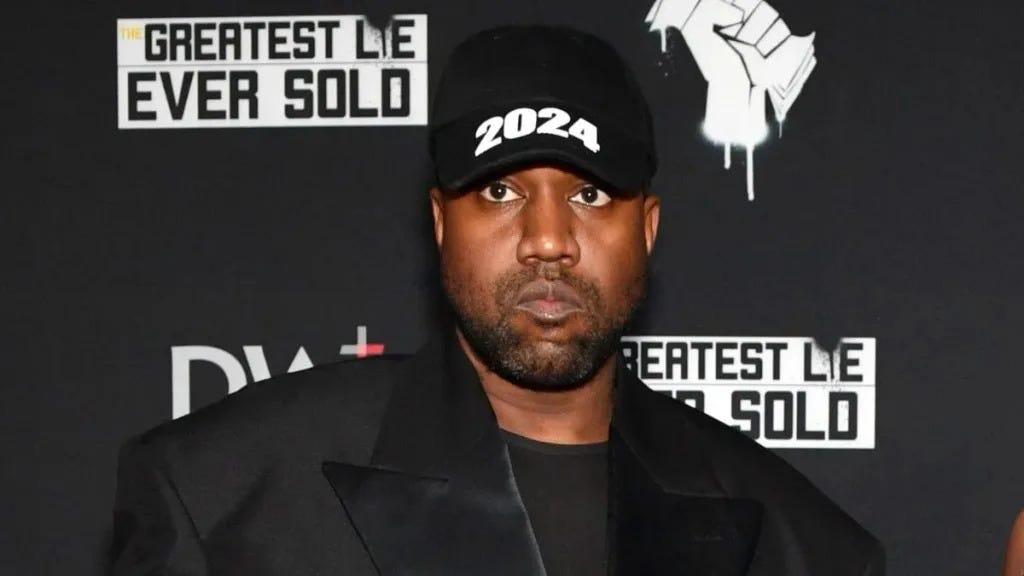
Kanye West’s apology would go a whole lot farther if he publicly denounced popular IslamoNazi influencers Nick “the Spic” Fuentes and Andrew “the Pimp” Tate et al recently filmed singing along and Nazi-saluting to his popular song.
We’ll know the apology is BS if he does the ritual trip to the Holocaust museum. We’ll know it was sincere if he actually engages with the Jewish community in a meaningful way.