


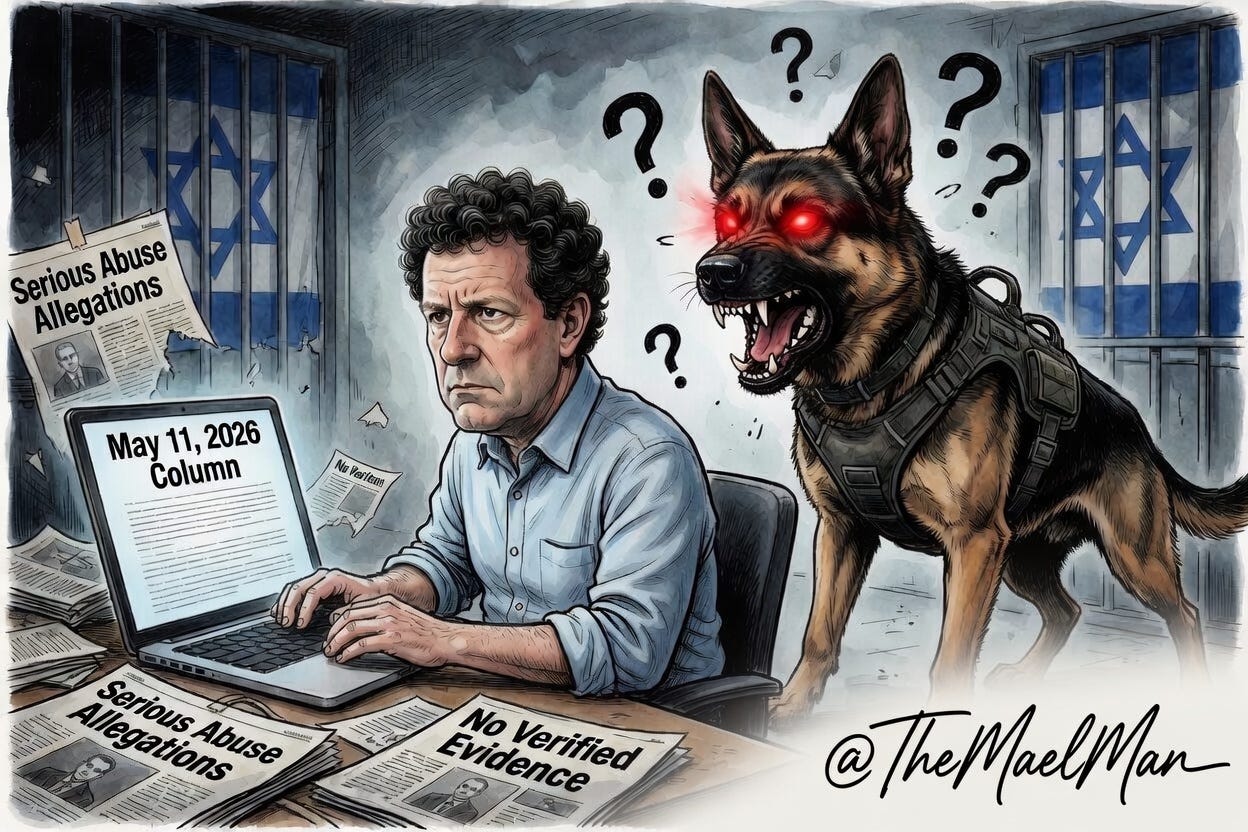
The New York Times is standing behind a story that claims Israel trains dogs to rape Palestinians.
Let that sentence sit for a moment. The paper of record, the institution that has spent decades presenting itself as the gold standard of American journalism, has looked at that claim and decided: yes, we’re comfortable with this. Yes, this meets our standards. Yes, we’re putting our name on it.
The Times’ defense came in a statement from spokesperson Charlie Stadtlander, issued in response to the avalanche of criticism that followed Nicholas Kristof’s column, “The Silence That Meets the Rape of Palestinians.” Instead of addressing the glaring evidentiary holes in Kristof’s work, the Times deployed its institutional weight to shield him, issuing a statement that is as revealing as the column itself.
Stadtlander’s statement described Kristof’s column as a “deeply reported piece of opinion journalism” that draws together “on-the-record accounts and cites several analyses documenting the practice of sexual violence and abuse conducted by various parts of Israel’s security forces and settlers.” He went on to claim that the accounts of the 14 men and women Kristof interviewed were “corroborated with other witnesses, whenever possible, and with people the victims confided in.”
This is not a defense of journalism. It is a defense of a narrative. And it requires us to suspend our understanding of what constitutes actual evidence.
Let’s look at what the Times is actually defending. Kristof’s column accuses Israel of running a detention system where sexual violence is “standard operating procedure.” He includes a horrific anecdote about a Palestinian journalist who claims he was raped by guards while a dog was summoned to participate. The journalist claims he heard someone say “don’t take photos” in Hebrew, implying the existence of cameras.
Yet, as I pointed out in my initial critique, Kristof produces no photos. He produces no videos. He names no perpetrators. He provides no medical reports. The Times spokesperson claims these accounts were “extensively fact-checked” and “cross-referenced with news reporting, independent research from human-rights groups, surveys and in one case, with U.N. testimony.”
But what does that actually mean in practice? It means that Kristof spoke to people who told him stories, and then he spoke to other people who said, “Yes, they told me that story too.” That is not corroboration. That is the echo chamber of hearsay. If a man claims he was assaulted and tells his lawyer, the lawyer confirming that the man told him the story does not prove the assault happened. It only proves the conversation happened.
The Times is asking its readers to accept a standard of proof that would be laughed out of any serious legal or investigative setting. They are asking us to believe that a systematic, state-sanctioned campaign of sexual violence is occurring, based entirely on the unverified testimonies of individuals who were found by “asking around among lawyers, human rights groups, [and] aid workers.”
This is the very definition of a pre-selected pool of sources embedded in activist networks. It is not independent journalism. It is the laundering of activist claims through the credibility of a legacy newspaper.
The Times statement also leans heavily on the idea that Kristof consulted “independent experts” on the assertions in the piece. But who are these experts? In the column itself, Kristof’s primary “expert witness” is Ehud Olmert, a disgraced former Prime Minister and convicted felon who admits in the very same breath that he doesn’t actually know much about the specific allegations. Since the column’s publication, Olmert has publicly accused Kristof of misrepresenting his words to validate allegations he did not endorse . If this is the caliber of expertise the Times relies on to fact-check claims of state-sanctioned rape, their editorial standards are in freefall.
What is perhaps most disturbing about the Times’ defense is its refusal to engage with the specific, extreme nature of the claims being made. Accusing a nation of training dogs to rape prisoners is an extraordinary allegation. It is the kind of claim that demands extraordinary, irrefutable proof. Instead, the Times offers a bureaucratic shrug, assuring us that the details were “cross-referenced” with surveys and U.N. testimony.
But the claim that a dog can be trained to sexually assault a human on command is not just unproven; it contradicts the foundational science of animal behavior. Dogs don’t respond to commands or training in that context. Their sexual behavior is instinctive and triggered mainly by hormones and scent, especially the smell of a female dog in heat. It is an involuntary, biologically triggered response, not a learned behavior that can be initiated by a verbal command from a handler.
Veterinary behavioral literature treats inappropriate mounting in dogs as a response to stress, anxiety, or over-arousal, and explicitly instructs owners to interrupt and distract the dog, noting that rewarding the behavior is contraindicated. A dog cannot be trained to sexually assault a human on command for the same reason a human cannot be commanded to sneeze on cue. The physiological response requires specific biological triggers that a handler cannot manufacture.
There is also a peer-reviewed forensic study that addresses this question directly. In 2009, Dr. Roger O. Blevins of the University of Oklahoma College of Medicine published a case report in the Journal of Forensic and Legal Medicine titled “A Case of Severe Anal Injury in an Adolescent Male Due to Bestial Sexual Experimentation” . The paper examined a case in which a child had initiated contact with his own dog. In plain terms, the dog did not act on its own. The child had to actively initiate the encounter. From that clinical finding, Blevins drew a conclusion that is directly relevant to Kristof’s column: “Spontaneous sexual assault of a human by a canine has never been described in the human or veterinary medical literature, nor is such a thing likely.”
Read that again slowly. A peer-reviewed forensic medicine study, published in a scientific journal, states that a dog spontaneously sexually assaulting a human has never once appeared anywhere in the medical or veterinary record. Not once. And the study’s author considers it unlikely that it ever could. What Kristof is asking readers to accept is not just unproven. According to the published forensic science, it is biologically implausible.
The New York Times is not just defending Nicholas Kristof. They are defending a methodology that allows for the most horrific, scientifically absurd accusations to be leveled against Israel without the burden of actual proof. They are defending a system where the severity of the charge overrides the need for evidence.
When the Times spokesperson says that Kristof’s piece starts with the proposition that “we should be able to unite in condemning rape,” he is engaging in a sleight of hand. No one is arguing that rape shouldn’t be condemned. The argument is about whether these specific, sensationalized, and unproven allegations actually happened. By framing the defense around the universal condemnation of rape, the Times is attempting to shame anyone who demands evidence, implying that questioning the reporting is tantamount to defending the crime.
There is a word for what happens when an institution of the Times’ stature decides that the normal rules of evidence are suspended for one particular country. It isn’t journalism. It isn’t advocacy. It is something older and uglier, and the Times knows exactly what it is, which is why Stadtlander’s statement is so carefully worded. He doesn’t defend the dog rape claim specifically. He defends the process. He talks about corroboration and fact-checking and independent experts. He wraps the whole thing in the language of rigor so that no one has to say out loud what the Times is actually standing behind.
But we can say it. The New York Times is standing behind a claim that Israeli soldiers train dogs to rape Palestinian prisoners, a claim that its own star columnist admitted he cannot verify, sourced from activist networks with documented ties to Hamas, contradicted by the only peer-reviewed forensic study that has ever examined the question, and published one day before a 430-interview report documented systematic sexual violence by Hamas on October 7.
That is the story. The Times has made its choice. Now the rest of us have to decide what that choice means for how much we trust anything else they print.
I am reminded of a story about LBJ running for Congress in the late 1940s. He was running against a guy who was a pig farmer, and LBJ wanted to plant a story that the guy screwed his pigs. LBJ's campaign manager said he can't say that, because its not true. Johnson's answer was, paraphrasing, of course its not true, I just want to see him deny it.
All of the above scientific info is great, and maybe it'll even make someone stop and think, but I just can't help thinking that Kristoff just wanted the Jews to deny it.
Unfortunately, journalism has long ago drifted away from reporting what happened and into the far simpler task of reporting what people say happened.
And why not when popular culture allows for everyone to have their personal truth - which usually means, at odds with the factual evidence - and false narratives that can - magically - reveal a “deeper” truth.
One thing is clear, though. A truthful article would have revealed that Israel’s prison system suffers from similar problems as all of those in the West. But that would be rejected as “normalizing” Israel and implicitly rejecting the narrative requirement that Israel is uniquely evil.
The NY Times cannot come clean on either the article’s truthfulness or the deliberate timing if its publication as that would not only cost it its credibility, but in the absence of flushing its Augean stable of social justice progressives masquerading as journalists, lead to an internal revolt. So best to circle the institutional wagons and hope that some other story attracts attention.
That said, it would be amusing if at every venue he attends, Kristof is greeted by chants of “Who let the dogs out?”