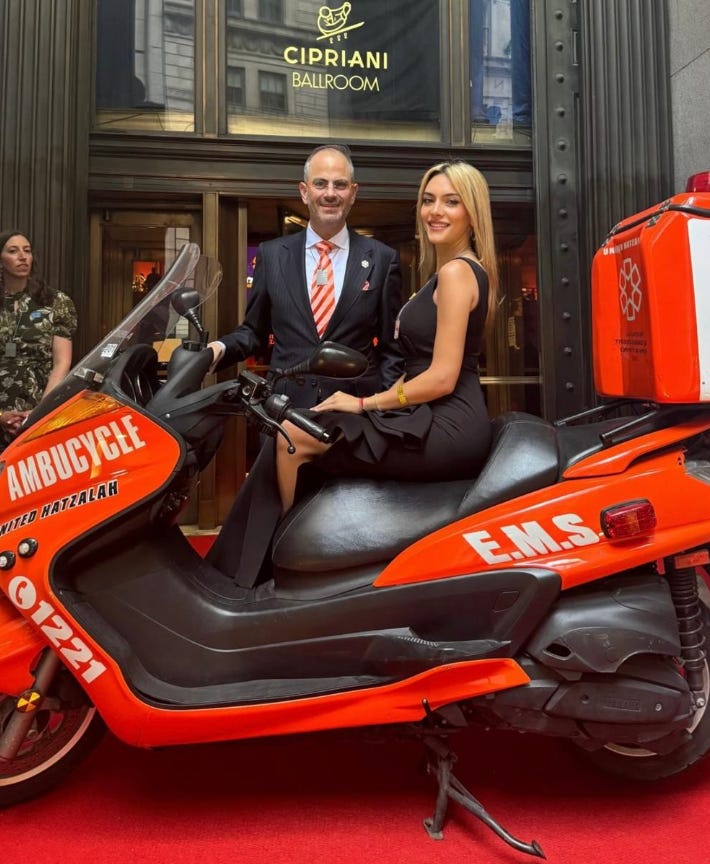
Israel’s emergency system is supposed to be clear and centralized. Dial 101 for Magen David Adom (MDA), the country’s sole nationally mandated emergency medical provider. By law, United Hatzalah and every one of the roughly twenty other independent Hatzalah organizations across Israel must transfer every emergency call and case into MDA’s system. Only MDA is authorized to serve as Israel’s national EMS provider.
Magen David Adom’s network is designed for speed, efficiency, and national unity. When a call comes into 101, the system immediately dispatches both an ambulance and the closest available emergency first responders. Those responders may be from Magen David Adom itself, from United Hatzalah, or from any other Hatzalah branch operating locally. This structure truly unifies the country around lifesaving medical care and ensures the greatest possible chance of survival for the patient.
United Hatzalah, however, has long promoted its own hotline, 1221, urging the public to call it directly in medical crises. The Health Ministry explicitly prohibited the group from advertising itself as an official emergency dispatch. In 2021, an Israeli District Court ruled that United Hatzalah had violated those directives, creating dangerous confusion in life-and-death situations. The court ordered damages and criticized the organization’s leadership for acting in bad faith.
Rather than scaling back, United Hatzalah embedded the disputed hotline into its identity. The amuta formally updated its registration so that its legal name became “איחוד הצלה ישראל 1221 (ע"ר)” or United Hatzalah Israel 1221 (RA). This ensured that every financial report, government filing, and audit document would reinforce the number 1221.
Observers note that this was not a coincidence. By incorporating “1221” into the legal name, United Hatzalah could justify painting it prominently across its ambulances, motorcycles, and emergency vehicles. Critics argue that this tactic overstated the hotline’s importance, presenting it visually as though it were a national emergency number even though United Hatzalah and every other Hatzalah is legally required to pass all emergencies to MDA.
Critics also stress that this strategy does not just affect Israelis. Abroad, donors see the vehicles, the 1221 branding, and the promotional material and may assume that United Hatzalah is Israel’s frontline emergency service, similar to 911 in the United States or 999 in the United Kingdom. The organization rarely emphasizes to foreign supporters that it is not the primary national responder but a supplementary volunteer network legally bound to defer to MDA. The result, critics say, is a powerful but misleading fundraising narrative. Donors often believe they are funding Israel’s first line of defense when in fact they are supporting a parallel network that must hand every emergency back to MDA.
The credibility gap runs deeper than just the 1221 maneuver. Eli Beer, a partner at Gindi Equities and the founder of United Hatzalah, has also been documented telling audiences abroad sensationalized stories about atrocities on October 7, including claims that were later disproven. These stories may have been effective in stirring emotion and raising funds, but they raise further questions about the reliability of the organization’s public messaging.
The High Court of Justice later upheld United Hatzalah’s right to possess the 1221 line, but it did not overturn the Health Ministry’s prohibition on promoting it as a national dispatch number. In practice, however, the amuta name change, the vehicle branding, and the international fundraising campaigns blur the line between a private nonprofit and the country’s official emergency authority.
For critics, the tactic is deliberate. It circumvents the system, confuses the public, and inflates United Hatzalah’s profile in moments when clarity can mean the difference between life and death. And that leaves one unavoidable question: if so many legal loopholes are required to maintain the illusion, how can anyone trust what United Hatzalah says?