


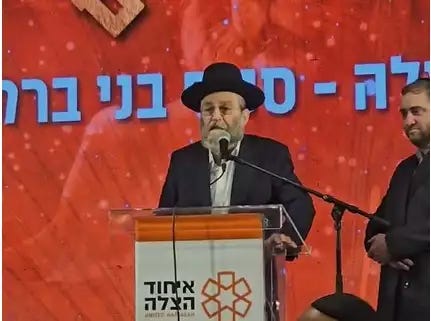
As MK Boaz Bismuth convened his first meeting today to tackle the Haredi draft law, we witnessed yet another masterpiece of political cynicism: the hint of a proposal that volunteering for United Hatzalah or Zaka should somehow count as conscripted service. This is a nuanced discussion of the Haredi draft issue, and if you are not interested in that level of analysis, this article is not for you. But make no mistake: this isn't just bad policy. It's an insult to every Israeli who has ever put on a uniform.
While politicians play word games about "alternative service," real soldiers are getting killed. While committees hold earnest discussions about religious sensitivities, reservists abandon their families and careers to defend a country that apparently considers some of its citizens too holy to fight.
Let's be clear about what this volunteer service proposal really is: an elaborate shell game designed to preserve privilege while appearing to address inequality. The sacred act of Torah study (and it is sacred) has been turned into a political weapon, deployed whenever anyone dares suggest that citizenship might come with actual physical, military obligations.
The evidence of this manipulation is everywhere. Thousands of deeply religious soldiers serve in the IDF right now, somehow managing to maintain their faith while fulfilling their duty to the state.
Now consider the absurdity of the equivalence being proposed. A combat soldier serves three years under military discipline. He goes where he's told, when he's told. He can't quit when things get tough or go home for dinner every night. He might die.
Compare this to the proposed "equivalent": volunteer work in civilian clothes, under civilian management, with the freedom to walk away whenever convenient. No military discipline, no combat risk, no real sacrifice. Just the warm glow of doing good while others do the dying.
This isn't just wrong. It's obscene.
The choice of United Hatzalah and Zaka reveals the cynical genius of this proposal. Who could possibly criticize organizations that save lives and honor the dead? It's emotional blackmail disguised as policy, designed to shut down debate before it starts.
But follow the money, and the real game becomes clear. United Hatzalah received 7.4 million shekels in government subsidies in 2024 and 8.5 million in 2023. Yeshivas get a staggering 1.7 billion shekels annually. Israeli taxpayers are funding both the organizations being offered as alternatives to service and the institutions that supposedly make service impossible. Citizens pay twice: once for the excuse, once for the exemption.
This raises an uncomfortable question for well-meaning donors abroad: if someone donates to the American non-profit equivalent of United Hatzalah or Zaka, are they inadvertently assisting in draft evasion? When these organizations are being used as convenient alternatives to military service, foreign donations effectively subsidize a system that allows some Israelis to avoid their civic duties while others bear the full burden of defense.
The pattern is clear from recent public statements. In a Matzav article, Eli Beer of United Hatzalah, offers his solution to the draft crisis, proposing that "Charedi men should serve 2-3 years of mandatory civil service as EMTs and paramedics, along with other vital civil service roles." Beer states: "But the rest of the people could do Chesed. What's so wrong, you do Chesed for a few hours a day, for three years. Instead of holding guns, you don't have to go hold guns and wear a uniform. That's my solution, for this biggest problem, which could lead to a war between the Jewish people." While framed as community service, the timing and context of such proposals amid draft law discussions make the implication clear. When organizations position themselves this way, foreign donations risk becoming part of the infrastructure that enables draft avoidance.
Here's where the logic collapses entirely. Serious volunteering would require leaving yeshiva full-time. But isn't that exactly what the Haredi parties claim they're fighting against? If young men can leave yeshiva to drive ambulances, they can certainly leave to serve their country. The whole premise crumbles under the weight of its own contradictions.
Meanwhile, the burden grows heavier for those who actually serve. Reservists get called up again and again. Regular soldiers serve longer, fight harder, sacrifice more. The military struggles to recruit as young Israelis watch their peers game the system while they give up years of their lives.
Now, there is absolutely merit in exempting the very best Torah scholars, the genuine prodigies whose learning represents something extraordinary. But this must be earned through rigorous testing, full-time yeshiva attendance, and strict oversight to ensure they're actually there, actually learning, actually among the most gifted of their generation. Such a system would distinguish between real scholarship and convenient excuse-making.
But for everyone else who insists on avoiding authentic military service? Let them fund their own way. Torah study is valuable and sacred, and yes, it does serve the state in its own profound way. But there is a way to both learn Torah and serve the state militarily, as thousands of religious soldiers prove every day. Those who refuse this dual path are not protecting Torah study; they are hiding behind it to avoid their obligations while expecting others to bear the physical burden of defense. If they choose to serve the state only through learning while rejecting military service, then let them also reject state funding. No taxpayer subsidies for yeshivas, no welfare payments, no government contracts. If you won't share in defending the state with your body, don't expect those who do to fund your alternative with their taxes.
The volunteer service proposal should be rejected not because volunteerism lacks value, but because accepting it abandons the principle that citizenship carries equal obligations. The core issue of equal participation in the state cannot be resolved through political theater and convenient alternatives. Until Israeli society addresses the fundamental question of whether all citizens must share equally in the burdens of national defense, these cynical proposals will continue to mock the sacrifice of those who serve while perpetuating a system that privileges some at the expense of others.
I agree that the state should stop funding the Haredi lifestyle. My rabbi makes a point that it might be too difficult to accommodate the ultra-religious in the military, to the point where it's not worth doing. In that case, a voluntary service substitute is better than nothing. I guess the reply to that would be that it is the Haredi who should meet the state half-way, especially in time of war, and serve without demanding special treatment when in uniform: after all, the great thing about the Jewish law is that it always allows for exceptions, especially in times of peril.
I wonder if there is a free-market, Coasian solution to this? Perhaps give the ultra-orthodox the right to pay an exemption fee to avoid being drafted (which could be funded by their American benefactors)? The collected funds could be used to fund insurance for the families of wounded and fallen soldiers who do serve. Worth thinking about.