


On October 7, 2023, as rockets and gunmen poured across the Gaza border, Israel’s emergency responders faced the unthinkable: mass slaughter, overrun communities, and battlefield conditions inside civilian towns. In the months and years since, a secondary battle has erupted not over territory, but over narrative. United Hatzalah, a volunteer-based NGO in Jerusalem, has presented itself to donors as the country’s indispensable first responder that day, in some cases contrasting its actions with those of Magen David Adom, Israel’s national emergency medical service. Leaders and fundraisers for United Hatzalah have repeated accounts portraying MDA as absent or hesitant.
MDA officials say those accounts are false. In interviews, they offered their own detailed timeline and rejected suggestions that their responders were told to stay back or that United Hatzalah alone braved the carnage. “The answer is hell no,” said Uri Shacham, MDA’s chief of staff, when asked whether leadership instructed responders to flee. He described how in the hours before the assault, MDA had placed more than 100 ambulances on high alert at volunteers’ homes across the south. When rockets began at 6:29 a.m., Director General Eli Bin doubled shifts and ordered every available ambulance manned.
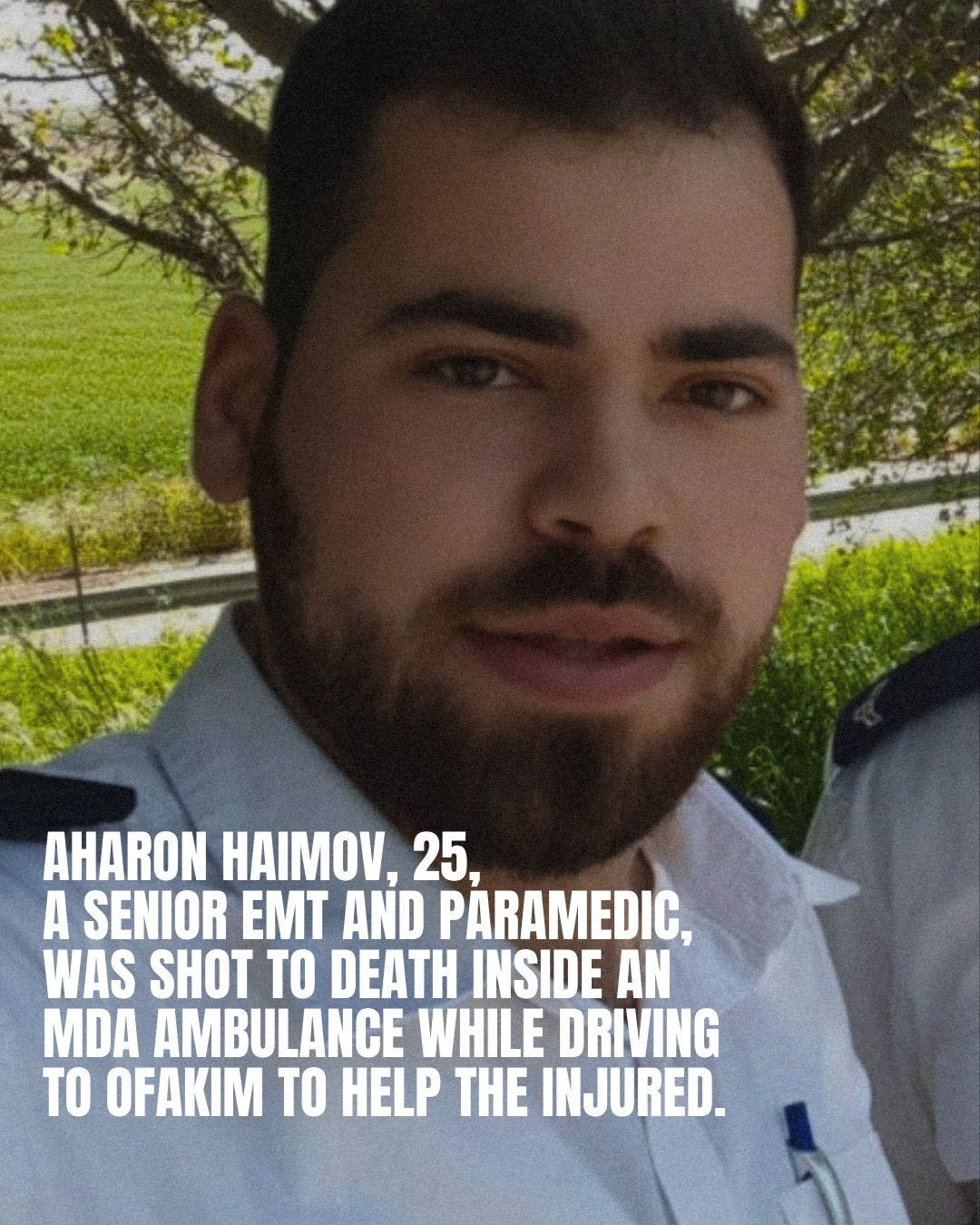
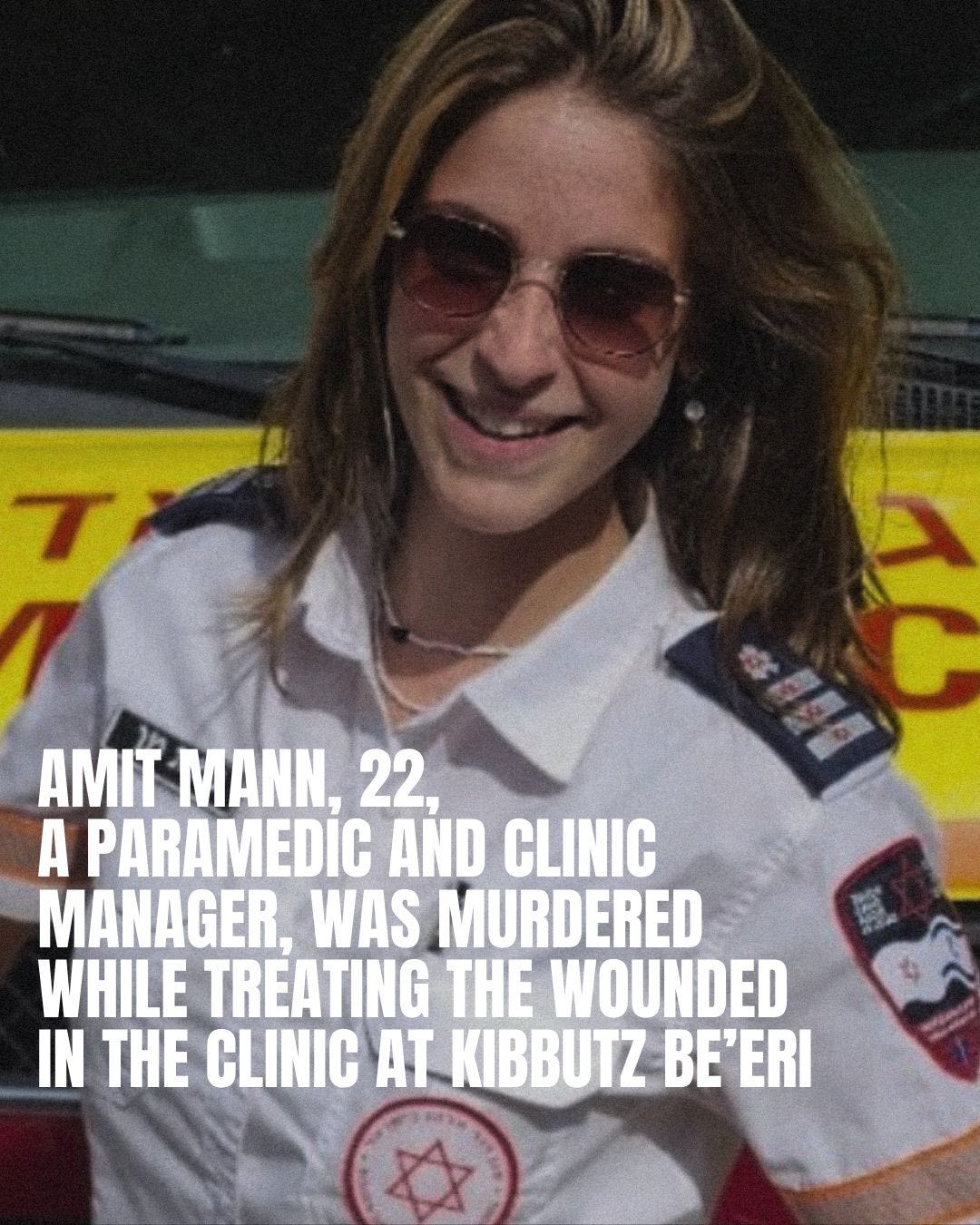
Within minutes, MDA vehicles were under fire. In Sderot, an ambulance en route to aid gunshot victims drove straight into a Hamas convoy and was riddled with bullets. In Ofakim, senior EMT Aharon Haimov was shot dead inside his ambulance while trying to reach casualties. At Kibbutz Be’eri, paramedic Amit Mann refused to abandon her clinic and was murdered while treating the wounded. “These were our people, risking and losing their lives,” Shacham said. “The idea that MDA retreated is not only false, it is insulting to their memory.”
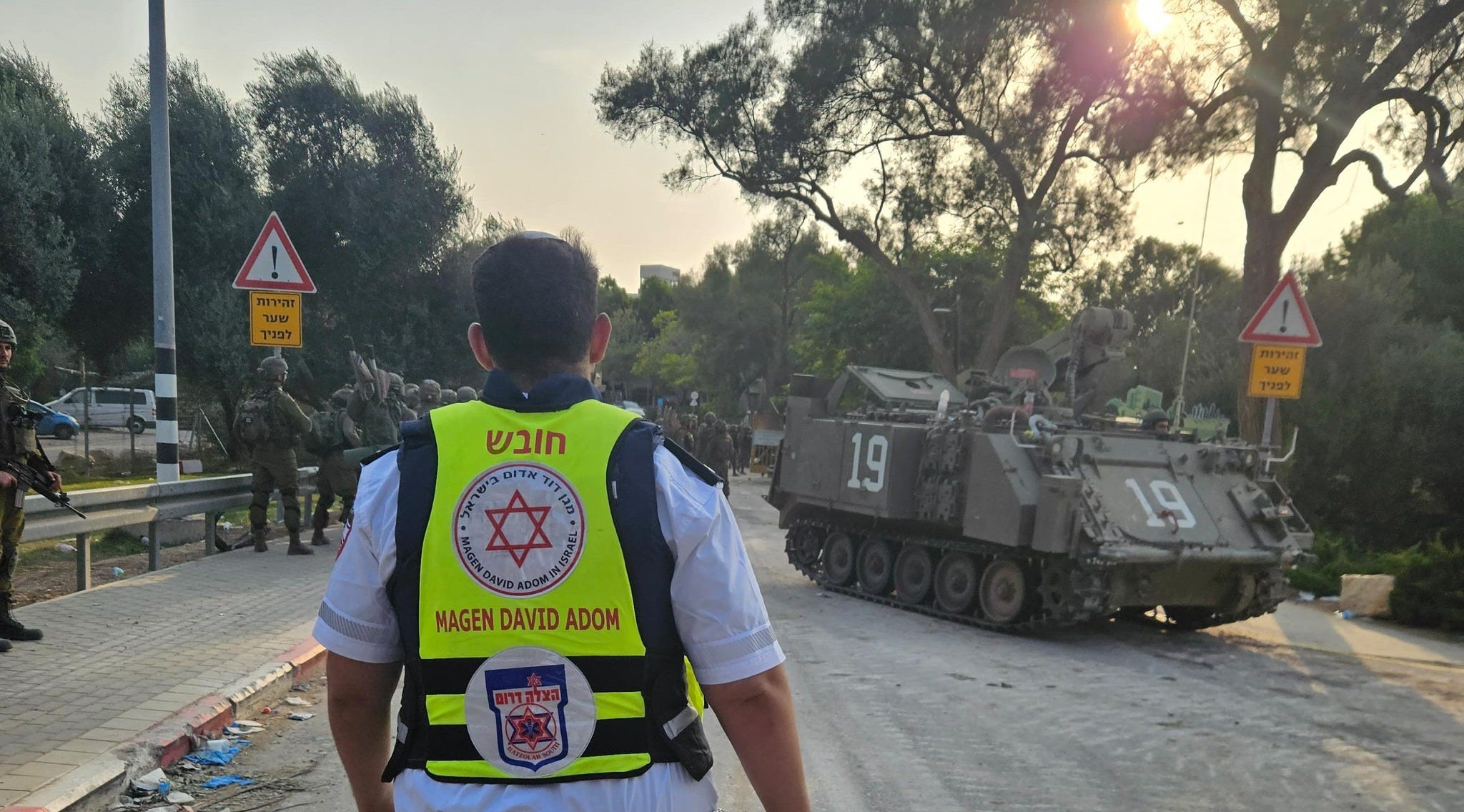
At the onset of the attack, the IDF’s Home Front Command and security forces were attempting to re-establish control of the southern communities. These were active combat zones, with terrorists still roaming freely. Entry into those areas was determined by the army and police, not by MDA leadership. To suggest that MDA personnel were told to stand aside misunderstands the chain of command. Neither the IDF nor MDA was actively sending responders into villages under terrorist control because that would have amounted to ordering suicide missions. Responders could only enter once security forces secured enough ground to allow them passage.
United Hatzalah’s leaders carried a history of disparaging MDA long before October 7. That history was laid bare in a 2021 Tel Aviv District Court ruling in which Judge Naftali Shilo found that United Hatzalah had launched what he called a defamatory smear campaign against MDA. The court examined slogans like “Cause of death MDA” and “MDA’s monopoly kills” circulated by United Hatzalah officials on posters, WhatsApp groups, and media outlets. Eli Beer himself recorded videos accusing MDA of ego games that cause deaths, while his spokesman claimed MDA leadership showed contempt for human life.
Judge Shilo ruled that such language was not legitimate criticism but malicious defamation intended to humiliate and delegitimize the country’s statutory rescue service. In one especially painful episode, United Hatzalah officials repeated the claim that MDA took half an hour to arrive at a kindergarten where a child had choked. The court reviewed MDA dispatch logs and determined the ambulance had arrived in nine minutes, and that the delay came because the first call was made to United Hatzalah, not to MDA. United Hatzalah’s own investigation confirmed its responder lacked proper pediatric equipment and waited six minutes before transferring the call. The court held that United Hatzalah knowingly spread falsehoods, failing to verify facts, omitting crucial details, and never seeking MDA’s response before publicizing its accusations. “The defense of truth does not apply,” the judge wrote, concluding the organization acted without good faith. He ordered United Hatzalah and two of its senior officials to compensate MDA, stressing that they had the option of raising their grievances with the Ministry of Health but instead chose an aggressive smear campaign designed to damage MDA’s reputation.
That record of distortion casts a long shadow over United Hatzalah’s self-presentation after October 7. By law, MDA operates the national 101 line and integrates first responders from multiple volunteer groups, including United Hatzalah. “When someone calls 101, the system automatically dispatches the nearest responders whether they are from MDA, United Hatzalah, or any of 20 other local Hatzalahs,” Shacham explained. “We do not care what vest they wear. We care that a professional gets there.” The Ministry of Health has audited the dispatch code to confirm it is impartial.
For MDA, the facts of October 7 are not in dispute. Dispatchers fielded more than 21,000 calls. Over 400 ambulances were deployed in the south. Seven MDA personnel were killed in the line of duty. Ambulances were shot at with rifles and RPGs. Volunteers treated the wounded for hours in basements, homes, and synagogues under siege. Shin Bet later revealed Hamas maps marking MDA stations as targets to seize. “We never ran away,” Shacham said. “We did everything possible to save lives, often at the cost of our own.”
The difference between the organizations, MDA argues, is not in courage but in honesty. United Hatzalah has claimed to have saved 2,500 lives on October 7, yet Ministry of Health figures show fewer than 1,500 patients were transported to hospitals that day by all means combined. United Hatzalah 1221’s CEO, Eli Pollak, even wrote in the Jerusalem Post on January 15, 2024, that his organization was “the only medical service on the ground.” For MDA, that statement is not just misleading but erases the sacrifice of its own medics who were killed while serving. Pollak has also boasted of responding to 2,000 emergencies a day, a number that does not match arithmetic and contradicts the group’s own annual claims. In Angels in Orange, the book by Nachman Seltzer, entire stories are presented that do not align with documented facts. One passage describes a United Hatzalah medic arriving in Kfar Aza before the army. Another includes distorted quotes attributed to President Biden and President Trump praising the group.
Perhaps the most troubling distortion involves the tragic story of Itai and Hadar Berdichevsky of Kfar Aza, murdered while protecting their ten-month-old twins. On television programs including The Ben Shapiro Show and Morning Joe, United Hatzalah representatives described a lurid account that included claims of multiple rapes, supposed calls to United Hatzalah’s private emergency number, and volunteers embedded with elite commandos. In Angels in Orange the story was embellished further, telling readers that the twins’ grandfather, Mickey Berdichevsky, had been killed in a car accident “not long before” October 7. That claim is false. Three independent sources from Kfar Aza confirm that Mickey is alive and well.
The facts, confirmed by both the IDF and the family, are stark. Itai and Hadar were among the earliest victims that morning. Hadar was killed as she stepped out to prepare bottles for the babies. Itai was shot moments later. Their twins lay alone beside their bodies for nearly fourteen hours until they were rescued by the Golani Brigade, led by Tomer Grinberg, who was later killed in Gaza. Only afterward did two United Hatzalah volunteers give the infants water and transport them to a hospital. That act was humane and important but far from the dramatic version that was circulated.
By weaving in distorted quotes, fabricated phone calls, and even a fictional car crash, United Hatzalah transformed the Berdichevsky family’s actual sacrifice and the heroism of Golani officer Tomer Grinberg, who rescued the twins and later fell in battle, into a spectacle of exaggeration. For the family of Hadar and Mickey, and for the comrades of Grinberg, these fabrications are not simply inaccuracies but a theft of memory that transformed a raw tragedy and a soldier’s sacrifice into theater for fundraising.
United Hatzalah also spread sensationalized stories in the immediate aftermath of October 7, including claims about a baby being cut out of a mother’s stomach and infants placed in ovens, accounts that were later discredited. These stories were repeated on influential stages in American media, reaching millions across the political spectrum. Even the Dinah Project, which has meticulously documented cases of sexual violence on October 7, makes no mention of the alleged rape of Hadar Berdichevsky. For a Jewish organization to promote such claims without verification undermines the very victims it seeks to honor.
For Israelis who lived through October 7, the contest over credit can feel grotesque. Families of fallen medics like Mann and Haimov bristle at any suggestion that MDA stayed away. “This is about honoring sacrifice,” one senior MDA figure said. “When another organization elevates itself by diminishing ours, it is not just inaccurate. It wounds the families of those who died.” MDA officials insist their rebuttal is not about rivalry but record. “We do not have our truth,” Shacham said. “We have the truth.” That truth is messy enough. Hundreds of ambulances were deployed. Thousands of calls were answered. Medics improvised under fire. Seven died in the line of duty. “We will never invent atrocities to raise money. We stick to facts.”
The dispute is unlikely to end soon. United Hatzalah remains a powerful fundraising force with a compelling brand of grassroots heroism. MDA continues to stress its statutory role and the sacrifices of its staff. For donors abroad, separating fact from fable has become part of the responsibility of giving. On Israel’s darkest day, both organizations had volunteers who showed extraordinary courage. The difference, MDA argues, is in how that courage is remembered as fact, or as fiction. The time has come for United Hatzalah to take responsibility. If the organization wishes to preserve trust and honor the memory of those who truly gave their lives, it must correct the record. Until it does, the burden of distortion rests on its shoulders.
Thank you for bringing this up and fighting for these heroes.